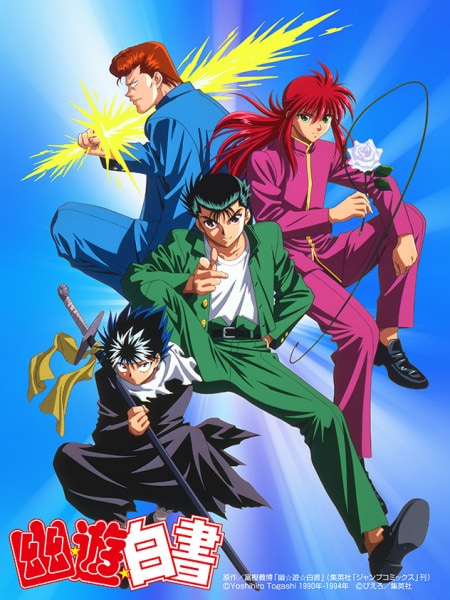
Yu Yu Hakusho
Is Yu Yu Hakusho worth watching?
Yes, it's worth watching. Anime Codex rates Yu Yu Hakusho 7.70 out of 10 — scored on six criteria (story, characters, themes, world-building, animation, and cultural impact), not crowd votes. 67th of 226 on the Codex rubric — top 30% of the catalogue. The crowd rates it 0.76 higher than the rubric does — the Codex is harder on it than on 62% of the catalogue.
Where to watch
Trailer
What the data says
Computed from the Codex rubric across the whole catalogue.
Summary
Yu Yu Hakusho is one of the foundational 90s Shonen Jump action titles, and it earns that status through character writing that outclasses many of its contemporaries. Yuusuke's evolution from disaffected delinquent to committed protector feels earned, and the supporting trio of Kuwabara, Hiei, and Kurama are granted genuine interiority and morally complicated pasts rather than functioning as flat sidekicks. The Dark Tournament arc is a masterclass in escalating stakes and remains a template for the format, while the Chapter Black arc adds rare thematic ambition by questioning whether humanity deserves protection at all, embodied in the excellent antagonist Sensui. Togashi's fingerprints — moral ambiguity, inventive rule-based powers like the Territories — point toward his later masterwork. The show's chief weakness is its ending: Togashi's burnout produces a rushed, deflating Three Kings finale that abandons the tension it spent the series building. The early episodic cases are slighter than what follows, and the worldbuilding, while consistent, is more functional than visionary. Animation is solid for its era with standout fight direction but fluctuates over its length. Judged against the best shonen, it is an excellent, character-rich action series held back from greatness by a stumbling conclusion.
Criterion breakdown
Story & narrative
The narrative escalates cleanly from episodic Spirit Detective cases to the tournament structure that the Dark Tournament arc perfects, and the Chapter Black arc raises genuinely thorny moral stakes around Sensui and his hatred of humanity. However, the pacing is uneven: the early case-of-the-week episodes feel slight compared to what follows, and Togashi's well-documented burnout produces a rushed, anticlimactic Three Kings finale that abandons the tournament tension for an off-screen-feeling resolution. It is a strong shonen arc structure undercut by an ending that does not pay off its setup.
Character writing & growth
Yuusuke's arc from nihilistic delinquent to someone who fights for others is convincingly gradual rather than instant, and the supporting cast is unusually rich for its era: Hiei and Kurama are given criminal backstories and motivations that resist easy heroism, with Kurama's Yoko reveal and Hiei's protectiveness of Yukina adding real dimension. Kuwabara, often the comic relief, is granted a sincere code of honor that the show treats with respect rather than mockery. Sensui stands out as an antagonist whose ideology mirrors and challenges Yuusuke's, elevating the final arc's character work.
Themes & emotional resonance
The Chapter Black arc's interrogation of whether humanity deserves to survive — voiced through Sensui's trauma and Itsuki — gives the show a moral weight beyond typical good-versus-evil shonen. The demon-as-other framing, particularly through Kurama and Hiei and later Yuusuke's own demon heritage, questions the lines between human and monster effectively. The emotional beats land, though the rushed ending blunts the thematic payoff and some early-arc moralizing stays surface-level.
World-building & power system
The three-realm cosmology (Human World, Spirit World, Demon World) is functional and the reiki/spirit energy system has clear internal rules, with signature techniques like Yuusuke's Spirit Gun and Hiei's Dragon of the Darkness Flame given satisfying escalation. The Territory powers in the Chapter Black arc are the most inventive element, allowing bizarre, rule-based abilities rather than raw power scaling. Still, the worldbuilding is more serviceable than deeply original, and the Demon World is gestured at more than fully realized before the series ends.
Animation & direction
Studio Pierrot's production is strong for early-90s television, with fluid, weighty fight choreography in the Dark Tournament — the Yuusuke vs. Toguro bout is a standout in framing and impact. The direction uses effective stillness and shadow for dramatic tension, and the iconic OST and Toguro's intimidating presence are well served by the visual mood. Animation quality fluctuates across 112 episodes as expected for the format, with some flatter filler stretches.
Cultural impact
As one of the defining Shonen Jump action series of the 90s, it was hugely influential domestically and a gateway anime for many Western viewers via Toonami. Its dub became iconic, and Togashi's character-driven, morally grey approach prefigured his later Hunter x Hunter, cementing his reputation. It remains a frequently cited touchstone for the tournament-arc format.
Synopsis (from MAL)
One fateful day, Yuusuke Urameshi, a 14-year-old delinquent with a dim future, gets a miraculous chance to turn it all around when he throws himself in front of a moving car to save a young boy. His ultimate sacrifice is so out of character that the authorities of the spirit realm are not yet prepared to let him pass on. Koenma, heir to the throne of the spirit realm, offers Yuusuke an opportunity to regain his life through completion of a series of tasks. With the guidance of the death god Botan, he is to thwart evil presences on Earth as a Spirit Detective. To help him on his venture, Yuusuke enlists ex-rival Kazuma Kuwabara, and two demons, Hiei and Kurama, who have criminal pasts. Together, they train and battle against enemies who would threaten humanity's very existence. [Written by MAL Rewrite]
Ranked nearby
Explore rankings
Discussion
Set a display name above to post.
Loading discussion…