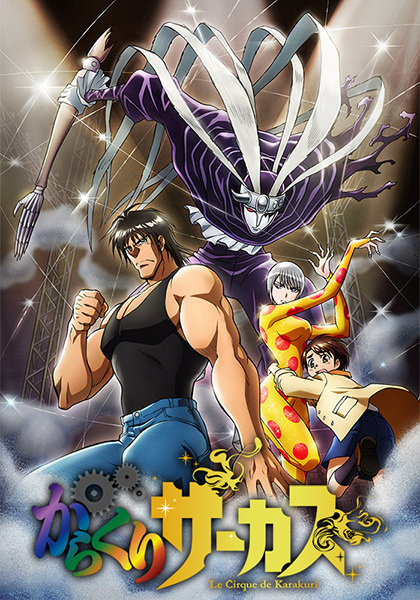
Karakuri Circus
Is Karakuri Circus worth watching?
Yes, it's worth watching. Anime Codex rates Karakuri Circus 7.68 out of 10 — scored on six criteria (story, characters, themes, world-building, animation, and cultural impact), not crowd votes. 70th of 226 on the Codex rubric — top 31% of the catalogue. The Codex rates it Δ +0.48 above its MAL score — more underrated than 97% of the catalogue.
Where to watch
Trailer
What the data says
Computed from the Codex rubric across the whole catalogue.
Summary
Karakuri Circus stands out in shonen for its unconventional middle-aged protagonist, its fusion of comedy, horror, and tragedy, and a premise where laughter is literally life-sustaining via ZONAPHA Syndrome. Built on Kazuhiro Fujita's beloved manga, it offers a centuries-spanning tragedy of grief and love — the Bai Yin and Francine flashback being its strongest material — alongside a distinctive automata power system and a genuinely moving central trio in Narumi, Masaru, and Shirogane. Yuki Kajiura's score and VOLN's eerie circus direction amplify its emotional reach. Its defining weakness is adaptation compression: squeezing 43 manga volumes into 36 episodes forces a rushed, uneven final third that shortchanges supporting characters and blunts the climax's impact. Inconsistent CGI puppet integration further dents the visual presentation in key fights. Despite these flaws, the show distinguishes itself from typical battle shonen through thematic ambition and tonal complexity, refusing to treat its villains as simple obstacles. It is a flawed but rewarding work — best appreciated by viewers who value emotional and narrative ambition over polish — and a worthy, if imperfect, anime entry point into one of Fujita's defining stories. A strong recommendation with caveats about its pacing.
Criterion breakdown
Story & narrative
Adapting Kazuhiro Fujita's sprawling 43-volume manga into 36 episodes forces brutal compression, and the rushed final stretch — particularly the truncated Aquarium and final battle arcs — undercuts the payoff. Yet the narrative architecture is genuinely ambitious: the mid-series pivot into the Chinese flashback explaining Bai Yin, Francine, and the origin of the automata recontextualizes the entire premise and ties the human-puppet war into a centuries-spanning tragedy. The interweaving of Narumi's, Masaru's, and Shirogane's threads is structurally clever even when the pacing betrays it.
Character writing & growth
Narumi is a rare shonen protagonist — a middle-aged man defined by self-sacrifice and the ZONAPHA condition that makes laughter literally vital — and his arc with Shirogane carries real weight. Masaru's growth from frightened heir to resolved fighter is earned, and the dual-Shirogane mystery (Eleonore/Angelina) gives the female lead unusual depth. The villain roster, especially the tragic Faceless and Bai Yin, blurs the hero-antagonist line effectively, though the compressed ending shortchanges several supporting Nakamaza members.
Themes & emotional resonance
The central conceit — that the puppets exist because of one man's grief-warped love for Francine, whose only desire was to see people laugh — fuses comedy and horror into a meditation on love, loss, and the weaponization of devotion. ZONAPHA Syndrome makes laughter a life-or-death stake rather than mere comic relief, an inventive thematic spine. The circus-and-marionette motif consistently reinforces ideas of who pulls whose strings.
World-building & power system
The Aragami/automata system, fueled by Aqua Vitae and governed by the Midnight Circus and the puppet-hunting Nakamaza, is distinctive and internally coherent, blending Western circus aesthetics with marionette combat. The historical lore of Bai Yin and the soul-transfer mechanics give the premise genuine originality within shonen. Some mechanics (Shirogane functions, Hayato lineage) are explained too hastily in the adaptation to land fully.
Animation & direction
Studio VOLN delivers strong character acting and memorable set pieces, but consistency wavers across 36 episodes, with noticeable CGI puppet integration that clashes with hand-drawn work in busier fight scenes. Direction shines in the eerie circus sequences and the Bai Yin flashback's tonal shift, though budget strain shows in the rushed climactic battles. Yuki Kajiura's score does heavy lifting to elevate the emotional peaks.
Cultural impact
As one of Fujita's two major works alongside Ushio and Tora, Karakuri Circus enjoys dedicated cult respect, and the 2018 adaptation finally brought it to a wider audience via Amazon. However, the compressed runtime limited its broader impact, and it remains a connoisseur's recommendation rather than a genre-defining touchstone within shonen.
Synopsis (from MAL)
Narumi Katou is a middle-aged man who suffers from the bizarre ZONAPHA Syndrome: a rare and inexplicable disease that causes its victims to endure severe seizures at random, with the only cure being to watch someone laugh. One day, during Narumi's part time job, a young boy with a giant suitcase fleeing from three adults runs into him. The boy introduces himself as Masaru Saiga, the new owner of the famous Saiga Enterprises following his father's recent death. However, other members of his family are trying to assassinate him and claim the fortune for themselves. Determined to save the child, Narumi helps Masaru escape and ends up fighting the pursuers, only to discover that they are sentient humanoid puppets with superhuman strength. As Narumi is about to lose, a white-haired girl suddenly joins the fray and swiftly summons yet another puppet from the boy's suitcase, claiming herself to be Shirogane, Masaru's guardian. Karakuri Circus follows three people from different backgrounds whose fates intertwine and diverge as they unravel the mysteries of an ancient tale of love and betrayal, and the long, ancient battle between humans and puppets. [Written by MAL Rewrite]
Ranked nearby
Explore rankings
Discussion
Set a display name above to post.
Loading discussion…