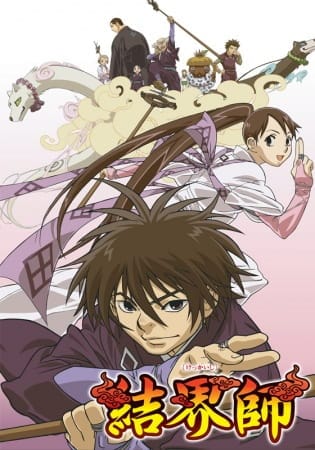
Kekkaishi
Is Kekkaishi worth watching?
Worth a look. Anime Codex rates Kekkaishi 6.75 out of 10 — scored on six criteria (story, characters, themes, world-building, animation, and cultural impact), not crowd votes. 156th of 226 on the Codex rubric — bottom 32% of the catalogue. The crowd rates it 0.87 higher than the rubric does — the Codex is harder on it than on 68% of the catalogue.
Where to watch
What the data says
Computed from the Codex rubric across the whole catalogue.
Summary
Kekkaishi stands out among mid-2000s shonen for its unusually grounded protagonist and its inventive power system. Yoshimura's preference for baking over battle, paired with the disciplined Tokine, gives the show a gentler, more domestic texture than the era's louder battle series, while the kekkai mechanic — defeating demons by boxing, crushing, and teleporting them — offers genuinely fresh, spatial combat rather than escalating energy fights. The Kokuboro arc, centered on the half-ayakashi outcast Gen Shishio, is the series' peak, delivering real emotional weight and its strongest direction. Its weaknesses are largely structural: the anime's first stretch leans heavily on repetitive nightly monster encounters that dilute momentum, and its 52-episode run ends before adapting the manga's most compelling revelations about Karasumori and the clan legacies, leaving the story feeling cut short rather than resolved. Supporting characters and clan politics remain underexplored, and the animation, though clean and atmospheric in its nighttime palette, rarely rises to spectacle. Judged against the best of its demographic, Kekkaishi is a solid, distinctive, and underappreciated entry — a thoughtful alternative to power-fantasy shonen that is held back from greatness by uneven pacing and an incomplete adaptation.
Criterion breakdown
Story & narrative
Kekkaishi's anime adaptation suffers from pacing whiplash typical of long-running Sunday adaptations — the early Karasumori monster-of-the-week episodes drift before the Kokuboro arc gives the show genuine momentum, especially Gen Shishio's introduction and his tragic arc, which is the emotional and structural high point. However, the 52-episode run ends without adapting the manga's stronger later revelations about Karasumori's nature and the Sumimura-Yukimura legacy, leaving the narrative feeling truncated rather than concluded. The nightly-defense premise is solid and the rival-clan framing gives stakes, but the episodic structure dilutes tension more than the best shonen of its era.
Character writing & growth
Yoshimura's reluctance to fight and his cake-baking passion make him a refreshingly low-key shonen lead, and his rivalry-respect dynamic with the more disciplined, mature Tokine grounds the show emotionally. Gen Shishio is the standout — his ostracization, half-ayakashi struggle, and arc through the Kokuboro conflict provide the series' most affecting growth and its single most devastating turn. The weakness is that supporting cast like Masamori and the Night Troop are underdeveloped in the anime's scope, and Yoshimura's own power escalation outpaces his interior development.
Themes & emotional resonance
The show meaningfully explores legacy and the burden of inherited duty through both clans, and questions whether power should be wielded reluctantly versus eagerly via Yoshimura and Gen as foils. Gen's arc tackles belonging and the dehumanization of being neither fully human nor ayakashi with real pathos. These themes resonate but are inconsistently sustained across the monster-of-the-week stretches, where emotional weight evaporates between major arcs.
World-building & power system
The kekkai barrier system is genuinely distinctive — combat built around boxing in, crushing, and transporting enemies rather than energy blasts is a clever, spatially-minded alternative to standard shonen power systems. Karasumori as a land that amplifies and corrupts power gives the setting internal logic and a reason for the nightly siege premise. The clan politics and the Shadow Organization add institutional depth, though the anime leaves much of this scaffolding unexplored due to its truncated adaptation.
Animation & direction
Sunrise delivers clean, functional animation that conveys the geometric nature of kekkai combat clearly, which matters given how spatial the fights are. The Kokuboro arc receives the strongest visual investment, with moodier direction and better fight choreography than the early filler-adjacent episodes. Overall it is competent but rarely spectacular — the nighttime palette is atmospheric but the show lacks the standout sakuga moments or directorial flourish of top-tier 2006 shonen.
Cultural impact
Kekkaishi maintains a devoted cult following and is fondly remembered as an underrated Shonen Sunday entry, but it never achieved the mainstream penetration of contemporaries like Bleach or Naruto. Tanabe's manga is more respected than the anime, which is often cited as a 'should have been bigger' title. Its influence on the medium is modest, sustained mostly by word-of-mouth recommendation lists.
Synopsis (from MAL)
Yoshimura Sumimura comes from a long line of "Kekkaishi," individuals who have supernatural abilities and are able to destroy evil creatures called Ayakashi that venture into the human realm from time to time. The Ayakashi are demons that look to feast on the power emanating from the land of Karasumori, which also happens to be where Yoshimura's high school is located. Now, Yoshimura must fight to protect his beloved school and hometown. Although, if it were up to him, he would rather be baking cakes than fighting off the ugly characters that show up at night. Thankfully, Yoshimura isn't the only one helping to keep the baddies at bay. His childhood friend and neighbor, Tokine Yukimura, joins him in this righteous battle. Despite the fact that they are from rival clans, these two make a fantastic team. And teamwork is something vital to fighting the evil that is closing in, as the Ayakashi attack in waves, looking to claim the land as their own, and a shadowy organization looks on, ready to pounce when the time is right...
Ranked nearby


Explore rankings
Discussion
Set a display name above to post.
Loading discussion…