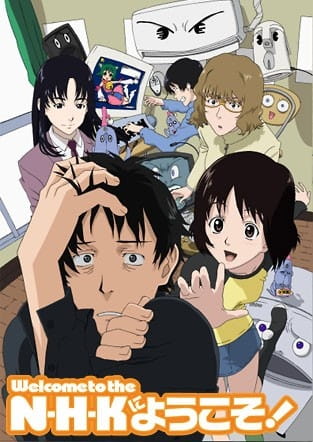
Welcome to the NHK (NHK ni Youkoso!)
Is Welcome to the NHK (NHK ni Youkoso!) worth watching?
Yes, it's worth watching. Anime Codex rates Welcome to the NHK (NHK ni Youkoso!) 8.22 out of 10 — scored on six criteria (story, characters, themes, world-building, animation, and cultural impact), not crowd votes. 40th of 226 on the Codex rubric — top 18% of the catalogue. The crowd rates it 0.10 higher than the rubric does — the Codex is harder on it than on 22% of the catalogue.
Where to watch
Trailer
What the data says
Computed from the Codex rubric across the whole catalogue.
Summary
Welcome to the NHK stands as one of seinen anime's most uncompromising character studies, using the dramedy format to examine hikikomori withdrawal, NEET despair, and internet escapism with unusual candor. Its greatest strength is Satou, a protagonist whose self-justifying paranoia and repeated self-sabotage feel painfully authentic, paired with a supporting cast — codependent Misaki, escapist Yamazaki — who are revealed to be equally damaged rather than redemptive figures. The narrative's cyclical structure honestly reflects how recovery actually stalls and relapses, and arcs like the pyramid scheme, the galge project, and the suicide-pact island deliver real emotional weight beneath the comedy. Weaknesses are notable: Gonzo's animation is uneven and budget-limited, off-model and stiff outside its effective surreal hallucination sequences, and the ending tidies up the source material's bleaker ambiguity somewhat too neatly. The back half also loses narrative momentum. Judged against the best psychological seinen, it falls short of the visual craft of top-tier productions but matches them in thematic courage and empathy. It remains a defining, frequently recommended treatment of social isolation and mental illness — flawed in execution, but rare and valuable in its willingness to sit with discomfort rather than resolve it.
Criterion breakdown
Story & narrative
The narrative structure mirrors Satou's cyclical relapses rather than building toward conventional milestones, which is thematically honest about how recovery from hikikomori isolation actually works — the pyramid scheme arc and the suicide pact island arc both escalate convincingly. However, the back half loses some momentum and the resolution feels slightly rushed and tidier than the messy realism that preceded it, softening the source novel's bleaker edge.
Character writing & growth
Satou is one of the most uncomfortably authentic depictions of social withdrawal in the medium, his self-justifying conspiracy logic and self-sabotage rendered without flattering the audience. Yamazaki's otaku escapism and his arc returning to his family's farm provide a sharp foil, and Misaki is revealed to be as broken and codependent as Satou rather than a manic-pixie savior, which deepens rather than cheapens the dynamic. Minor characters like Senpai's hostess-club spiral reinforce the theme that everyone is faking functionality.
Themes & emotional resonance
The show treats hikikomori culture, NEET despair, internet addiction, MMO escapism, and suicidal ideation with a candor rare even in seinen, refusing easy uplift. The galge-creation arc and the offline-meeting suicide pact land with genuine emotional weight because the comedy never fully shields the audience from how grim the underlying material is. It occasionally tips into didacticism, but the empathy is real.
World-building & power system
Read as premise originality and setting depth, the show excels: its grounded depiction of mid-2000s Japanese social malaise — the apartment as a prison, the part-time job economy, doujin culture, MMO grinding — is internally consistent and specific. The 'NHK conspiracy' framing device cleverly externalizes Satou's paranoia rather than positing actual supernatural elements. It loses points only because the world is intentionally claustrophobic and narrow in scope by design.
Animation & direction
Gonzo's production is functional but uneven, with off-model moments and limited motion that reflect a modest budget. Direction shines in the surreal sequences — Satou's hallucinations, the appliance-spirit visions, and the disorienting island episode use distorted color and imagery effectively to convey psychological states. The character designs are appealing but the overall visual polish is below the best seinen dramas of its era.
Cultural impact
The show became a defining reference point for the hikikomori and NEET phenomena in anime discourse, frequently cited whenever these subjects arise. Its unflinching depiction of mental illness and internet escapism gave it enduring cult status among Western fans, though it never reached the broad mainstream penetration of larger seinen titles. It remains a touchstone recommendation for socially anxious viewers.
Synopsis (from MAL)
Twenty-two-year-old college dropout Tatsuhiro Satou has been a hikikomori for almost four years now. In his isolation, he has come to believe in many obscure conspiracy theories, but there is one in particular which he holds unshakable faith in: the theory that the evil conspirator behind his shut-in NEET (Not in Employment, Education or Training) status is the Nihon Hikikomori Kyokai (NHK)—an evil and secret organization dedicated to fostering the spread of hikikomori culture. NHK ni Youkoso! is a psychological dramedy that follows Tatsuhiro as he strives to escape from the NHK's wicked machinations and the disease of self-wrought isolation, while struggling to even just leave his apartment and find a job. His unexpected encounter with the mysterious Misaki Nakahara might signal a reversal of fortune for Tatsuhiro, but with this meeting comes the inevitable cost of having to face his greatest fear—society. [Written by MAL Rewrite]
Ranked nearby

Explore rankings
Discussion
Set a display name above to post.
Loading discussion…