Tongari Boushi no Atelier Is the Codex's Quietest Prestige Bet: Why Bones Film's Adaptation Will Be Judged on Restraint, Not Spectacle
Kamome Shirahama's witchcraft seinen arrives with the year's most fragile adaptation problem — and the rubric is already weighting it for failure on the criterion that matters most.
Kamome Shirahama's witchcraft seinen arrives with the year's most fragile adaptation problem — and the rubric is already weighting it for failure on the criterion that matters most.
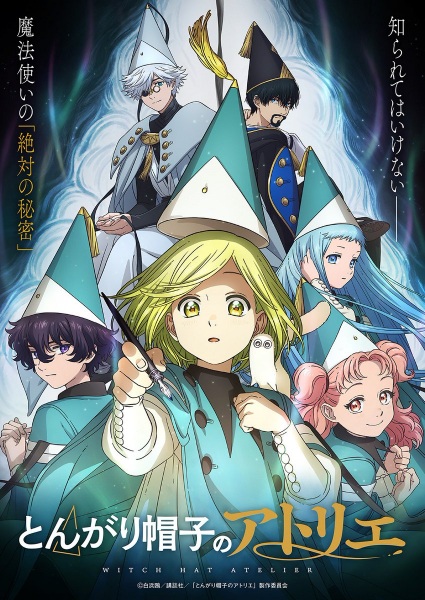
The single most important production decision on Tongari Boushi no Atelier was made before a single storyboard was drawn: Bones Film, not Bones proper, is handling it. That's not a footnote. That's the entire critical frame. Shirahama's manga is a book about the discipline of mark-making — about ink, line weight, the moral weight of drawing a thing into existence — and the studio assignment tells you exactly how much creative oxygen the project is being given. The Codex is watching this one with a sharper knife than the AniList trending rank 4 placement suggests it deserves.
The Consensus Is Already Wrong About Tongari Boushi no Atelier
The early discourse around tongari boushi no atelier — what little of it exists; Reddit's top-week post count sits at zero, and the Wikipedia page is pulling modest monthly views relative to the season's louder titles — is converging on a comfortable shorthand: "the cozy witch anime." That framing is wrong in the specific way that cozy framings are always wrong about Shirahama's work. The Witch Hat Atelier manga is not cozy. It is a procedural about apprenticeship under a regime that executes children for drawing the wrong symbol. Coco's arc is shaped around a foundational trauma — her mother's petrification — and the Brimmed Caps are a genuine ideological faction, not a villain-of-the-week generator. MyAnimeList's pre-air score has the series parked in the 8.0s on anticipation alone, which is roughly where adaptations of beloved seinen with high illustrative ceilings always start before reality intervenes.
The Codex departs from that consensus by refusing to grade the show on potential. The rubric weights story and character heavily for low-action seinen, and animation isn't a free pass when the source material's entire identity is line work. This is not a show that can be saved by good vibes.
The Source Is a Treatise on Craft, and That's the Adaptation Trap
Shirahama is a working illustrator first and a mangaka second — her cover work on the American Monstress and Star Wars books is what trained her hand into the absurd density that Witch Hat panels carry. The manga's central conceit is that magic is drawing, and drawing is labor, and labor is morally legible. Every spell circle is a panel of actual ink on actual paper, rendered with a calligrapher's discipline. The story's best chapters — the early Qifrey workshop introductions, Coco's first failed silver-eye encounter, the Tartah arc, the entire third test sequence — work because Shirahama's linework gives the magic a tactile cost. You feel the pen drag.
Animation cannot replicate that. Animation can gesture toward it, the way Science SARU gestured toward Yuasa's painterly impulses in Inu-Oh, or the way Madhouse compressed Urasawa's panel-density in Monster by leaning on stillness. But Bones Film is not Science SARU and the early PV materials suggest a clean, slightly under-rendered TV look — competent, not transcendent. The Codex's worldbuilding criterion is going to ask one question: does the show make magic feel like work? If the answer is no, the entire thematic apparatus collapses into generic fantasy-school iconography, and we are watching a Little Witch Academia variant with better character designs.
Coco Is Not a Generic Protagonist and the Adaptation Has to Know That
The protagonist problem here is real and underdiscussed. Coco is a deliberately limited POV character — naive, guilt-laden, structurally incapable of the kind of escalation that drives shonen-coded fantasy. Her arc is about apprehending the ethics of a craft she entered illegally. That's not a hook. That's a discipline. Shirahama writes her with a patience that the manga's monthly schedule can afford and a 24-episode adaptation almost certainly cannot.
The closest comparison in the Codex catalogue is not another fantasy series — it's the seinen pacing problem that Vinland Saga's adaptations almost squandered. Yukimura's Farmland arc is also a story about a protagonist whose growth is measured in restraint and refusal, and Wit's first season worked because the staff trusted that stillness. The Witch Hat adaptation needs that same trust. If episode 3 — likely the first test sequence with Agott, Tetia, and Richeh — is paced for shonen beats rather than workshop rhythm, the whole character architecture buckles. Coco's apprenticeship reads as filler unless the show is willing to make the audience sit with her failures.
The Brimmed Caps Are the Theme, Not the Villain
Where the Codex is least forgiving is the themes criterion. Shirahama's central argument — that any sufficiently powerful craft will be regulated by an authority that fears it, and that the regulators and the rebels are often the same people one generation apart — is the only thing elevating the manga above its visual achievements. The Brimmed Caps are not evil. They are former insiders who concluded that the Conference's restrictions on forbidden magic were themselves the violence. Qifrey's backstory, when it lands, is supposed to recontextualize the entire pedagogical project.
This is where I expect the adaptation to bleed scoring. Anime productions consistently misread morally ambiguous antagonist factions as twist material to be saved for late-season reveals, when the manga treats them as ambient context from chapter one. If Bones Film stages the Brimmed Caps as a mystery rather than a thesis, the themes score craters — and the cultural impact ceiling caps somewhere uncomfortably close to where Demon Slayer sits when you strip the Ufotable layer off. Beautiful, watchable, thematically inert.
The Counter-Argument: Maybe Faithfulness Is Enough
The strongest defense of a modest adaptation is that Shirahama's manga is so structurally sound that a competent translation is sufficient — that you don't need a visionary director to make Witch Hat work, you just need someone who doesn't actively break it. There's evidence for this position. The manga's chapter structure is unusually adaptation-friendly: clean arc breaks, natural episode-length beats, dialogue that's already efficient. A straightforward seasonal adaptation that hits the Tartah arc by episode 18 and the third test conclusion by episode 24 would, in theory, deliver most of the source's emotional payload.
The rubric reads this differently. Faithfulness is a floor, not a ceiling, and the Codex has been burned by the faithfulness-as-virtue argument before — it's the same logic that props up half of MAL's top 50. Animation as a criterion isn't measuring fidelity; it's measuring whether the adaptation justifies its own existence as a different medium. A Witch Hat anime that merely transcribes Shirahama's panels into motion has not earned its score. It has only avoided losing points.
Verdict
Tongari Boushi no Atelier enters the Codex as a provisional B+, with a realistic ceiling of A- if Bones Film commits to stillness and a realistic floor of B if they pace it like a shonen. The trending rank 4 placement is anticipatory, not earned, and the rubric will not be generous when episode counts start banking. The manga is one of the decade's best seinen; the adaptation will be judged on whether it understands why.
Featured in the Codex
More from The Codex
Slam Dunk at 8.12: The 6.8 on Animation That Decides How Toei's Basketball Landmark Gets Remembered
Slam Dunk earns 9.5 on cultural impact and 9.0 on character, but Toei's 1993 production caps it at 8.12 — and the gap between manga and adaptation is measured in still frames.
The Promised Neverland Review: An 8.18 That Lives on Story and Direction, and Loses Ground on World and Legacy
Judged against one consistent rubric, The Promised Neverland is best understood by which criteria carry it and which drag it down — not by a single number.
Anime Like Re:Zero: 5 the Codex Rubric Says You'll Love
Fans of Re:Zero respond to its strongest criteria — character at 9.0, cultural weight at 9.0, story and themes at 8.5 — and these five picks deliver the same qualities, ranked by how close their critical profile sits to it, not by vibes.
Discussion
Set a display name above to post.
Loading discussion…


