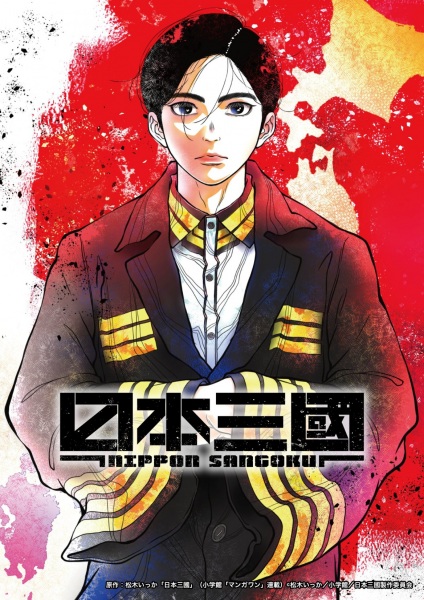
Nippon Sangoku Is the Codex's Most Suspicious Pre-Release Darling: Why Studio Kafka's Sangoku Era Adaptation Has to Earn Its 82
Trending rank 21 on AniList and a 25-post Reddit week don't make a strategist epic — and the rubric is watching the third nation, not the first battle.
Trending rank 21 on AniList and a 25-post Reddit week don't make a strategist epic — and the rubric is watching the third nation, not the first battle.
The most interesting number around Nippon Sangoku right now isn't the AniList community score of 82, the 2.7k monthly Wikipedia pageviews, or the AniList trending rank of 21. It's the gap between those numbers and the show's actual release footprint — twelve episodes, one studio with limited pedigree, and a source manga that's been quietly serializing on Ura Sunday since November 2021 without ever becoming a Shogakukan flagship. Nippon Sangoku is being graded on potential. The Codex doesn't grade potential.
What the Discourse Around Nippon Sangoku Is Already Getting Wrong
Twenty-five top-week Reddit posts in the run-up to a 2026 premiere is not organic enthusiasm; it's the familiar shape of seinen-tag arbitrage, where Politics, Dystopian, and Post-Apocalyptic on the AniList tag list do most of the rhetorical work before episode one airs. The community read — that Ikka Matsuki's manga is a Romance of the Three Kingdoms transposition with nuclear-collapse window-dressing, and that Aoteru Misumi's rise from agricultural officer to genius strategist is the season's must-watch arc — flattens what the synopsis actually promises. The premise is not a Sangokushi retelling. It's a post-collapse political drama that happens to borrow the tripartite structure. Those are different shows, and the discourse keeps conflating them.
The AniList 82 also deserves scrutiny. Pre-broadcast community scores skew high by ten to fifteen points across the board — the people rating early are the people who already bought in. Compare the cratering trajectories of every seinen war drama since the late 2010s and the pattern is consistent: opening episodes weighted with worldbuild exposition score well, the middle stretch loses thirty percent of voters, and the finale either justifies the framework or doesn't. Nippon Sangoku has twelve episodes to do what Vinland Saga needed twenty-four to even begin, and the rubric is not granting it the same patience the Wit-to-MAPPA handoff bought Yukimura's adaptation.
Studio Kafka Is the Variable Nobody Is Pricing In
Studio Kafka is not Wit. It is not MAPPA. It is not Bones Film. The studio's production track record does not include a credit comparable in scope to a twelve-episode political-military seinen with three competing factions, and the rubric weights world-building and animation at premium values for the Sci-Fi/Action/Drama genre cluster Nippon Sangoku occupies. Seiki Tamura as Art Director is the one unambiguous strength on the staff sheet — backgrounds in a post-apocalyptic Japan split into three nations will carry enormous narrative load, and Tamura's involvement signals the production at least understands that.
The key animation rotation is where the math gets uncomfortable. Hironori Tanaka on episode one is a statement opening — Tanaka's effects work and impact frames have carried premieres for studios with much deeper benches. But Tsuyoshi Tanabe being credited across episodes three, five, seven, and nine means the same animator is anchoring the show's entire middle stretch, which is either a sign of disciplined planning or a sign that the production committee couldn't book anyone else. Twelve-episode seinen with one animator carrying four non-consecutive episodes is a production schedule that breaks. The Codex has watched this exact pattern collapse before — and when it collapses on a show whose entire pitch is the spectacle of three-nation warfare, the animation criterion does not forgive it.
The Strategist-Genius Framing Is a Character Trap
Aoteru Misumi "rises through the ranks with only his knowledge and eloquence" is the synopsis's most load-bearing sentence and its most dangerous one. The strategist-genius archetype — the Kongming, the Lelouch, the Yang Wen-li — only works when the writing is smarter than the character. When it isn't, the audience watches a protagonist win arguments against opponents the author has deliberately weakened, and the entire premise collapses into wish fulfillment with map graphics.
Matsuki's manga has been serializing for four years on MangaONE without breaking into mainstream Shogakukan prestige, which is meaningful context. It suggests the source is competent but not transcendent — a workmanlike political drama, not a generational seinen. Yoshitsune Asama as the second named lead implies a foil structure, possibly a rival-strategist or the leader of one of the three nations, but the research doesn't confirm the configuration and the Codex will not pretend it does. What the rubric can say is that twelve episodes is a brutally short window to establish three nations, two leads, a strategist's intellectual signature, and the political vocabulary that makes any of it legible. Compare to how Death Note burned its conceptual capital in its first twelve episodes and then spent twenty-five more episodes proving it had nothing left — Nippon Sangoku doesn't even have the runway to make that mistake.
The Themes Tag Cluster Is Doing Suspicious Work
War. Politics. Dystopian. Military. Philosophy. Revenge. Post-Apocalyptic. That is the tag list of a show trying to be every prestige seinen at once, and the rubric reads tag-stacking as a warning rather than a promise. Real thematic coherence comes from a show committing to one or two ideas and exhausting them — the post-broadcast histories of the seinen canon are littered with twelve-episode adaptations that gestured at six themes and delivered on none. The Philosophy tag in particular is the one that almost always overpromises; it's the tag that shows reach for when they want credit for thinking without doing the work of an argument.
If Nippon Sangoku's actual thesis is that knowledge and eloquence can reunify a fractured nation, that is a defensible and even interesting argument — but it requires the show to dramatize the limits of that thesis, not just celebrate Misumi for embodying it. The cultural impact criterion will weight whether the show says something specific about post-collapse Japan or whether it merely uses the aesthetic as set dressing for a Sangokushi homage.
The Strongest Case for the 82
The honest counter-argument is that Studio Kafka is exactly the kind of unproven studio that sometimes produces the year's surprise — that Tamura's art direction and Tanaka's premiere KA work signal a production with real ambition, and that the seinen audience genuinely is hungry for political drama after a decade of isekai saturation. The 25-post Reddit week and the trending rank 21 are not nothing; they reflect a real appetite, and appetite sometimes meets execution.
The rubric's response is that the Codex grades finished work. Tongari Boushi no Atelier is currently being weighted for failure on the criterion that matters most despite a stronger studio and a more proven source, because pre-release hype is not evidence. Nippon Sangoku gets the same treatment — the 82 is a prediction, not a score.
The Codex provisional read on Nippon Sangoku is a show whose ceiling is high enough to justify watching and whose floor is low enough to justify suspicion. The verdict won't come from the trending rank, the Wikipedia traffic, or the Reddit week. It comes from whether episode nine, with Tanabe's fourth key animation credit and the middle-stretch politics fully loaded, can carry the weight the premise has stacked on it.
Featured in the Codex
More from The Codex
Slam Dunk at 8.12: The 6.8 on Animation That Decides How Toei's Basketball Landmark Gets Remembered
Slam Dunk earns 9.5 on cultural impact and 9.0 on character, but Toei's 1993 production caps it at 8.12 — and the gap between manga and adaptation is measured in still frames.
The Promised Neverland Review: An 8.18 That Lives on Story and Direction, and Loses Ground on World and Legacy
Judged against one consistent rubric, The Promised Neverland is best understood by which criteria carry it and which drag it down — not by a single number.
Anime Like Re:Zero: 5 the Codex Rubric Says You'll Love
Fans of Re:Zero respond to its strongest criteria — character at 9.0, cultural weight at 9.0, story and themes at 8.5 — and these five picks deliver the same qualities, ranked by how close their critical profile sits to it, not by vibes.
Discussion
Set a display name above to post.
Loading discussion…


