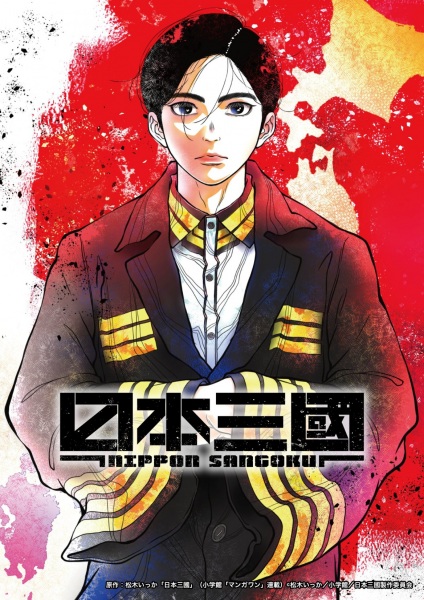
Nippon Sangoku
Is Nippon Sangoku worth watching?
Yes, it's worth watching. Anime Codex rates Nippon Sangoku 7.68 out of 10 — scored on six criteria (story, characters, themes, world-building, animation, and cultural impact), not crowd votes. 71st of 226 on the Codex rubric — top 31% of the catalogue. The crowd rates it 0.83 higher than the rubric does — the Codex is harder on it than on 66% of the catalogue.
Where to watch
Streaming availability varies by region — check your local services.
Trailer
What the data says
Computed from the Codex rubric across the whole catalogue.
Summary
Nippon Sangoku is a confident, atmospheric entry in the seinen war-drama space that distinguishes itself through premise rather than spectacle. Its central conceit—a future Japan that has collapsed back into a feudal, post-Meiji order divided among three empires—is genuinely fresh, and it grounds the well-worn 'unify the realm' narrative in melancholy questions about culture as a fragile inheritance. Aoteru, the literature-obsessed theorist dragged into violence, anchors the show with a believable reluctance, and the decaying Osaka arc gives the early episodes real grit and stakes. The production design and restrained, weighty swordplay suit the somber tone well. The weaknesses are those of a young, ongoing series: Yoshitsune's convenient arrival as an ideologically identical partner strains credulity, the geopolitics are still delivered as exposition rather than active conflict, and the show occasionally states its themes aloud instead of dramatizing them. The mechanics of Japan's original collapse remain underexplained. Judged against the best seinen, it is not yet definitive, but it is a craft-forward, intelligent series with a distinctive world and a protagonist worth following—good and promising, with room to grow into something more if its larger structure delivers on its setup.
Criterion breakdown
Story & narrative
The premise of a literary idealist navigating a post-collapse Japan reverted to a pseudo-Meiji feudal order is a strong reframing of the classical 'unify the realm' war narrative, and the early Osaka arc (episodes 3-5) effectively grounds Aoteru's lofty theory in brutal reality through his near-death and forced pragmatism. However, the convenient encounter with Yoshitsune as an ideologically identical mirror is a contrivance that undercuts the show's otherwise grounded tone, and the first twelve episodes still lean on setup over payoff, with the three-territory geopolitics introduced more as exposition than active conflict. As an ongoing seinen it shows craft but hasn't yet proven its larger structure delivers.
Character writing & growth
Aoteru's arc from a paralyzed armchair theorist who refuses to act into someone forced into violence is the show's spine, and his reluctance reads as genuine rather than performative cowardice. Yoshitsune is the weaker half so far—his 'masterful swordsmanship plus identical dream' framing makes him feel like a wish-fulfillment foil rather than a person with his own interior conflict. Secondary figures in the Osaka underworld are vividly sketched but several disappear before earning their weight.
Themes & emotional resonance
The tension between preserving forgotten culture and the bloody pragmatism required to enforce a vision is the show's most resonant thread, and Aoteru's literature obsession as both motivation and naivety gives the idealism-versus-violence theme real texture. The post-collapse 'civilization is a fragile inheritance' melancholy lands well in quieter scenes, though the show sometimes states its themes through dialogue rather than dramatizing them, blunting emotional impact.
World-building & power system
The conceit of a future Japan that has technologically and culturally regressed to a post-Meiji feudal state, fractured into Yamato, Buo, and Seii, is genuinely original and avoids generic fantasy-Europe defaults. The decayed Osaka—'once one of the three jewels of Kansai'—is the standout setting, internally consistent in showing how collapse breeds crime and warlordism. The mechanism of how modern Japan fell remains frustratingly vague this early, leaving the backstory's internal logic partly unverified.
Animation & direction
Studio Kafka renders the ruined-Meiji aesthetic with strong production design—lantern-lit slums and crumbling infrastructure give Osaka real atmosphere. Swordplay is choreographed with weight and restraint rather than flashy spectacle, suiting the seinen tone, though crowd and battle scenes occasionally thin out in detail. Direction favors muted palettes and deliberate pacing that reinforce the somber mood, with a memorable use of stillness in Aoteru's pre-departure tragedy.
Cultural impact
An 8.51 MAL score across 86,000+ members for an ongoing twelve-episode seinen signals strong reception and word-of-mouth momentum. Its inversion of historical-warlord tropes into a post-collapse future has generated discussion, but as a still-airing title without a confirmed source magazine listed, its lasting footprint on the demographic is unproven and currently rests on promise rather than legacy.
Synopsis (from MAL)
The pinnacle of modern civilization known as Japan is now long forgotten. Ravaged by civil war and technological collapse, Japan has regressed into a post-Meiji era society and is now divided into three imperial territories known as Yamato, Buo, and Seii. However, Aoteru Misumi, a 15-year-old literature enthusiast, dreams to bring back the culture and technology that once made the pride of his country. Although unwilling to turn his theoretical knowledge into concrete action at first, a tragic turn of events drives Aoteru to head to Osaka in hopes of enlisting in the army and eventually uniting the country under his own banner. Osaka—once one of the three jewels of Kansai—has become a crime-ridden city where Aoteru almost loses his life. Luckily, he encounters a fellow ambitious young man named Yoshitsune Asama who pursues the same dream. With Aoteru's strategic prowess and Yoshitsune's masterful swordsmanship, the two now embark on a journey to restore the former glory of Japan. [Written by MAL Rewrite]
Ranked nearby


Explore rankings
Discussion
Set a display name above to post.
Loading discussion…