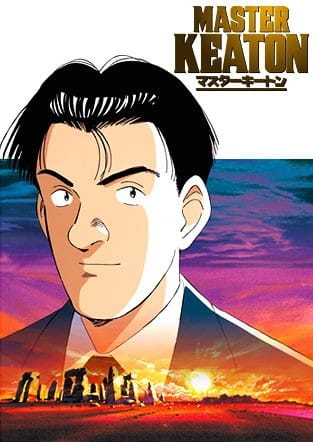
Master Keaton
Is Master Keaton worth watching?
Yes, it's worth watching. Anime Codex rates Master Keaton 7.77 out of 10 — scored on six criteria (story, characters, themes, world-building, animation, and cultural impact), not crowd votes. 65th of 226 on the Codex rubric — top 29% of the catalogue. The Codex rates it Δ +0.12 above its MAL score — more underrated than 87% of the catalogue.
Where to watch
Streaming availability varies by region — check your local services.
What the data says
Computed from the Codex rubric across the whole catalogue.
Summary
Master Keaton is a model of grounded, episodic seinen drama: an erudite, gentle adventure series that mines real archaeology, survival craft, and European postwar history for stories about human dignity rather than spectacle. Taichi Keaton is a quietly excellent protagonist—a Falklands veteran and would-be scholar whose competence serves empathy, not heroics—and the recurring family threads with his daughter and novelist father lend warmth to an otherwise standalone format. As an early Urasawa adaptation, it previews the humanist craftsmanship of Monster while standing confidently on its own. Its strengths are its intelligence, its respect for the viewer, and its lived-in international settings. Its weaknesses are structural and tonal: the purely episodic design builds little cumulative momentum, Keaton himself barely changes across 24 episodes (functioning as a fixed moral lens), some archaeology-lecture installments feel slight beside the stronger human dramas, and resolutions can tie off a bit too neatly. The Madhouse production is competent and tasteful but visually modest, prioritizing composed dialogue over animation flair. Judged against the best mature, character-driven seinen, it is a thoughtful, consistently rewarding show that lands just short of the genre's definitive heights—a connoisseur's recommendation rather than a landmark.
Criterion breakdown
Story & narrative
The largely episodic structure plays to the strength of its source in Big Comic Original, with self-contained mysteries spanning insurance investigation, archaeological riddles, and survival scenarios across Europe. Standout episodes like the wine-country reconciliation between estranged generations and the survival-in-the-wilderness cases show tight, humane plotting that resolves through deduction and empathy rather than violence. The lack of an overarching narrative arc is intentional and suits the slice-of-adventure format, though it means the series builds little cumulative tension and a few archaeology-lecture episodes feel slighter than the human dramas.
Character writing & growth
Keaton is a quietly compelling protagonist whose competence never tips into superheroics; his Oxford archaeology dreams, SAS past, and gentle paternalism are revealed gradually rather than dumped. The recurring family threads—his bond with daughter Yuriko and the warm friction with his romantic-novelist father Taihei—give the episodic format a human spine. The trade-off is that Keaton himself changes little across 24 episodes; he is a fixed moral lens through which others grow, which limits conventional protagonist arc but fits the mature, observational seinen mode.
Themes & emotional resonance
The show consistently champions dignity, postwar European reconciliation, and the quiet decency of ordinary people, often using a case as a pretext to examine grief, forgiveness, or class resentment. Episodes dealing with aging veterans, displaced refugees, and fractured families carry genuine emotional weight without melodrama. It occasionally moralizes a touch too neatly, with tidy resolutions that soften the harder edges its premises raise.
World-building & power system
The grounded, research-driven premise is its strongest differentiator: real survival tactics, archaeological methodology, and insurance-investigation procedure are woven in with evident care from Hokusei Katsushika and Naoki Urasawa's source. The pan-European settings—rural France, Germany, the Mediterranean—feel specific and lived-in rather than generic backdrops. Internal consistency is high; Keaton's skill set is broad but always justified by his established background, avoiding deus ex machina.
Animation & direction
Madhouse delivers solid, restrained late-90s production values appropriate to a grounded drama, with strong character acting and naturalistic European location design over flashy spectacle. Direction favors composed, dialogue-driven framing that serves the mysteries well. The animation is functional rather than remarkable, with occasional flat sequences and limited motion in talky episodes, and it shows its TV-budget seams next to Madhouse's more ambitious work.
Cultural impact
As an early Naoki Urasawa adaptation it holds a respected niche and foreshadows the mature, humanist mystery storytelling he'd perfect in Monster and 20th Century Boys. It enjoys a devoted cult following among seinen fans and licensing complications long hampered its visibility in the West. Its overall footprint remains modest compared to genre landmarks, more a connoisseur's recommendation than a widely influential title.
Synopsis (from MAL)
The amazing Taichi Keaton works on cases around the globe that always lead to adventure! He combines his arsenal of multidisciplinary expertise in investigation, archeology, and survival with his experience as a professor, a Falklands Conflict veteran and a SAS agent to unravel the often dangerous challenges in each riveting episode. (Source: Geneon Entertainment USA)
Ranked nearby


Explore rankings
Discussion
Set a display name above to post.
Loading discussion…