Is Fire Force Overrated? A 6.68 That Rides David Production's Flame Effects Into Numbers the Sol Conspiracy Won't Actually Earn
Fire Force posts a 1.04-point gap between MyAnimeList's 7.72 and the Codex 6.68 because the crowd is grading a David Production sakuga reel and a Soul Eater pedigree, not the twenty-four episodes Atsushi Ohkubo's mystery actually resolves.
Fire Force posts a 1.04-point gap between MyAnimeList's 7.72 and the Codex 6.68 because the crowd is grading a David Production sakuga reel and a Soul Eater pedigree, not the twenty-four episodes Atsushi Ohkubo's mystery actually resolves.
The gap between Fire Force's reputation and its rubric score is the story. MyAnimeList's crowd hands the 2019 David Production adaptation a 7.72; the Codex rubric returns a 6.68. That 1.04-point delta isn't a rounding artifact — it's the sound of one criterion doing all the work while five others quietly refuse to sign the check. Name what the crowd is rewarding that the rubric won't, and the show comes into focus fast.
The Consensus Position, and Why It's Incomplete
The MAL 7.72 is a scoring pattern anyone who reads shonen aggregation numbers knows on sight: strong premiere buzz, Atsushi Ohkubo's Soul Eater pedigree carrying trust from a prior fandom, and — critically — a first-cour animation showcase that gave the community a highlight reel to point at. The pitch is easy to sell. Firefighters versus religious pyro-cult. Devil's Footprints. A studio, David Production, that in the same decade produced JoJo's Bizarre Adventure with real directorial swagger.
What that 7.72 is not measuring is whether the twenty-four episodes actually deliver a satisfying arc. It's not measuring whether Shinra Kusakabe grows. It's not weighing the fanservice cutaways against the direction they interrupt. The Codex rubric weighs six criteria and lets the weakest ones speak; the crowd score compresses everything into a single feeling, and that feeling is dominated by the animation cel that trended on Twitter in August 2019. This is the same failure mode that produces the Hellsing Ultimate gap — a scorecard where one silhouette carries a show whose structural work never earns the number.
The Animation Score Is Doing Almost All the Lifting
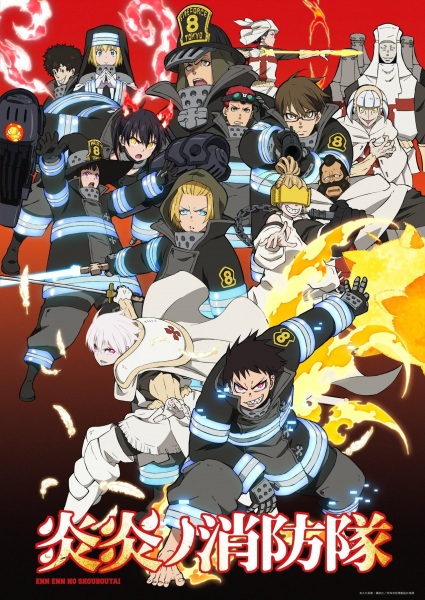
Fire Force's animation criterion sits at 8.5, and it deserves it. David Production's fight choreography — Shinra's speed-based footwork, the Company 7 katana sequences in the Asakusa arc, the flame VFX that treats fire as a stylistic language rather than a particle preset — is genuinely among the strongest action direction of its year. The OP and ED sequences carry more design confidence than most shows deploy in an entire cour. When Shinra ignites into the corridor engagements against the White-Clad, the camera language is doing work most shonen adaptations don't attempt.
That 8.5 is the pillar. Now look at what surrounds it: story 6.5, character 6.0, themes 6.0, world 7.0, cultural 6.5. Five criteria clustered in the mid-sixes. The animation number isn't lying — the direction really is that good — but it's a single tall column in a scorecard of low ones, and the crowd is grading the column and ignoring the plaza.
The other side of that same direction, incidentally, is the reason the number isn't a 9. The tonal whiplash of cutting from a Company 7 blade exchange into a Tamaki fanservice gag is not a minor flaw; it's a directorial decision that breaks its own compositions. The show's most confident asset is repeatedly undermined by its most cowardly one.
The Mystery Sets Up More Than the Season Closes
The story criterion lands at 6.5, and the justification is that the plotting is functional shonen mystery — neither incoherent nor especially tight. That's the honest read. Season 1 opens a compelling central thread: the fire that killed Shinra's family, the Evangelist, the theocratic conspiracy around Sol and the church's grip on the Amaterasu. The Asakusa/Company 7 arc and the revelations about Shō and the White-Clad genuinely inject late-cour momentum.
But the season ends mid-investigation. The Evangelist remains a distant silhouette. Shō's arc is opened, not closed. The show is structured as prologue for a second season, and prologue is not a payoff — it's an IOU. Compare the discipline of a season-one arc that lands its own thesis (any of the Jujutsu Kaisen adjacencies that the rubric respects for exactly this reason) to Fire Force's decision to split time between Infernal-of-the-week filler and the actual conspiracy plot, and the pacing problem becomes structural, not incidental. Episodes that should be tightening the noose around the Sol cult are instead servicing a monster-of-the-week format the premise doesn't need.
The Character Work Is Thinner Than the Premise Suggests
Character comes in at 6.0, and this is where the gap widens. Shinra's nervous-laughter tic as a trauma response is a genuinely intelligent piece of characterization — one of the show's real strengths, and Ohkubo deserves credit for the idea. His rivalry with Arthur Boyle is reliably funny. But across twenty-four episodes, Shinra doesn't grow. His motivation — find the truth about his mother, save his brother, become a hero — is the same in episode 24 as in episode 1. The Company 8 ensemble — Akitaru Ōbi, Maki Oze, Takehisa Hinawa — is charming in the way well-cast shonen supporting casts always are, and thin in the way shonen supporting casts usually are.
And then there's Tamaki. The "lucky lecher" recurring gag isn't a tonal quibble; it's an active drag on the character criterion. Every time the show cuts to it, it forfeits the emotional register of the scene it's leaving. When the criterion asks whether characters develop, the honest answer is that Tamaki is developed backwards from her introduction and the leads don't develop much at all.
The Themes Are Gestured At, Not Landed
Themes score 6.0. The framework is there — the Fire Force as salvation or control, the cult of Sol, the "laying souls to rest" framing that gave the early sister-Infernal episode a genuine melancholy weight. The world-building at 7.0 supports it: the Solar Era theocracy, the Amaterasu as an energy-and-faith monopoly, the generational pyrokinetic system. The setting has ideas most action shonen don't attempt.
But themes only score what the show emotionally lands, not what it sets up. Season 1 gestures at religious critique without committing to it. The Sol imagery is aesthetic before it's argumentative. The show wants to be Trigun with a firehose and settles for being a fight-of-the-week with a cross in the background. Ambition acknowledged; execution deferred to a season the rubric can't yet grade.
The Strongest Counter-Case
The honest steelman: Fire Force is a first-season adaptation of an ongoing manga, and judging it as a self-contained work is a category error. The Evangelist plot is meant to run for seasons. Shinra's growth is meant to happen across the full run. David Production is delivering an adaptation, not an original — the pacing complaints belong to Ohkubo's serialization, not the studio.
That defense is real, and it partly explains why the Codex 6.68 isn't lower. The world-building and animation scores absorb the "this is a setup" argument. But the rubric grades what aired between July and December 2019, not what a hypothetical complete adaptation might have earned. Twenty-four episodes exist; those episodes have a shape; that shape leaves Shinra static, Tamaki degraded, and the central mystery half-open. This is the same trap that catches Kaiju No. 8's scorecard — a premiere season graded on the promise of what comes next rather than what it actually delivered.
Verdict
Fire Force earns its 8.5 animation number and pays for it everywhere else. The 1.04-point gap to MAL's 7.72 is the crowd rewarding David Production's flame work, Ohkubo's Soul Eater cachet, and a premise that photographs well — while the rubric registers a mystery that stalls, a lead who doesn't grow, and a fanservice reflex that sabotages the show's best scenes. It's a solid mid-tier shonen. It is not what a 7.72 promises.
Featured in the Codex


More from The Codex
The Seven Deadly Sins Is a 6.60 Wearing a 7.60 Costume: A One-Point Gap Earned by Groping Gags and Convenient Flashbacks
The Seven Deadly Sins scores 6.60 on the Codex against MyAnimeList's 7.60 because the crowd is grading a Netflix breakout and a Ban-and-King friendship, not the 24 episodes A-1 Pictures actually broadcast in 2014.
The 10.0 That Built a Sunday: How Sazae-san's Cultural Score Carries a 6.58 Scorecard
Sazae-san is a case study in how a single criterion — cultural — can define how a show is remembered, and the 10.0 the Codex hands Eiken's 1969 institution is doing every bit of the heavy lifting its other five scores refuse to.
The Sebastian Problem: Why Black Butler Sits 1.10 Below Its MAL Line and the Crowd Refuses to Notice
Black Butler (Kuroshitsuji) posts a 1.10-point gap between MyAnimeList's 7.65 and the Codex 6.55 because the crowd is grading Sebastian's silhouette and a Phantomhive aesthetic, not the anime-original finale A-1 Pictures actually shipped in 2009.
Discussion
Set a display name above to post.
Loading discussion…