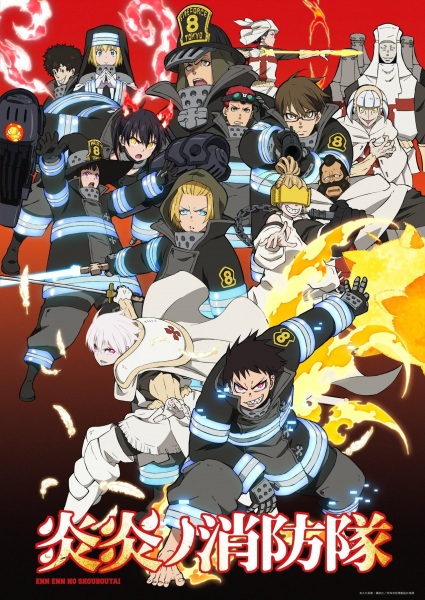
Fire Force
Is Fire Force worth watching?
Worth a look. Anime Codex rates Fire Force 6.68 out of 10 — scored on six criteria (story, characters, themes, world-building, animation, and cultural impact), not crowd votes. 164th of 226 on the Codex rubric — bottom 28% of the catalogue. The crowd rates it 1.04 higher than the rubric does — the Codex is harder on it than on 75% of the catalogue.
Where to watch
Trailer
What the data says
Computed from the Codex rubric across the whole catalogue.
Summary
Fire Force's first season is a stylish, ambitious action shonen elevated chiefly by David Production's superb animation and a genuinely original premise — a theocratic Tokyo plagued by Spontaneous Human Combustion, fought by pyrokinetic firefighters who 'lay souls to rest.' Okubo's worldbuilding around the Church of Sol and generational fire powers gives it conceptual texture rarer than the average battle series, and Shinra's nervous-grin trauma tic shows real characterization instinct. The combat is fast, fluid, and visually distinctive. Yet the season is held back by uneven pacing that toggles between filler-feeling Infernal missions and the slow-burn Evangelist mystery, ending mid-investigation rather than on a contained climax. Character growth is thin across these episodes, and persistent, intrusive fanservice — especially Tamaki's 'lucky lecher' running gag — repeatedly undercuts both tone and the show's more serious thematic aspirations around faith, salvation, and grief. The result is a good-but-flawed entry: it clears the bar for action shonen on spectacle and premise originality, but trails the genre's best in narrative tightness and emotional payoff. Viewers drawn to inventive worlds and high-quality fight direction will find plenty here, provided they tolerate tonal inconsistency and a setup-heavy season that defers most of its rewards.
Criterion breakdown
Story & narrative
Season 1 sets up a compelling central mystery — the cause of Shinra's family's death tied to the Evangelist and the religious conspiracy around Sol — but pacing is uneven, splitting time between episodic Infernal-of-the-week missions and the larger plot. The Asakusa/Company 7 arc and the revelations about Sho and the White-Clad inject momentum late, yet the season ends mid-investigation with much left dangling rather than delivering a satisfying contained payoff. The plotting is functional shonen mystery, neither incoherent nor especially tight.
Character writing & growth
Shinra's nervous-laughter tic as a trauma response is a genuinely thoughtful character touch, and his rivalry with Arthur provides reliable levity. However, growth is shallow over these 24 episodes — Shinra remains largely static in motivation, and the supporting Company 8 cast (Maki, Hinawa, Obi) get charm but little real development. Tamaki's recurring 'lucky lecher' fanservice gag actively undermines her as a character and is a persistent weakness.
Themes & emotional resonance
The fusion of religious iconography, the cult of Sol, and the question of whether the Fire Force serves salvation or control gives the show thematic ambition beyond standard shonen heroics. The 'laying souls to rest' framing lends early Infernal encounters a melancholy weight, as with the sister-Infernal episode. But these ideas remain underdeveloped in season 1, gestured at more than emotionally landed.
World-building & power system
The Spontaneous Human Combustion premise and the generational pyrokinetic system (first-gen Infernals, controlled second/third-gen abilities) is a distinctive hook, and Shinra's foot-ignition 'Devil's Footprints' is a creative niche power. The theocratic society powered by the Amaterasu and the church's grip on energy and faith adds genuine setting depth. Some internal mechanics feel underexplained this early, but the originality of the concept stands out among action shonen.
Animation & direction
David Production delivers the show's strongest asset: fluid, kinetic fight choreography with expressive flame effects and stylish, high-contrast direction. Shinra's speed-based combat and the Company 7 katana battles are standouts, and the OP/ED visual energy is excellent. The chief flaw is tonal whiplash — the direction's slick action is repeatedly interrupted by jarring fanservice cutaways that break immersion.
Cultural impact
As a Weekly Shonen Magazine title from the creator of Soul Eater, it built a substantial following (over 1.5 million MAL members) and notable name recognition, aided by Atsushi Okubo's pedigree. Its real-world resonance was complicated when an episode was edited following sensitivity concerns. It is a solidly popular mid-tier shonen rather than a genre-defining phenomenon.
Synopsis (from MAL)
Spontaneous Human Combustion: a chaotic phenomenon that has plagued humanity for years, randomly transforming ordinary people into flaming, violent creatures known as Infernals. While Infernals make up the first-generation accounts of Human Combustion, the second and third generations became known as pyrokinetics—people gifted with the ability to manipulate and control their flames while remaining human. To combat the Infernal threat and discover the cause, the Tokyo Armed Forces, Fire Defense Agency, and Holy Church of Sol produced their answer: the Special Fire Force. Young and eager third-generation pyrokinetic Shinra Kusakabe, nicknamed Devil's Footprints for his explosive ability to ignite his feet at will, becomes a member of the lively Special Fire Force Company 8. Upholding the brigade's duty to extinguish the blazing Infernals and lay their souls to rest, Shinra is determined to become a hero who will save the lives of those threatened by the flame terror. However, this is not the hero's game Shinra imagined. The Fire Force is a fractured mess of feuding brigades, abnormal Infernal sightings are increasing all over Tokyo, and a shadowy group is claiming to have answers to the strange fire that caused the death of Shinra's family 12 years ago. Faced with many obstacles within and outside the Fire Force, Shinra fights to uncover the truth behind the burning mysteries that have kept him in the dark. [Written by MAL Rewrite]
Ranked nearby

Explore rankings
Discussion
Set a display name above to post.
Loading discussion…