Is Hellsing Ultimate Overrated? A 6.85 That Rides Alucard's Coat and the Major's Speech Into Numbers Madhouse's Handoff Won't Actually Earn
Hellsing Ultimate posts a 1.49-point gap between MyAnimeList's 8.34 and the Codex 6.85 because the crowd is grading a monologue and a silhouette, not the ten-OVA structure three studios actually shipped.
Hellsing Ultimate posts a 1.49-point gap between MyAnimeList's 8.34 and the Codex 6.85 because the crowd is grading a monologue and a silhouette, not the ten-OVA structure three studios actually shipped.
Alucard walks out of a burning Brazilian hotel wearing sunglasses and a body count, and for a certain kind of viewer that image alone is the review. It is not the review. The gap between Hellsing Ultimate's reputation and its rubric score is the story, and naming what the crowd is rewarding that the rubric won't is the only honest way to write about this OVA in 2024.
The consensus position, stated plainly
MyAnimeList scores Hellsing Ultimate at 8.34. The Anime Codex weighted score is 6.85. That 1.49-point delta is not a rounding error and it is not a taste dispute — it is a structural disagreement about what a ten-episode OVA released between 2006 and 2012 across Madhouse, Satelight, and Graphinica is actually delivering. The consensus reads Hellsing Ultimate as a defining seinen: Alucard as the platonic overpowered antihero, the Major's war monologue as thesis-statement cinema, the manga-faithful adaptation as a corrective to Gonzo's 2001 TV run. All of that is real. None of it adds up to an 8.34.
Is Hellsing Ultimate overrated? By 1.49 points, yes — and the interesting question is which criteria are absorbing that inflation. The answer, unsurprisingly, is two: cultural cachet and animation set-pieces. Everything else the rubric touches gets softer the harder you press it.
The story is a delivery mechanism, not a structure
Kouta Hirano's manga is a war narrative that escalates from a rogue-vampire monster-of-the-week opening into Millennium's Nazi vampire battalion razing London in the final OVAs. That escalation is real and it is propulsive. It is also, on the rubric, a 7.0 — because propulsion is not construction. The middle stretch of the OVA is episodic carnage. The Valentine brothers' raid on the Hellsing manor is a spectacular action sequence that resolves without meaningfully changing the board. The Brazil hotel arc functions as a showcase for Alucard's cruelty rather than a plot beat that Millennium's plan actually requires. Yousuke Kuroda's series composition never quite solves the problem that the show's central conflict is not a war between organizations so much as a two-hander between Alucard and the Major, both of whom are ideologically committed to enjoying it.
That is a real thematic choice. It is also a structural problem. When the antagonist and the protagonist share a philosophy about the beauty of slaughter, most of the participants in the actual slaughter become set-dressing. Iscariot's Anderson gets a genuinely operatic exit; most of the Millennium officers get glossy death poses. The stakes, in rubric terms, belong to two men who both wanted this.
Alucard is magnetic and Alucard is static
The character score sits at 6.5, and the number is defensible. Alucard begins the OVA as an essentially invincible force and ends it as an essentially invincible force whose only arc is a philosophical longing to find a human worthy of killing him — a longing the finale resolves via Schrödinger's consumed paradox and Integra's continued refusal of vampirism. That is elegant on the page. On screen, across ten episodes shipped over six years, it means the central figure does not change; he waits for the show to arrange his ending.
Seras Victoria is the one real arc in the cast. Her journey from traumatized rookie to a vampire who accepts what she is after Pip Bernadotte's death — drinking his blood, choosing the transformation — is the OVA's most emotionally coherent thread and the only place the rubric's themes score finds real purchase. Integra is iconic without being examined. Walter's late-run betrayal reveal is one of the show's clearest execution failures: the motivation lands flat because the OVA has not built the interiority the twist requires. The Major delivers arguably the most famous villain monologue in modern anime and functions, mechanically, as a mouthpiece. He is a thesis, not a person.
Themes: nihilism at monologue length
The themes score of 6.0 is where the delta with the crowd sharpens. The Major's speech on the love of war is genuinely chilling as a thesis statement, and the Integra-Seras mirror — one refusing monstrosity, one embracing it — is a clean structural rhyme. Beyond that pairing, the show's thematic material rarely deepens past stylish nihilism. Most deaths are operatic rather than affecting. When Pip dies and Seras drinks him, the show earns a genuine emotional beat; when Millennium officers die in stylized spray, the show earns applause. Those are not the same currency, and the rubric weights them differently.
This is the pattern that shows up across shows the crowd over-rewards for a single delivered monologue — the same inflation problem Tokyo Ghoul posts when the discourse grades "Unravel" and Kaneki's white hair instead of the twelve compressed episodes Pierrot shipped. Hellsing Ultimate is not that badly compressed, but the mechanism of over-scoring is identical.
The animation is real, and it is uneven
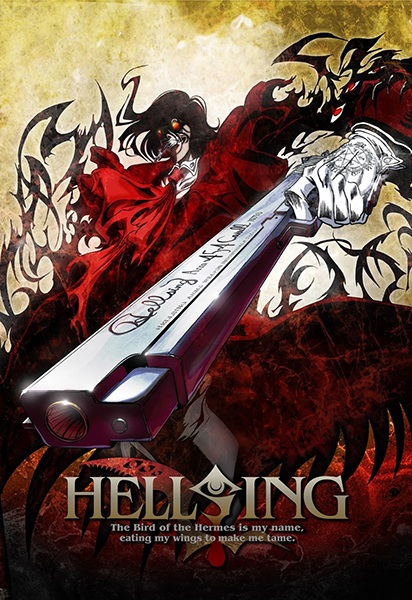
The 8.0 on animation is the highest score on the sheet and it is earned. Alucard's level-zero release against Luke Valentine — the coat unspooling into familiars and the Baskerville hound erupting out of shadow — is a genuine set-piece, and the final aerial assault on London sustains inventive direction across the studio handoffs. The Cromwell Invocation as a restraint-level system gives the power fantasy tangible internal rules, which most vampire-action anime never bother with.
It is also uneven in a way the community score papers over. Madhouse's early OVAs and the later Satelight/Graphinica episodes are visibly different productions. Character designs shift. Timing shifts. The gothic art direction and the score hold the operatic tone together, but the fluctuation is real and the crowd tends not to price it in. This is a show that shipped over six years across three studios, and it looks like it.
Culture is doing the heaviest lifting
The 7.5 on cultural impact is the other place the score is generous rather than stingy. Alucard is a defining icon of the overpowered antihero archetype. The Major's monologue is one of the most-circulated pieces of anime rhetoric of the last twenty years. The OVA's swaggering hyper-violent aesthetic influenced a niche of vampire-action work that outlived it. That footprint is durable, but it is also narrower than the genre-defining seinen titans it gets grouped with in fan discussion — an inflation problem the rubric handles the same way it handled Fist of the North Star's catchphrase economy and Dragon Ball's generational halo. Cultural weight is a real criterion. It is not six other criteria.
The counter-argument, taken seriously
The strongest version of the 8.34 position is this: Hellsing Ultimate is not trying to be tightly constructed drama. It is trying to be an operatic, blasphemous, gleefully excessive vampire war, and by that internal standard the OVA is a near-total success. The Protestant Hellsing / Vatican Iscariot / Nazi Millennium triangle is one of the most audacious premises in seinen (the world score of 7.5 concedes this directly), and holding the OVA to a construction standard it never wanted is a category error.
The rubric's answer is that operatic intent does not exempt a show from execution grading. When Walter's betrayal reads as pose rather than motive, when the middle arcs function as episodic carnage rather than escalation, when the central ideological duet leaves the rest of the cast as scenery — those are executional failures inside the operatic mode, not outside it. Excess is a style. It is not an alibi.
Verdict
Hellsing Ultimate at 6.85 is a genuinely stylish, animation-forward, culturally weighty OVA whose reputation has been laundered by one monologue, one silhouette, and Alucard's coat. The 1.49-point delta to MyAnimeList's 8.34 is the crowd grading iconography; the rubric is grading the ten episodes three studios actually shipped. Both readings are legible. Only one of them survives contact with the middle arcs.
Featured in the Codex

More from The Codex
The Seven Deadly Sins Is a 6.60 Wearing a 7.60 Costume: A One-Point Gap Earned by Groping Gags and Convenient Flashbacks
The Seven Deadly Sins scores 6.60 on the Codex against MyAnimeList's 7.60 because the crowd is grading a Netflix breakout and a Ban-and-King friendship, not the 24 episodes A-1 Pictures actually broadcast in 2014.
The 10.0 That Built a Sunday: How Sazae-san's Cultural Score Carries a 6.58 Scorecard
Sazae-san is a case study in how a single criterion — cultural — can define how a show is remembered, and the 10.0 the Codex hands Eiken's 1969 institution is doing every bit of the heavy lifting its other five scores refuse to.
The Sebastian Problem: Why Black Butler Sits 1.10 Below Its MAL Line and the Crowd Refuses to Notice
Black Butler (Kuroshitsuji) posts a 1.10-point gap between MyAnimeList's 7.65 and the Codex 6.55 because the crowd is grading Sebastian's silhouette and a Phantomhive aesthetic, not the anime-original finale A-1 Pictures actually shipped in 2009.
Discussion
Set a display name above to post.
Loading discussion…