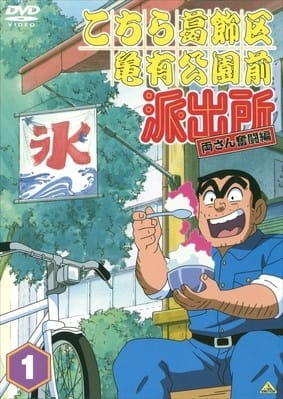
KochiKame: Tokyo Beat Cops
Is KochiKame: Tokyo Beat Cops worth watching?
Worth a look. Anime Codex rates KochiKame: Tokyo Beat Cops 6.70 out of 10 — scored on six criteria (story, characters, themes, world-building, animation, and cultural impact), not crowd votes. 159th of 226 on the Codex rubric — bottom 31% of the catalogue. The crowd rates it 1.22 higher than the rubric does — the Codex is harder on it than on 82% of the catalogue.
Where to watch
Streaming availability varies by region — check your local services.
Trailer
What the data says
Computed from the Codex rubric across the whole catalogue.
Summary
KochiKame: Tokyo Beat Cops is a monument of Japanese gag comedy, adapting one of the longest-running manga in history into a reliable episodic engine of slapstick and satire. Its strength is consistency: Ryoutsu Kankichi is a perfectly calibrated comic everyman whose greed-driven schemes inevitably collapse, and the foil cast of elite Nakagawa and disciplined Reiko keeps the formula sharp. The Kameari precinct setting is its quiet triumph — a specific, affectionate portrait of working-class Shitamachi Tokyo that doubles as a running snapshot of contemporary Japanese fads and consumer culture. Within shonen comedy, this is craft of a high order. Its weaknesses are inherent to the form: the rigid episodic structure precludes narrative momentum or character growth, the 373-episode length rewards sampling over marathoning, and emotional resonance is intentionally shallow. Gallop's animation is faithful but workmanlike, rarely rising above competent TV production. As a piece of cultural infrastructure, however, KochiKame is enormous — a national institution with a statue and decades of brand presence, even if its international profile remains modest. Judged as the gag comedy it is, rather than against plot-driven shonen, it is a durable, well-built, genuinely funny series that achieves exactly what it sets out to do.
Criterion breakdown
Story & narrative
KochiKame is fundamentally episodic, with each installment following Ryoutsu's get-rich-quick scheme escalating to inevitable disaster and a reprimand from Chief Ohara — a rigid formula that delivers reliable comic payoff but almost no narrative momentum across 373 episodes. The structure works because the gag engine is genuinely inventive in its premises (Ryoutsu's fads, gadgets, and scams reflecting real-period Japanese culture), but the lack of any overarching arc means episodes are interchangeable and the show is better sampled than marathoned. As a comedy episodic in the vein of long-running Jump gag manga, it is competent and consistent rather than ambitious.
Character writing & growth
Ryoutsu Kankichi is an enduringly vivid comic protagonist — greedy, lazy, hot-tempered, yet weirdly competent and warm — and the contrast cast of straitlaced elites Nakagawa and Reiko gives the slapstick a reliable structural foil. The supporting ensemble (Volterra, Honda the meek officer who transforms on a motorcycle) adds texture, but the comedy genre flatly precludes growth: Ryoutsu resets to baseline every episode, by design. Within gag-comedy conventions this is excellent characterization, though the static nature limits it from the top tier.
Themes & emotional resonance
The recurring thread of an underpaid working-class everyman chasing easy money against a rigid institutional hierarchy carries a gentle satirical bite about bubble-and-post-bubble Japanese consumerism and salaryman frustration. There is real affection beneath the chaos — Ryoutsu's loyalty to the Kameari precinct and old Shitamachi neighborhood gives the show an undercurrent of nostalgia and community. But emotional resonance is shallow by intent; the show prioritizes the laugh over any lasting feeling, so it rarely lands beyond the surface.
World-building & power system
The Kameari Park precinct in Tokyo's working-class Shitamachi district is rendered with genuine specificity and consistency, functioning as a living comic ecosystem rather than mere backdrop. The premise's originality lies in its near-real-time engagement with contemporary Japanese trends, technology fads, and pop culture, making each episode a kind of period snapshot. This grounded, internally coherent setting is a real strength for a gag comedy, even if it never aspires to elaborate lore.
Animation & direction
Gallop's production is serviceable TV-anime workmanlike — the character designs faithfully reproduce Osamu Akimoto's distinctively round, exaggerated art with Ryoutsu's connected eyebrows, and the elastic slapstick timing is competent. But the animation is rarely a highlight, prioritizing volume and consistency over polish across its enormous run, with frequent reuse and flat staging. Directorial energy peaks in the physical-comedy set pieces but settles into routine elsewhere.
Cultural impact
KochiKame is a Japanese institution — the source manga ran in Weekly Shonen Jump for 40 years and over 200 volumes, holding records for longevity, and the franchise is deeply woven into Japanese popular memory. Ryoutsu is an instantly recognizable national mascot, with a real-world statue in Kameari and enduring brand presence. Its domestic footprint vastly outstrips its modest international recognition, but as a cultural artifact it is heavyweight.
Synopsis (from MAL)
Ryoutsu, being an underpaid policeman, is always coming up with underhanded schemes in order to make a quick buck. But in the end, his plans (which are ridiculous to begin with) always go wrong and land him in big trouble with the chief.
Ranked nearby

Explore rankings
Discussion
Set a display name above to post.
Loading discussion…