Is Dr. Stone Overrated? A 7.63 That Rewards Its Premise and Forgets to Score Its Cast
Dr. Stone's crowd score outruns its rubric by 0.63 points because MyAnimeList is grading a tech tree, not a story — and the supporting cast, the middle-arc pacing, and the missing Tsukasa confrontation are what the numbers actually see.
Dr. Stone's crowd score outruns its rubric by 0.63 points because MyAnimeList is grading a tech tree, not a story — and the supporting cast, the middle-arc pacing, and the missing Tsukasa confrontation are what the numbers actually see.
Senku's "this is exhilarating" is a genuinely new note in shonen — a lead who wins by knowing what saltpeter does. That novelty is doing more work than the show around it, and the crowd is rewarding the novelty as if it were the entire production. It isn't.
The gap is the story
MyAnimeList scores Dr. Stone 8.26. The Codex rubric scores it 7.63. That 0.63-point delta is not a rounding error, and it is not a disagreement about whether the show is enjoyable — it is a disagreement about what a shonen is being graded on. The consensus is grading a premise. The rubric is grading six criteria, and only one of them — world-building at 8.5 — meets the reputation.
This is the pattern the Codex catalogue keeps surfacing when a show becomes a discourse object: a single monster criterion carries a scorecard that looks weaker once you separate the columns. It happened with Yu Yu Hakusho, where Toguro and Toonami memory float a show whose finale doesn't exist, and it's happening here — except the load-bearing pillar is the periodic table instead of nostalgia. Name what the crowd is rewarding that the rubric won't, and the gap explains itself.
World-building is doing everything, and the crowd is scoring it twice
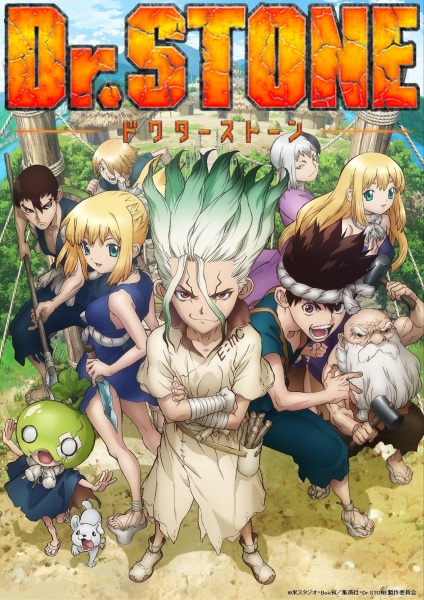
The 8.5 on world is correct and, honestly, defensible higher. TMS Entertainment's 2019 adaptation gets one thing unambiguously right: it treats real chemistry as a plot engine. The tech tree from fire to iron to sulfa drugs to the endgame vacuum tube is genuinely rigorous — dependencies stack the way they'd have to stack in reality, and Riichiro Inagaki's original story never cheats a step to reach a set piece faster. The premise itself — a petrified humanity, a forest-swallowed Earth, 3,700 years of green growing through concrete — is nearly unmatched in the genre. The green-light petrification imagery and the reveal of the statue-world are visually the strongest thing the show does.
The problem is that the crowd is scoring this criterion twice. Once as world-building, and again — implicitly — as story, character, and theme, because the tech-tree engine keeps forward momentum going even when nothing else is happening. Watching Senku make a cell phone feels like plot because it is structured like plot. It is not the same thing as plot. The rubric separates those columns. The crowd doesn't.
Story at 8.0 hides where the season actually breaks
The story score is generous, and the justification is honest about why: the season builds cleanly from the Taiju and Yuzuriha revival through the cure-all for Tsukasa's sister and into the establishment of Ishigami Village, and then it slows down. The back half is a tournament-and-alliance holding pattern — village politics, the chief's succession, the sorcery-versus-science posturing — that exists to stall the actual confrontation with the Empire of Might until a second season can pay it off.
That is not disciplined shonen structure. That is a first cour doing the work and a second cour buying time. The Senku-Tsukasa ideological clash is the season's stated engine, and 24 episodes end without engaging it. The crowd forgives this because the next season exists; the rubric doesn't grade on future episodes. A story that defers its central conflict for a full second cour is a story that scored an 8.0 on the strength of its opening act.
Character at 7.0 is where the reputation actually loses
This is the number that most cleanly explains the 0.63-point gap. Senku is a real character — cerebral, specific, funny in a way most Jump leads aren't — and Tsukasa is a genuinely coherent antagonist whose philosophy about who deserves the revived world is legible and defensible. Two characters. That's the ledger.
Taiju is brawn and shouting; the show introduces him as a co-lead and then quietly benches him because it cannot find a second thing for him to do. Yuzuriha is a plot device wearing a character design. Kohaku has charm and a fighting style and no interior life the show is interested in excavating. Chrome is the closest thing to a second real arc — the village scientist recognizing his own ceiling and choosing to be Senku's peer — but even that stays conceptual. Growth in Dr. Stone is almost entirely external: alliances form, roster expands, faction lines get drawn. Characters do not change. In a 24-episode season built around a philosophical argument about civilization, having exactly two characters capable of holding that argument is the ceiling the rubric is registering.
Themes at 7.5 are undercut by the show's own tone
The wonder-at-science reading is the correct one — the fire moment, the glass moment, the antibiotic moment all land, and the show is genuinely evangelizing cumulative human knowledge in a way anime almost never bothers to. The Senku-versus-Tsukasa question — revival for everyone or revival for the strong — is a real ideological frame, not a cartoon one.
But the show cannot stop being upbeat long enough to let its own stakes register. Byakuya's arc, revealed through the space-station recordings, is the one sequence where the tone drops into something like grief, and it works precisely because everything around it doesn't. When every crafting montage is scored like a triumph and every setback is a joke beat away from resolution, the ideological weight the show wants to carry keeps sliding off. A 7.5 is the rubric acknowledging the ambition and marking down the execution.
Animation at 7.5 is polished, not exceptional
TMS delivers a consistent, saturated, competently directed adaptation. Minako Shiba's chief animation direction from episode 4 onward holds the character work steady, and Yuu Kou's storyboards on episodes 2, 5, and 6 handle the early world-establishing beats cleanly. What the show does not have is a sakuga set-piece — no sequence a viewer names the way they name specific cuts from a MAPPA or Ufotable production. CG crowds are functional. Fight choreography, when it happens, is serviceable. This is a mid-tier production doing its job, and the rubric is scoring it as such.
The steelman: the crowd is rewarding a show that tried something
The strongest defense of the 8.26 is that Dr. Stone earned its audience by being the show that proved science-edutainment could work in a Jump slot — and that novelty has real value the rubric may be under-pricing at a 7.0 cultural score. It's fair. Dr. Stone genuinely carved a niche, sustained multiple sequel seasons through a 2026 finale, and produced a lead who reads differently from every shonen protagonist around him. Some of the 0.63-point gap is a crowd correctly registering that this show did something new. This is the same failure mode the Codex catalogue keeps finding when popularity and quality get separated: novelty and craft are different variables, and MyAnimeList scores conflate them.
Verdict
Dr. Stone is a 7.63 because one criterion is doing the load-bearing, one is generously scored, and the character column — the column that decides whether a philosophical shonen actually works — tops out at two people. Worth watching for Senku, Tsukasa, and the tech tree. Not worth defending as an 8.26.
Featured in the Codex

More from The Codex
The Seven Deadly Sins Is a 6.60 Wearing a 7.60 Costume: A One-Point Gap Earned by Groping Gags and Convenient Flashbacks
The Seven Deadly Sins scores 6.60 on the Codex against MyAnimeList's 7.60 because the crowd is grading a Netflix breakout and a Ban-and-King friendship, not the 24 episodes A-1 Pictures actually broadcast in 2014.
The 10.0 That Built a Sunday: How Sazae-san's Cultural Score Carries a 6.58 Scorecard
Sazae-san is a case study in how a single criterion — cultural — can define how a show is remembered, and the 10.0 the Codex hands Eiken's 1969 institution is doing every bit of the heavy lifting its other five scores refuse to.
The Sebastian Problem: Why Black Butler Sits 1.10 Below Its MAL Line and the Crowd Refuses to Notice
Black Butler (Kuroshitsuji) posts a 1.10-point gap between MyAnimeList's 7.65 and the Codex 6.55 because the crowd is grading Sebastian's silhouette and a Phantomhive aesthetic, not the anime-original finale A-1 Pictures actually shipped in 2009.
Discussion
Set a display name above to post.
Loading discussion…