Cowboy Bebop at 8.71: Where Watanabe's Space Western Actually Lands on the Seinen Map
Anime Codex scores Bebop 8.71 against MyAnimeList's 8.75 — a rounding-error gap that hides a specific argument about which criteria carry the show and which quietly limit it.
Anime Codex scores Bebop 8.71 against MyAnimeList's 8.75 — a rounding-error gap that hides a specific argument about which criteria carry the show and which quietly limit it.
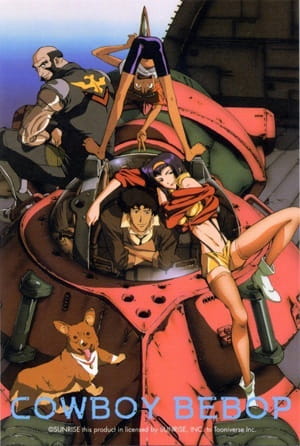
Ranking a show only means something relative to its peers. Place Cowboy Bebop on the seinen map and explain the coordinates — that is the only exercise worth doing here, because Bebop's reputation has calcified into a shorthand ("greatest anime of all time," "gateway series," "the dub") that no longer describes what the show does session by session. Against the field of best seinen anime, the 1998 Sunrise production directed by Shinichirō Watanabe with a Yoko Kanno score lands high but not at the ceiling, and the reason is legible on the scorecard.
The Consensus and Where It's Incomplete
The MyAnimeList crowd scores it 8.75. The Codex weighted score is 8.71. Numerically, this is a non-argument — four hundredths of a point across twenty-six episodes. But the crowd's 8.75 is doing work the Codex figure isn't: it's absorbing the show's status as a cultural artifact, the Adult Swim afterlife, Kanno's soundtrack sold as a standalone object, and the English dub's canonization. Strip those out and grade the twenty-six episodes on their own terms, and Bebop still scores well — just not on every criterion.
The consensus position treats Bebop as a monolith. The rubric doesn't. Two criteria (cultural at 9.5, animation at 9.3) carry the score. Two (world at 8.2, story at 8.5) are the weak points, at least relative to what the top of the seinen tier demands. Explaining the gap between those numbers is more interesting than defending the average.
Animation and Cultural Impact Are Doing the Heavy Lifting
The 9.3 on animation is the least controversial claim in the file. The church shootout in "Ballad of Fallen Angels" — the stained-glass fall, the cross-cut of Julia's memory into Spike's descent, the way Kanno's vocal cue lands on the frame instead of underneath it — is the sequence every subsequent action-drama director has had to answer to. Toshihiro Kawamoto's character designs remain expressive without ever tipping into the deformation that dates most 1998 television animation. "Tank!" over the opening still functions as a thesis statement: jazz-timed editing, cinematic framing, sound-image marriage that Sunrise has never quite matched since.
The 9.5 on cultural impact is where Bebop separates from every other seinen contender. Toonami placement, the English dub as a reference standard, the Kanno soundtrack's independent commercial life — these compound. When we scored 195 shows to test whether popularity tracks quality, Bebop is one of the cases where the correlation actually holds: it is popular because it is good, not the reverse. That is rare enough to be worth naming.
Themes Score Higher Than Story, and That's the Real Signal
The 8.8 on themes against the 8.5 on story is the most diagnostic pair of numbers in the scorecard. Bebop is a show whose thematic architecture — loneliness, the inescapability of the past, found family that cannot hold — is more coherent than its plot architecture. Spike's "I'm not going there to die, I'm going to find out if I'm really alive" is the show's thesis, and it's carried by episodes that are, individually, more thematically legible than they are narratively necessary.
The connective Vicious/Red Eye arc is thin. It surfaces intermittently and collapses most of its work onto "The Real Folk Blues" at the end. This is a real limitation. The best seinen anime with serialized ambition — think of what Madhouse did with Black Lagoon's Roanapur or how Parasyte accumulates Shinichi's transformation — either commit to a season-long spine or make the episodic structure genuinely thematic. Bebop tries both and pays a small tax on the story score for it. "Mushroom Samba" is comedy. "Pierrot le Fou" is horror. "Speak Like a Child" is quiet elegy. The tonal range is a virtue; the serialized payoff is thinner than the show's reputation suggests.
Character Revelation, Not Character Growth
The 8.7 on character is precisely calibrated. Bebop does revelation, not growth. Jet's guilt over his ISSP past surfaces in "Black Dog Serenade." Faye's amnesia and her recovered childhood tape crystallize in "Speak Like a Child." Spike ends essentially as he began — fatalistic, tethered to Julia, walking toward a confrontation he already knows the outcome of. This is deliberate. It is also a ceiling on what "character" can score when the rubric rewards transformation.
Ed and Ein are functional. Ed is a tonal instrument — she exists to modulate the crew's texture, to introduce comic relief and eventual departure — but her interior life is not written. Ein is a device. In a twenty-six episode ensemble, having two of four core cast members operate primarily as texture rather than psychology is what keeps the character score at 8.7 rather than the low 9s that top-tier seinen character work demands.
World-Building Is Atmospheric, Not Systemic
The 8.2 on world is the score most likely to surprise readers. The 2071 solar system, the Astral Gate accident, the terraformed Mars, the grimy bounty economy — all of this is texturally superb. But it is texture, not system. Kimitoshi Yamane's mechanical design and the show's noir-Western-blaxploitation collage produce atmosphere rather than lore. There is no equivalent to the rigorously constructed political geography that carries the upper-tier world scores in the catalogue.
This is a defensible choice — Bebop is not that kind of show — but the rubric grades what is on screen, not what was intended. Atmospheric world-building caps at the low 8s. Mechanical, deep-lore construction is what pushes into the 9s.
The Steelman: Bebop as a Complete Object
The strongest counter-argument is that grading Bebop criterion by criterion misses the point. The show is a gesamtkunstwerk — direction, score, design, voice performance, and thematic voice fused into an object that resists decomposition. Kanno's music isn't a soundtrack; it's a co-author. Watanabe's episode-as-session framing isn't a story limitation; it's a form.
The rubric hears this argument and answers it. Cultural (9.5) and animation (9.3) are precisely the criteria that reward the gesamtkunstwerk reading. Bebop scores near the ceiling where its integration is strongest. It scores lower where individual criteria — narrative connective tissue, world systematicity, character transformation — are what the rubric is asking about. Those are not the same question, and pretending they are is how a show ends up overrated by half a point instead of correctly placed by four hundredths.
Verdict
Bebop at 8.71 sits in the upper tier of seinen, carried by the two criteria (animation, cultural impact) where it is genuinely without peer and held back from the ceiling by a story that leans on its finale and a world that trades system for atmosphere. That is not a demotion — it is a coordinate. The show is exactly where the rubric says it is, and the rubric is not wrong.
Featured in the Codex





More from The Codex
The Seven Deadly Sins Is a 6.60 Wearing a 7.60 Costume: A One-Point Gap Earned by Groping Gags and Convenient Flashbacks
The Seven Deadly Sins scores 6.60 on the Codex against MyAnimeList's 7.60 because the crowd is grading a Netflix breakout and a Ban-and-King friendship, not the 24 episodes A-1 Pictures actually broadcast in 2014.
The 10.0 That Built a Sunday: How Sazae-san's Cultural Score Carries a 6.58 Scorecard
Sazae-san is a case study in how a single criterion — cultural — can define how a show is remembered, and the 10.0 the Codex hands Eiken's 1969 institution is doing every bit of the heavy lifting its other five scores refuse to.
The Sebastian Problem: Why Black Butler Sits 1.10 Below Its MAL Line and the Crowd Refuses to Notice
Black Butler (Kuroshitsuji) posts a 1.10-point gap between MyAnimeList's 7.65 and the Codex 6.55 because the crowd is grading Sebastian's silhouette and a Phantomhive aesthetic, not the anime-original finale A-1 Pictures actually shipped in 2009.
Discussion
Set a display name above to post.
Loading discussion…