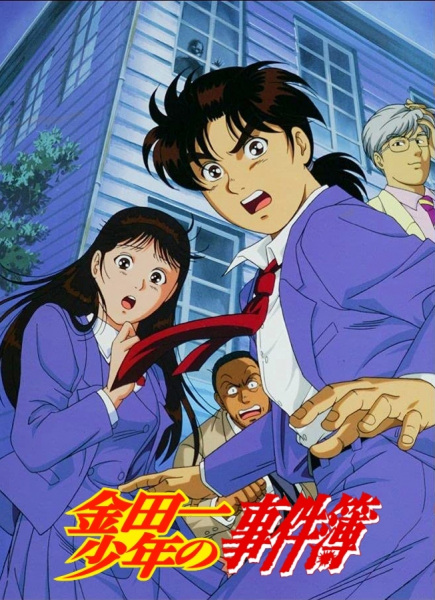
The Kindaichi Case Files
Is The Kindaichi Case Files worth watching?
Worth a look. Anime Codex rates The Kindaichi Case Files 7.10 out of 10 — scored on six criteria (story, characters, themes, world-building, animation, and cultural impact), not crowd votes. 123rd of 226 on the Codex rubric — bottom 47% of the catalogue. The crowd rates it 0.95 higher than the rubric does — the Codex is harder on it than on 73% of the catalogue.
Where to watch
Streaming availability varies by region — check your local services.
What the data says
Computed from the Codex rubric across the whole catalogue.
Summary
The Kindaichi Case Files is a cornerstone of shonen mystery, prizing genuine fair-play deduction over spectacle and trusting its audience to solve elaborate locked-room puzzles alongside Hajime. Its greatest strength is atmosphere and humanity: isolated, dread-soaked settings host murders rooted in tragedy, so each case carries emotional weight beyond the mechanical reveal, and recurring villains like the Puppeteer from Hell lend rare serialized stakes to an episodic format. Judged within its genre, it is excellent at what it sets out to do. Its limitations are equally clear. Hajime and Miyuki are static archetypes — the eternally clever heir and the perpetual damsel — so character growth is minimal, with the emotional depth outsourced to one-off culprits. The 148-episode length exposes uneven case quality and an over-reliance on the 'remote location plus tragic revenge' template, while Toei's modest late-90s animation keeps the visuals serviceable rather than memorable. As a puzzle anthology it rewards patience but does not transform across its run. Still, its influence is undeniable: it helped ignite the detective-manga boom and shaped the template Detective Conan would popularize, securing its place as a notable, genre-defining entry rather than a flawless one.
Criterion breakdown
Story & narrative
As a mystery-of-the-week format, the show excels at fair-play whodunits where clues are genuinely planted before Hajime's reconstructions, with standout arcs like 'The Murders at Kit Hotel' and 'Opera House Murders' delivering elaborate locked-room and revenge-motive plots. The serialized confrontations with the recurring antagonist Hideo Akechi's rival and the phantom 'Puppeteer from Hell' (Jigoku no Kairaishi) add welcome continuity to an otherwise episodic structure. Weakness: with 148 episodes the case quality is uneven, and some culprit motives lean on melodramatic tragic-backstory formulas that telegraph the killer's identity early.
Character writing & growth
Hajime is a likable but largely static lead — his grandfather-genius pedigree and 'jiichan no na ni kakete' catchphrase define him more than any arc of growth, and Miyuki functions mostly as a damsel and reaction character rather than a developed partner. The real character writing lives in the one-off culprits, whose grief and motives are often the emotional core of each arc. Inspector Kenmochi and rival Kengo Akechi provide texture, but the cast is fundamentally fixed across the run.
Themes & emotional resonance
The series consistently roots its murders in human tragedy — bullying, betrayal, lost loved ones, and institutional injustice — so the 'why' often lands harder than the 'how,' as in cases where the culprit's revenge is framed sympathetically. This gives the show genuine emotional resonance uncommon in puzzle fiction. It rarely interrogates these themes beyond the confines of each case, however, keeping the moral weight episodic rather than cumulative.
World-building & power system
Read as setting and premise originality, the show thrives on atmospheric isolated locations — cursed islands, snowbound mansions, opera houses, hot-spring inns — that enforce internally consistent closed-circle logic. The 'detective inheritance' premise and the recurring criminal-mastermind framework give it more structural identity than a generic case anthology. The trade-off is repetition: the remote-location-with-a-grudge template recurs so often that the world feels more like rotating stage sets than a cohesive whole.
Animation & direction
Toei's late-90s TV production is functional rather than striking, with limited animation, recycled reconstruction sequences, and modest character designs typical of the era's long-running shonen. Direction earns points for mood — fog, shadow, and tense reveal pacing during the climactic accusation scenes — but visual ambition is low and the long runtime shows in corner-cutting. The reconstruction visuals do effectively clarify complex spatial tricks for the viewer.
Cultural impact
Kindaichi is a foundational pillar of the modern detective-manga boom and directly preceded and influenced the explosion of Detective Conan, helping legitimize whodunit fiction within Weekly Shonen Magazine. Its fair-play formula and recurring-antagonist structure became a genre template, and the franchise's longevity across manga, anime, and live-action attests to its lasting footprint.
Synopsis (from MAL)
Hajime Kindaichi's unorganized appearance and lax nature may give the impression of an average high school student, but a book should never be judged by its cover. Hajime is the grandson of the man who was once Japan's greatest detective, and he is also a remarkable sleuth himself. With the help of his best friend, Miyuki Nanase, and the peculiar inspector Isamu Kenmochi, Hajime travels to remote islands, ominous towns, abysmal seas, and other hostile environments. His life's mission is to uncover the truth behind some of the most cunning, grueling, and disturbing mysteries the world has ever faced. [Written by MAL Rewrite]
Ranked nearby



Explore rankings
Discussion
Set a display name above to post.
Loading discussion…