Banana Fish Review: An 8.70 Built on Themes and Character, Taxed on World-Building
Judged against one consistent rubric, Banana Fish is best understood by which criteria carry it and which drag it down — not by a single number.
Judged against one consistent rubric, Banana Fish is best understood by which criteria carry it and which drag it down — not by a single number.
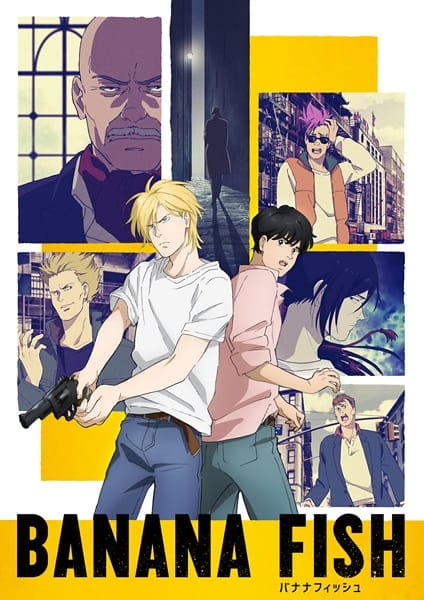
The 2018 MAPPA adaptation of Akimi Yoshida's manga ends on a single static shot inside a public library, and that shot is doing more critical work than the previous twenty-three episodes combined. Most readers arriving at a Banana Fish review want to know whether the show survives the contemporary update of its 1980s source material. The rubric says yes — but the survival is uneven, and the gap between what the show does extraordinarily and what it does adequately is the entire story.
The Codex Position and the MAL Gap
Anime Codex scores Banana Fish at 8.70. MyAnimeList sits at 8.45. The 0.25-point spread is not a rounding error and not a fan-base disagreement — it is a structural consequence of weighting. MAL aggregates a single user impression, which tends to compress a show like this into "how hard did it hit." The Codex rubric splits that impression into six load-bearing criteria and weights them by genre. Banana Fish is catalogued as shoujo, and in shoujo the themes and character axes carry disproportionate weight. Those happen to be the two criteria where this show does its most defensible work: themes at 9.2, character at 9.0. The crowd score is honest about emotional impact and silent about everything else. The Codex score is louder about thematic ambition and quieter about world-building shortfalls, and the arithmetic ends up slightly above the consensus rather than below it.
This is not a case of contrarianism for its own sake. As we've argued before about which criteria each demographic is built to dominate, shoujo's structural advantage is interiority, and Banana Fish executes that advantage with unusual force.
The Themes Axis Is Doing Most of the Lifting
A 9.2 on themes is rare anywhere on the Codex, and Banana Fish earns it by refusing the standard exits. The show interrogates cycles of abuse without offering recovery as a clean narrative payout. Ash Lynx has been conditioned by Dino Golzine into a survival instrument, and the script — handled across all 24 episodes by Hiroshi Seko — declines to suggest that competence, intelligence, or love can undo conditioning. The Cape Cod imprisonment sequence in the middle of the run is the show's clearest thesis statement: Ash's skills do not protect him from what was done to him, and the writing knows it.
This is what separates Banana Fish from the broader category of trauma-as-aesthetic shows. The commodification of bodies is not metaphor here; it is the literal economy of the story. Few works in any demographic confront exploitation this directly, and the ambiguous tragedy of the final episode — that library shot — lands as catastrophe rather than catharsis. The show that flinched would have scored a 7. This one doesn't, and so it doesn't.
Character Writing as the Emotional Spine
The 9.0 on character is built almost entirely on the Ash–Eiji axis, and the rubric is honest about why. Eiji Okumura functions less as a romantic interest than as a structural device: a single space in Ash's life that is not transactional. Every other relationship Ash has — with Dino, with his gang, with Shorter Wong before the betrayal, with Yut-Lung — runs through power, debt, or violence. Eiji's gentleness is dramatically necessary, not sentimental, and the library finale only works because the show has spent twenty-three episodes establishing why that one exception matters.
The supporting cast is more uneven. Shorter and Sing land with real interiority; their decisions cost the show something when they break. Yut-Lung, who should be Ash's mirror, never quite acquires the dimensional weight the script seems to want for him. The 9.0 score reflects this honestly — extraordinary lead writing, strong middle tier, one underdeveloped antagonist.
Where the Score Pays Tax: World-Building and Animation
The 7.5 on world-building is the post's most contested number, and it is the right number. The grimy New York underworld — gangs, mafia, military experiments, political corruption reaching senators — is internally consistent as a noir thriller premise, but Banana Fish itself, the mind-control drug, is a serviceable MacGuffin rather than a rigorous system. The conspiracy mechanics are pulp. The contemporary update from the manga's 1980s setting introduces anachronisms the script can't fully absorb: the gang structure, the communication tech, the way information moves through the underworld all feel pinned to an earlier era while the surface dressing insists on the present. This is not fatal. It is a tax.
Animation at 8.0 reflects MAPPA's deliberate restraint. The studio prioritized character expression and lighting over spectacle, and intimate scenes — the prison sequences, the hospital interludes — show real directorial discipline with color. Action is competent, not flashy, which is correct for the thriller register but means there are no set pieces to point at as showcase work. Some mid-series episodes show flatter, more functional animation between the high points. The final library shot is a masterclass in directorial economy: a held frame, an absence, and the entire show recontextualized. That single decision is doing as much work for the 8.0 as the cumulative competence of the preceding episodes.
The Story Score and the Cultural Weight
Story at 8.5 captures both the achievement and the limit. Sustaining tension across 24 episodes through gang warfare, drug conspiracy, and the Dino political web is genuinely difficult, and the breakneck plotting mostly succeeds. The Shorter Wong betrayal is one of the most effective single-character pivots in recent shoujo. But the plot leans on convenient escapes more often than a tighter thriller would, and political machinations get rushed when the show needs to return to Ash. Cultural impact at 8.5 acknowledges the manga's foundational status in shoujo thriller and BL-adjacent storytelling, and the 2018 MAPPA adaptation's role in introducing Yoshida's work to a global audience that had largely missed the original serialization.
The Counter-Argument
The strongest case for scoring Banana Fish lower than 8.70 — closer to MAL's 8.45 — is that the world-building weakness is more corrosive than the rubric admits. If the conspiracy mechanics are pulp, the argument goes, then the political stakes Ash is fighting against are pulp, and the trauma narrative is doing emotional work in a structural vacuum. There is something to this. The show does ask the viewer to take its noir architecture more seriously than the architecture earns.
The rubric reads it differently because shoujo weighting prioritizes interior over systemic coherence, and because the themes axis is doing genuine, rare work that compensates for soft world-building. A show that treats abuse this honestly while building toward an ending this uncompromising clears the 8.70 bar even with a 7.5 anchor. As we noted in the Frieren review, the rubric exists precisely to surface this kind of asymmetry rather than smooth it into a single impression.
Banana Fish is carried by themes and character and taxed by world-building, and the 8.70 is what's left when both forces resolve. The library shot is the show's argument, and the rubric agrees with it.
Featured in the Codex






More from The Codex
The Seven Deadly Sins Is a 6.60 Wearing a 7.60 Costume: A One-Point Gap Earned by Groping Gags and Convenient Flashbacks
The Seven Deadly Sins scores 6.60 on the Codex against MyAnimeList's 7.60 because the crowd is grading a Netflix breakout and a Ban-and-King friendship, not the 24 episodes A-1 Pictures actually broadcast in 2014.
The 10.0 That Built a Sunday: How Sazae-san's Cultural Score Carries a 6.58 Scorecard
Sazae-san is a case study in how a single criterion — cultural — can define how a show is remembered, and the 10.0 the Codex hands Eiken's 1969 institution is doing every bit of the heavy lifting its other five scores refuse to.
The Sebastian Problem: Why Black Butler Sits 1.10 Below Its MAL Line and the Crowd Refuses to Notice
Black Butler (Kuroshitsuji) posts a 1.10-point gap between MyAnimeList's 7.65 and the Codex 6.55 because the crowd is grading Sebastian's silhouette and a Phantomhive aesthetic, not the anime-original finale A-1 Pictures actually shipped in 2009.
Discussion
Set a display name above to post.
Loading discussion…