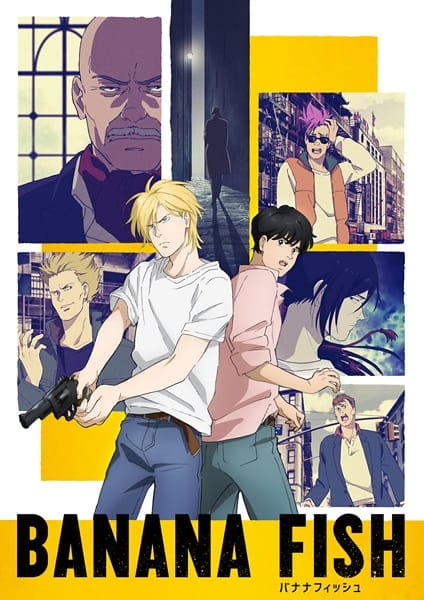
Banana Fish
Is Banana Fish worth watching?
Yes — a standout. Anime Codex rates Banana Fish 8.70 out of 10 — scored on six criteria (story, characters, themes, world-building, animation, and cultural impact), not crowd votes. 14th of 226 on the Codex rubric — top 6% of the catalogue. The Codex rates it Δ +0.25 above its MAL score — more underrated than 92% of the catalogue.
Where to watch
Streaming availability varies by region — check your local services.
Trailer
What the data says
Computed from the Codex rubric across the whole catalogue.
Summary
Banana Fish is one of the most acclaimed and atypical shoujo adaptations, a hard-edged crime thriller that uses a romance-adjacent core to explore trauma, abuse, and the question of whether love can save someone built for survival. Ash Lynx is among the medium's most compelling tragic protagonists, and his bond with Eiji provides genuine tenderness against a brutal backdrop of gang violence and conspiracy. The show excels in emotional resonance and character writing, building relentlessly toward a finale that ranks among anime's most devastating endings. MAPPA's direction is tasteful and character-focused rather than spectacular, serving the story's noir mood well. Its weaknesses are largely structural: the conspiracy plotting can feel rushed and pulpy, the contemporary update introduces minor anachronisms that undercut the source's 1980s logic, and antagonists like Yut-Lung are thinner than the leads deserve. Yet within and beyond its demographic, Banana Fish stands out for refusing to soften its subject matter or offer easy redemption. It treats sexual violence, agency, and grief with seriousness rare for any category, making it a benchmark for shoujo willing to be genuinely dark, mature, and emotionally uncompromising rather than merely romantic.
Criterion breakdown
Story & narrative
Adapting Akimi Yoshida's 1980s manga, the narrative sustains tension across 24 episodes through the Banana Fish drug conspiracy, gang warfare, and Dino's web of corruption reaching into senators and the military. The Shorter Wong betrayal arc and the mid-series Cape Cod imprisonment are gut-wrenching set pieces, though the breakneck plotting occasionally rushes political machinations and leans on convenient escapes. The relocation from the manga's 1980s to a contemporary setting creates minor anachronisms but the core thriller momentum never flags toward its devastating final episode.
Character writing & growth
Ash Lynx is a genuinely tragic protagonist—genius-level intellect and lethal competence layered over deep trauma from sexual abuse, and the writing refuses to let his skills heal him. The Ash–Eiji relationship is the emotional spine: Eiji's gentleness functions as the one space free of exploitation, and the contrast crystallizes in episodes like the library finale. Supporting figures like Shorter and Sing get real interiority, though Yut-Lung's arc feels comparatively underdeveloped.
Themes & emotional resonance
The show interrogates cycles of abuse, the impossibility of escaping a violent past, and whether love can redeem someone conditioned only for survival. Its unflinching treatment of trauma, agency, and the commodification of bodies is rare for any demographic, and the ambiguous tragedy of the ending lands with crushing emotional weight rather than catharsis. Few shoujo works confront violence and exploitation this directly.
World-building & power system
The grimy New York underworld of gangs, the mafia, military experiments, and political corruption is vividly realized and internally consistent as a noir thriller premise. Banana Fish as a mind-control drug is a serviceable MacGuffin rather than a deep system, and the contemporary update strains plausibility around technology and gang structure. The setting depth is strong but the conspiracy mechanics are more pulp than rigorous.
Animation & direction
MAPPA delivers clean, restrained direction that prioritizes character expression and tension over spectacle, with strong use of color and lighting in intimate scenes like the prison and hospital sequences. Action is competent if not flashy, fitting the thriller tone. The understated final shot in the library is a masterclass in directorial economy, though some mid-series episodes show flatter, more functional animation.
Cultural impact
The original manga is a landmark that influenced the BL and shoujo thriller landscape for decades, and the 2018 anime introduced it to a massive new global audience, becoming a fandom phenomenon. Its frank engagement with queerness, trauma, and violence gave it lasting discourse weight well beyond typical shoujo reach.
Synopsis (from MAL)
Aslan Jade Callenreese, known as Ash Lynx, was a runaway picked off the streets of New York City and raised by the infamous godfather of the mafia, Dino Golzine. Now 17 years old and the boss of his own gang, Ash begins investigating the mysterious "Banana Fish"—the same two words his older brother, Griffin, has muttered since his return from the Iraq War. However, his inquiries are hindered when Dino sends his men after Ash at an underground bar he uses as a hideout. At the bar, Skip, Ash's friend, introduces him to Shunichi Ibe and his assistant, Eiji Okumura, who are Japanese photographers reporting on American street gangs. However, their conversation is interrupted when Shorter Wong, one of Ash's allies, calls to warn him about Dino. Soon, Dino's men storm the bar, and in the ensuing chaos kidnap Skip and Eiji. Now, Ash must find a way to rescue them and continue his investigation into Banana Fish, but will his history with the mafia prevent him from succeeding? [Written by MAL Rewrite]
Ranked nearby




Explore rankings
Discussion
Set a display name above to post.
Loading discussion…