Baki Hanma Is the Codex's Most Honest B-Tier: A Show That Knows Exactly What It Is
Netflix's Baki Hanma trilogy doesn't fail because it's stupid — it fails because TMS treats Itagaki's grotesque body-horror as a checklist of fight setups, gutting the only thing that ever made the manga interesting.
Netflix's Baki Hanma trilogy doesn't fail because it's stupid — it fails because TMS treats Itagaki's grotesque body-horror as a checklist of fight setups, gutting the only thing that ever made the manga interesting.
The Pickle arc should have been the moment Baki Hanma transcended its reputation as gym-bro brainrot and became something genuinely strange — a meditation on evolutionary violence, prehistoric memory, and the absurdity of pitting a Tokyo high schooler against a Cretaceous predator. Instead, TMS delivered forty minutes of static close-ups, recycled flashbacks, and a fight choreography so inert that the show's own premise — that this is the apex of martial-arts storytelling — collapses under the weight of its budget. The Codex scores Baki Hanma at a defensible but unflattering tier, and the numbers tell a quieter story than the discourse around the series would suggest.
The Consensus Misreads the Object
MyAnimeList puts Baki Hanma somewhere in the mid-7s — a score that flatters the production while papering over the structural failures of the adaptation. The Wikipedia page pulls a modest 481 monthly views, which positions the series well outside the cultural conversation occupied by current shonen tentpoles. Reddit's weekly top posts this cycle contain zero Baki Hanma entries. The show is, in measurable terms, a long-tail catalogue title — watched, occasionally meme'd, rarely defended in writing. That long-tail position is itself the critical fact: Baki Hanma is not a show people argue about. It's a show people consume between seasons of things they actually care about.
The consensus reading — that Baki is "so dumb it's brilliant," that its excess is the point, that critique misses the joke — is a defensive posture, not an argument. Itagaki's manga has always been operating in deliberate camp register, and a serious adaptation would lean into the surrealism Keisuke Itagaki encodes into every panel: the impossible musculature, the demon-back, the prison-break choreography that reads like a Renaissance fresco of violence. TMS leans away. The Netflix run is competent television about a manga that demanded incompetent television — wild, broken, formally unhinged.
TMS Animates the Wrong Layer
Toshiki Hirano's direction across the Baki Hanma seasons treats fight scenes as information delivery rather than physical event. When Yujiro arrives — and the entire trilogy is structured as a runway to the father-son fight — the camera language never escalates. Compare this to what Madhouse pulled off with the Maximum Tournament in the 2001 Baki the Grappler series, where even on a tighter budget the fights had real spatial geography. Hirano's Hanma-era Baki shoots impact like a soap opera shoots dialogue: cut to face, cut to face, cut to wide, cut to face. The Pickle fight should have been the most kinetic sequence in the franchise. It plays like a clip show.
The animation criterion is where the Codex is most unforgiving, and rightly so. This is the Netflix era of TMS, the same studio capable of the Dr. Stone production — and the contrast inside a single studio's roster is the indictment. Resources went elsewhere. Baki Hanma got the leftover key animators and a compositing pipeline that flattens every punch into the same mid-frequency thud. The sakuga ceiling of the entire trilogy is maybe two cuts in the Yujiro fight. That's not enough for a show whose entire reason for existing is choreographed violence.
The Themes Criterion Is Where the Show Actually Has a Case
Here the Codex is more generous than the production deserves, because Itagaki's source material is doing something most martial-arts shonen never attempt: a sustained argument about inheritance, masculinity, and the obsolescence of physical dominance in a civilized world. Yujiro Hanma is not a villain. He is a thesis — that pure strength, decoupled from social context, becomes its own moral order. Baki's pursuit of his father is Oedipal in the most literal sense available to the genre. The dinner scene in the finale, where Yujiro and Baki eat together before fighting, is one of the strangest beats in modern shonen — it earns the comparison to Vagabond's quieter chapters, even if the adaptation undersells it.
This is where the show diverges from something like the structurally rigorous shonen argumentation of Fullmetal Alchemist: Brotherhood, which earns its themes through plot architecture. Baki earns its themes through repetition and obsession — a less elegant method, but a real one. The problem is that TMS films the repetition without the obsession. The camera doesn't believe in Yujiro the way Itagaki's pen does.
Worldbuilding by Assertion, Not Construction
The Underground Arena, the Pickle excavation, the Chinese kenpo lineage Retsu represents — Itagaki gestures at a vast subterranean ecosystem of fighters, financiers, and pseudo-scientific institutions, but the worldbuilding is almost entirely told rather than built. There are no economic stakes. There are no political consequences. Tokyo continues to function while men with biceps the size of compact cars beat each other in basements.
This is the criterion where Baki Hanma scores lowest in the Codex rubric, and it's the gap that separates the series from the genre's actual world-builders. The contrast with what Togashi constructed underneath Hunter × Hunter is almost embarrassing — and that's a fair comparison, because both shows are nominally about combat tournaments that expand into something larger. Togashi's expansion is architectural. Itagaki's expansion is anecdotal. Pickle exists because Itagaki wanted to draw a caveman. That's the entire worldbuilding logic.
The Counter: This Was Never Supposed to Be Serious
The strongest defense of Baki Hanma is that the Codex is applying the wrong rubric — that this is genre exercise, not literature, and grading it against the seinen architectures of Vinland Saga's pacifist argument is a category error. The show is camp. The show is meant to be camp. Hanayama tearing his own palm open to grip a sword better is funny, and meant to be funny, and demanding thematic rigor of a Baki adaptation is missing the joke.
The rubric accommodates this. The cultural-impact and character criteria both give Baki real credit for the iconography Itagaki built — Yujiro's silhouette is one of the most recognizable in the medium, and the Hanma stare has become shorthand far outside the show's actual viewership. But camp requires conviction, and TMS's adaptation is too tasteful, too measured, too Netflix-formatted to commit. The manga commits. The anime hedges. A camp adaptation that hedges isn't camp — it's just thin.
Verdict
Baki Hanma lands where the Codex places it because the rubric measures execution, not premise, and TMS executed a B-tier action show from A-tier source material. The trilogy is watchable, occasionally striking, and structurally inert — a long-tail title for a reason. Itagaki deserved a director who understood that excess is a discipline.
Featured in the Codex
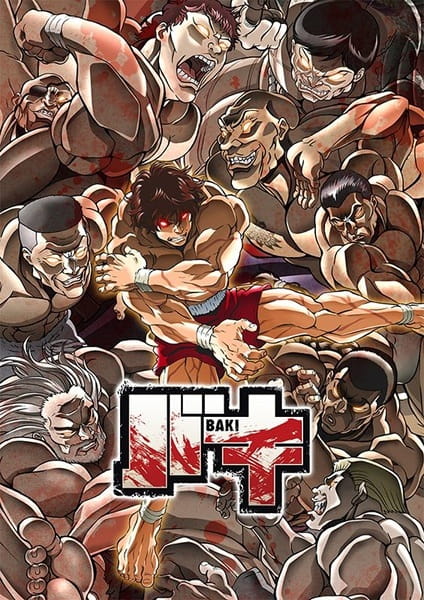



More from The Codex
The Seven Deadly Sins Is a 6.60 Wearing a 7.60 Costume: A One-Point Gap Earned by Groping Gags and Convenient Flashbacks
The Seven Deadly Sins scores 6.60 on the Codex against MyAnimeList's 7.60 because the crowd is grading a Netflix breakout and a Ban-and-King friendship, not the 24 episodes A-1 Pictures actually broadcast in 2014.
The 10.0 That Built a Sunday: How Sazae-san's Cultural Score Carries a 6.58 Scorecard
Sazae-san is a case study in how a single criterion — cultural — can define how a show is remembered, and the 10.0 the Codex hands Eiken's 1969 institution is doing every bit of the heavy lifting its other five scores refuse to.
The Sebastian Problem: Why Black Butler Sits 1.10 Below Its MAL Line and the Crowd Refuses to Notice
Black Butler (Kuroshitsuji) posts a 1.10-point gap between MyAnimeList's 7.65 and the Codex 6.55 because the crowd is grading Sebastian's silhouette and a Phantomhive aesthetic, not the anime-original finale A-1 Pictures actually shipped in 2009.
Discussion
Set a display name above to post.
Loading discussion…