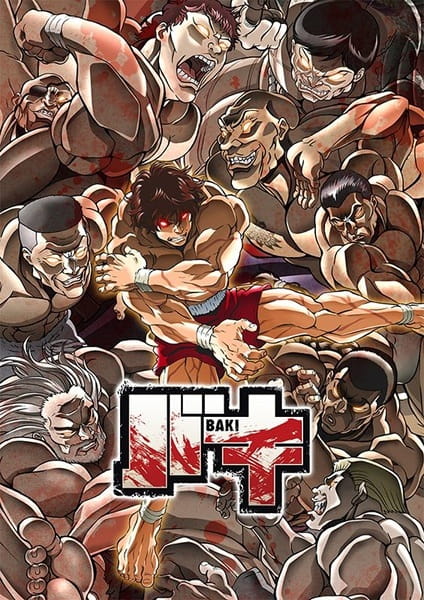
Baki the Grappler
Is Baki the Grappler worth watching?
Mixed — depends what you want. Anime Codex rates Baki the Grappler 5.73 out of 10 — scored on six criteria (story, characters, themes, world-building, animation, and cultural impact), not crowd votes. 218th of 226 on the Codex rubric — bottom 5% of the catalogue. The crowd rates it 1.58 higher than the rubric does — the Codex is harder on it than on 92% of the catalogue.
Where to watch
Trailer
What the data says
Computed from the Codex rubric across the whole catalogue.
Summary
Baki (2018) is pure martial-arts spectacle that knows exactly what it is: a parade of grotesquely muscled fighters testing themselves in increasingly absurd, ultraviolent duels. Its strength lies in distinctiveness—no magic or ki, just hyperbolic human bodies—and in memorable antagonists like the death-row convicts Doyle, Spec, and Sikorsky, who arrive in Tokyo hungry to finally taste defeat. Standout bouts (Hanayama's brawls, Kaiou Retsu's resilience) deliver the brutal, over-the-top thrills the franchise is known for. Yet within shonen, it falls short of the best. The narrative is episodic and ends mid-journey without confronting Baki's true goal against his father Yuujirou, and Baki himself barely grows, often overshadowed by his supporting cast. Thematically it celebrates strength and violence more than it examines them, and TMS's animation is functional rather than dazzling, with stiff motion and budget inconsistencies undercutting its most savage moments. It is a reliable, testosterone-soaked guilty pleasure with a genuinely unique premise and strong cult appeal, but its thin plotting, static protagonist, and shallow emotional depth keep it firmly in the 'good but flawed' tier rather than among shonen's elite.
Criterion breakdown
Story & narrative
The Most Evil Death Row Convicts arc has a strong hook—five elite criminals converging on Tokyo seeking the taste of defeat—but the narrative is episodic to a fault, functioning as a string of duels (Doyle vs. Hanayama, Sikorsky's escape, Spec) rather than a building plot. The Yanagi poison-fist subplot and the Kaiou Retsu hospital sequence add stakes, but the saga ends without resolving Baki's central goal against Yuujirou, leaving it feeling like setup. Tension is consistent within fights, yet the overarching throughline is thin.
Character writing & growth
Baki himself stagnates; he is already near-peak and learns little beyond reaffirming his resolve, so his growth is minimal across 26 episodes. The convicts (Doyle, Spec, Sikorsky, Dorian) are memorable as concepts but are villains-of-the-week with shallow interiority. Side fighters like Hanayama, Kaiou Retsu, and Shibukawa carry more charisma than the protagonist, and Yuujirou looms effectively, but emotional arcs are sacrificed for spectacle.
Themes & emotional resonance
Baki gestures at themes of strength, the warrior's compulsion to fight, and what it means to crave defeat, embodied in the convicts' shared death wish. However, it rarely interrogates these ideas with depth—violence is celebrated more than examined, and the show leans on machismo and shock (torture, dirty tactics) rather than genuine emotional resonance. It works as visceral spectacle more than meaningful commentary.
World-building & power system
The underground martial-arts world with figures like Tokugawa orchestrating events gives a distinct setting, and the 'no power system, just exaggerated human bodies' premise is its signature appeal. Itagaki's pseudo-scientific musculature, named techniques, and absurd physical feats are internally consistent in their own logic. It loses points because the worldbuilding rarely expands beyond a venue for the next fight.
Animation & direction
TMS delivers serviceable but inconsistent visuals; the exaggerated muscle anatomy and impact frames land in key bouts like Hanayama vs. Doyle, but motion is often stiff with noticeable reuse and budget dips. Color and gore are committed, yet the direction lacks the kinetic flair of top-tier action anime, and some fights resolve too statically for the brutality being depicted.
Cultural impact
Baki is a long-running franchise pillar dating to Itagaki's 1990s manga, and this 2018 Netflix-distributed series broadened its global audience considerably. It remains a cult touchstone for hardcore martial-arts and 'manliness' fans and spawned memes, though it sits well below shonen icons in mainstream reach and influence.
Synopsis (from MAL)
After emerging victorious from a brutal underground tournament, Baki Hanma continues on his path to defeat his father, Yuujirou, the strongest man in the world. However, he gets no time to rest when the tournament runner, Tokugawa Mitsunari, visits him at school. He reveals to Baki that five incredibly dangerous death row inmates from around the world—all skilled in martial arts—have simultaneously escaped confinement and are heading to Tokyo, each wishing to finally know the taste of defeat. Tokugawa warns that, due to his well-known strength, Baki is bound to encounter them sooner or later, and he will not be their only target. Adapting the first saga of the second manga series, Baki centers on the all-out war between the esteemed martial artists of Japan and those of the dark underground world. [Written by MAL Rewrite]
Ranked nearby


Explore rankings
Discussion
Set a display name above to post.
Loading discussion…