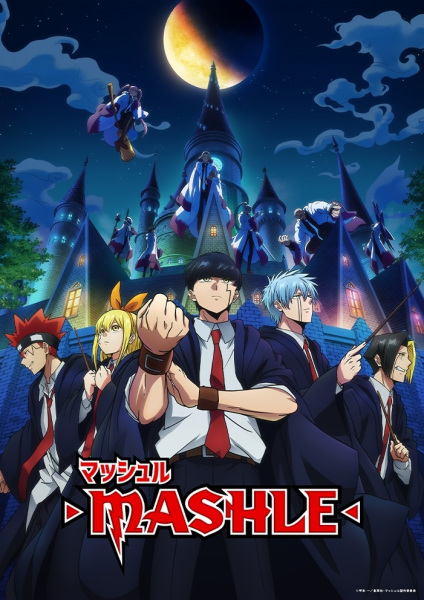
Mashle: Magic and Muscles
Is Mashle: Magic and Muscles worth watching?
Mixed — depends what you want. Anime Codex rates Mashle: Magic and Muscles 5.63 out of 10 — scored on six criteria (story, characters, themes, world-building, animation, and cultural impact), not crowd votes. 221st of 226 on the Codex rubric — bottom 3% of the catalogue. The crowd rates it 1.98 higher than the rubric does — the Codex is harder on it than on 99% of the catalogue.
Where to watch
Trailer
What the data says
Computed from the Codex rubric across the whole catalogue.
Summary
Mashle is a brisk, competently produced parody that mashes a Harry Potter-style magic academy with a Saitama-style invincible protagonist, mining most of its appeal from the gag of a magicless meathead punching through a rigid caste society. A-1's animation is clean and the comedic timing—deadpan delivery against dramatic scoring—lands more often than not, making it an easy, entertaining watch. Within shonen, however, it sits comfortably below the genre's best. Its formulaic episodic structure removes nearly all tension because Mash never faces a problem his fists can't solve, and his complete lack of character growth keeps him an amusing but static figure. The supporting cast are quick archetypes, and the genuinely interesting premise—a society that exterminates the powerless—is treated as background flavor rather than a theme worth exploring, leaving the show emotionally weightless. It excels as comedy and spectacle but rarely aspires beyond that. Its largest cultural footprint came from the season two opening rather than the story itself. Judged against strong Jump comedy-action peers, Mashle is enjoyable and well-crafted yet narratively thin: a fun, disposable pastiche that prioritizes the joke over depth, satire, or stakes.
Criterion breakdown
Story & narrative
Season 1 follows a deliberately formulaic shonen-academy structure—Mash enrolls at Easton, climbs the ranks toward Divine Visionary status, and clears episodic challenges like the magic-broom flying test and the dungeon arc against Dot and Lemon. The narrative's primary function is to set up gags rather than build genuine stakes, and the predictable 'Mash punches the problem' resolution drains tension from nearly every confrontation. It moves briskly and competently but offers little structural ambition or surprise within the genre.
Character writing & growth
Mash is a one-note Saitama-derived protagonist whose deadpan obsession with cream puffs is amusing but static—he experiences essentially zero internal growth across twelve episodes. Supporting cast like the prideful Lance Crown, insecure Finn, and rival Dot Barrett are functional foils given quick redemption beats, but none receive the depth that elevates better Jump ensembles. The writing leans on archetype and running gags rather than meaningful arcs.
Themes & emotional resonance
The premise carries a pointed message about a discriminatory society that exterminates the magicless, and Mash literally embodying merit-through-effort over inherited privilege has real satirical potential. However, the show rarely commits to this theme with weight, undercutting any emotional resonance with comedy so that the persecution backdrop feels decorative rather than examined. It gestures at class and ability critique without earning genuine pathos.
World-building & power system
The Harry Potter pastiche of Easton Academy with wands, houses, and lines on the face denoting magical caste is derivative but functional, and the central inversion—a power system the hero entirely bypasses with brute strength—is the show's cleverest idea. The exterminate-the-magicless premise hints at a darker internal logic that's never fully explored, leaving worldbuilding shallow despite its strong comedic hook. Originality lives in the gag, not the setting.
Animation & direction
A-1 Pictures delivers clean, fluid action with strong comedic timing—Mash's absurd feats like crushing golems and the broom race are rendered with satisfying impact and exaggerated physical comedy. Direction sells the deadpan humor through well-paced reaction shots and dramatic music cues that intentionally clash with the silly payoffs. It's polished and consistently watchable, if not visually distinctive among A-1's top output.
Cultural impact
The show found a sizable audience and a memetic foothold, with its opening 'Bling-Bang-Bang-Born' by Creepy Nuts becoming a genuine viral dance phenomenon that vastly outgrew the anime itself. As a Jump title it carries name recognition and a solid fanbase, but its impact rests more on that musical moment than on narrative influence within the genre.
Synopsis (from MAL)
In this magical world, one is easily identified as having magical abilities by a distinctive mark on their face. Those unable to practice magic are swiftly exterminated to maintain the magical integrity of society. However, deep within a forest lies an anomaly in Mash Burnedead, who can be found pumping iron with one arm and lifting a cream puff with the other. This aloof boy with superhuman strength—but no magical abilities—leads a quiet life with his father, far removed from society. Mash's peace is soon disturbed when the authorities discover his lack of magical powers. They issue him an ultimatum: compete to become a Divine Visionary, which would force everyone to accept him, or be persecuted forever. To protect his family, he enrolls in the prestigious Easton Magic Academy, which only the most elite and gifted students are allowed to attend. Now, Mash must overcome his shortcomings as a magic-less being and surpass the other students—relying solely on his muscles. [Written by MAL Rewrite]
Ranked nearby

Explore rankings
Discussion
Set a display name above to post.
Loading discussion…