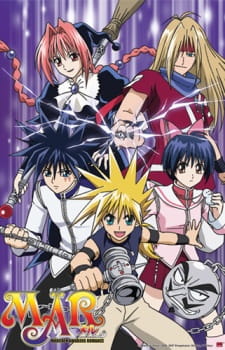
MÄR (Märchen Awakens Romance)
Is MÄR (Märchen Awakens Romance) worth watching?
Mixed — depends what you want. Anime Codex rates MÄR (Märchen Awakens Romance) 5.93 out of 10 — scored on six criteria (story, characters, themes, world-building, animation, and cultural impact), not crowd votes. 214th of 226 on the Codex rubric — bottom 6% of the catalogue. The crowd rates it 1.37 higher than the rubric does — the Codex is harder on it than on 88% of the catalogue.
Where to watch
Streaming availability varies by region — check your local services.
What the data says
Computed from the Codex rubric across the whole catalogue.
Summary
MÄR is a competent, comfortably mid-tier battle shonen that distinguishes itself primarily through its ÄRM power system — magical weapons spanning Nature, Guardian, and Darkness types — and the charming talking-mace mentor Babbo. Its War Games tournament structure delivers reliable escalation and gives supporting characters like Alviss, Dorothy, and Nanashi room for spotlight matches, with the Snow/Koyuki dual-identity reveal serving as its emotional high point. The fairy-tale-flavored world and chess-themed antagonist hierarchy lend the setting a pleasant identity within Shonen Sunday conventions. Its weaknesses are significant for the format: at 102 episodes, the adaptation outpaced the manga and resorted to padding, diluting pacing and stakes in its second half. SynergySP's budget-constrained animation relies on reused cuts and stiff battle choreography, and the thematic content — believing in dreams, friendship, the cost of war — stays firmly within familiar territory without transcending it. Ginta is a likable but archetypal lead. Judged against the best of battle shonen, MÄR is solidly enjoyable comfort viewing with one genuinely inventive system and a handful of strong character beats, held back by length-induced bloat and modest production values rather than any fundamental conceptual failure.
Criterion breakdown
Story & narrative
MÄR's central conceit — the War Games, a tournament structured as a series of one-on-one battles between the Cross Guard and the Chess Pieces — gives the show a clean, escalating spine that works well for its target audience. However, the narrative drags considerably in its second half, where SynergySP padded the adaptation with anime-original arcs after catching up to Anzai Nobuyuki's manga, diluting momentum and softening the manga's darker resolution. The Ginta-versus-Phantom and the Snow/Koyuki revelations provide genuine stakes, but the tournament's repetitive bracket structure becomes predictable.
Character writing & growth
Ginta is a serviceable but archetypal shonen lead whose arrival-from-our-world wish-fulfillment angle is well-executed early on, and Babbo's comedic mentor dynamic adds personality. Supporting cast like Jack, Dorothy, Alviss, and Nanashi get individual spotlight matches that reveal backstory, but growth is uneven — Alviss's trauma with Phantom is the strongest thread, while many Chess Pieces remain one-note villains defined by a single gimmick. The Snow/Koyuki dual-identity twist is the most emotionally invested arc of character writing.
Themes & emotional resonance
The show leans on familiar themes of believing in dreams, friendship, and the cost of war, fitting comfortably within Shonen Sunday conventions but rarely transcending them. Ginta's outsider-who-believes framing and the recurring fairy-tale (Märchen) motif give it a gentle thematic charm, and Alviss's guilt over being a Phantom pawn carries real weight. Still, the emotional resonance is blunted by the padded pacing and a tendency toward tidy, low-stakes resolutions in the latter half.
World-building & power system
The ÄRM system — magical weapons divided into Nature, Weapon, Guardian, Dimensional, and the rare Darkness ÄRMs — is the show's most distinctive feature, offering varied, creative matchups beyond simple strength escalation, and the talking ÄRM Babbo is a clever original hook. MÄR Heaven's fairy-tale-inspired geography and the chess-themed antagonist hierarchy give the setting a coherent identity. Internal consistency is decent, though the ÄRM rarity tiers sometimes function as convenient plot escalators rather than rigorously defined rules.
Animation & direction
SynergySP's production is functional but visibly budget-limited, with flat color work, frequent reused animation in battle sequences, and stiff motion during ÄRM clashes. The 102-episode length stretched resources thin, and the anime-original padding shows in particularly static stretches. Character designs faithfully adapt Anzai's manga, but the direction rarely elevates the choreography beyond standard mid-2000s TV-anime fare.
Cultural impact
MÄR enjoyed moderate visibility through its Shonen Sunday serialization, a Nintendo DS/GBA game tie-in, and an English dub that aired on broadcast, giving it some Western recognition during the mid-2000s shonen wave. However, it never achieved lasting cult status and is largely overshadowed by contemporaries; its legacy is mostly as a competent example of Anzai's work following Flame of Recca. Today it is remembered fondly but seldom discussed as influential.
Synopsis (from MAL)
Dreaming of a magical world every night, the young Toramizu Ginta yearns to be able to go there. With only his friend Koyuki believing in his dreams, Ginta remains positive despite the slander he receives from others over his dreams. But his wishes are answered, as one day a large door appears in front of Ginta, summoning him to the land of MAR Heaven. In this land, the weapons known as ARMS exist. While initially Ginta greatly enjoyed the discovery of this magical world, he soon learns of the terrible wars that have once plagued MAR Heaven and the upcoming war that may soon appear.
Ranked nearby
Explore rankings
Discussion
Set a display name above to post.
Loading discussion…