Is The Heroic Legend of Arslan Overrated? A 6.93 That Rides Persian Aesthetics and a Silver Mask Into Numbers the Second Season Won't Defend
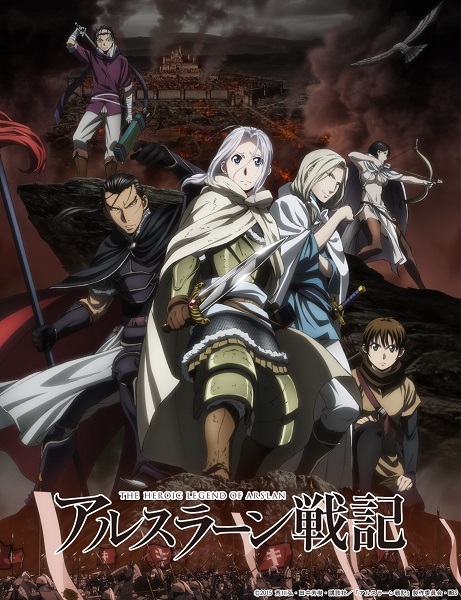
The Heroic Legend of Arslan posts a 0.72-point gap between MyAnimeList's 7.65 and the Codex 6.93 because the crowd is grading Achaemenid production design and a novelist's pedigree, not the rushed 25-episode adaptation LIDENFILMS actually shipped.
The Heroic Legend of Arslan posts a 0.72-point gap between MyAnimeList's 7.65 and the Codex 6.93 because the crowd is grading Achaemenid production design and a novelist's pedigree, not the rushed 25-episode adaptation LIDENFILMS actually shipped.
The betrayal at Atropatene is the best hour of television Arslan has to offer, and it happens before the show has earned the right to spend it. Everything after — the flight from Ecbatana, the slow assembly of Narsus's cabinet, the promise of Hermes behind the silver mask — is running on the credit that opening bought, and the animation ledger runs out well before the final siege.
Where the crowd is right, and where it stops looking
MyAnimeList's 7.65 is not a hallucinated number. It reflects real virtues: Yoshiki Tanaka's source material is genuinely denser than most shonen war fantasy, Hiromu Arakawa's character designs carry brand equity from Fullmetal Alchemist, and the Persian-inspired setting is the rarest thing in the demographic — a fantasy world that isn't a stitched-together medieval Europe or a feudal Japan pastiche. The question is not whether Arslan is competent. The Codex has it at 6.93, which is competent. The question is what the 0.72-point gap is being spent on, and the answer is the same answer that shows up in Kingdom's rubric and in most historically-flavored war epics the community grades generously: prestige of premise is being scored as delivery of premise.
The gap between The Heroic Legend of Arslan's reputation and its rubric score is the story. Name what the crowd is rewarding that the rubric won't.
The story opens like an epic and finishes like a summary
Story lands at 7.0, and it earns every tenth of that in the first half. Atropatene is a proper war-of-succession opening — an ambush, a betrayal by Kharlan, a capital that falls because of internal rot rather than external strength. The Hermes subplot, in which the Silver Mask claims Arslan's legitimacy is forged, is exactly the kind of dynastic knife the political framework needs. It is not a hero-versus-villain premise; it is a claim-versus-claim premise, and that's a harder, better shape.
Then the adaptation runs out of runway. The 25-episode structure — the first 25-episode run being what the Codex is grading here — noticeably loses momentum in its back half, and the second season's material is compressed to the point where multiple siege engagements blur into each other without a satisfying resolution to any of them. Hermes is given a motivation the adaptation never fully cashes. Arslan reclaims narrative territory without reclaiming his throne. A war epic that opens on the fall of a capital owes the viewer the capital back, or an honest reckoning with why it isn't coming, and Arslan delivers neither.
The animation is the weakest pillar, and it fails in exactly the wrong place
Animation scores 6.0 — the lowest number on the card, and the one that most cleanly explains the delta with the crowd. The problem is not the character art, which is handsome, or the individual duels, which are staged with real weight, particularly Daryun's set pieces. The problem is that Arslan is a show about armies, and the CGI armies are stiff and weightless. The infantry blocks look like painted models being nudged across a diorama. Cavalry charges lose momentum the moment the camera pulls back to establish scale. This is a war epic whose most important shots — the wide ones — are its worst.
The hybrid pipeline reads as a compromise between what the show wanted to be and what the budget would sustain. Costume design and Ecbatana's architecture impress in still frames; the moment three hundred soldiers need to move in unison, the frame flattens. Compare this to Kingdom's early Studio Pierrot CGI, which has the same problem for the same structural reason: a novelist's-scale war on a TV animator's budget. The rubric doesn't grade intent. It grades what's on the screen during the siege.
The characters carry weight the themes never fully cash
Character posts the highest non-world score on the card at 7.2, and the supporting cast is where the show is actually best. Narsus's strategic arrogance is written with the confidence of a writer who trusts the audience to find him funny without underlining it. Daryun's loyalty is stoic without being wooden. Gieve and Farangis give the retinue a lighter register that the political material needs. Etoile is the show's cleanest thematic device — a Lusitanian believer whose faith is not caricatured, whose clashes with Arslan force the abolitionist prince to defend his own liberalism rather than simply enact it.
Arslan himself grows credibly. His confrontation with Kharlan works because he arrives at moral clarity through argument, not epiphany. His clashes with Andragoras are the show at its most politically alive — a son whose ethics are legible only against the father whose empire built them.
Themes score 7.0, and the ceiling is set by the same problem the story has: the show raises kingship, religious fanaticism, and the ethics of slavery, and then retreats to a battle before the emotional weight of any of it lands. Lusitania's monotheism versus Parsian polytheism is a genuine crusade analogue, textured enough to be uncomfortable, and the adaptation keeps flinching from the discomfort. A show that wants to be about whether Arslan should be king cannot keep cutting to whether Arslan can win the next engagement.
World-building is the one number the crowd actually undersells
World lands at 7.5, and it's the score that most deserves its place. Pars, drawn from Achaemenid and Sassanid aesthetics, is a genuine departure from a demographic that defaults to quasi-European fantasy on autopilot. The religious and political conflicts feel internally consistent. Tanaka's homework shows in the specificity of court ritual, in the distinction between Parsian and Lusitanian military doctrine, in the way slavery is embedded into the economy rather than dropped in as a plot device. The wider geography stays vague — the map beyond Pars is more gesture than terrain — but within its own borders, this is a fully imagined kingdom.
The counter-argument: pedigree is a real criterion, just not this one
The strongest defense of the 7.65 is that Arslan is graded, correctly, as a prestige adaptation — Tanaka's novels are a serious literary object, Arakawa's manga is a serious commercial one, and the anime inherits both. That's a legitimate lens. It's also what the Codex scores as cultural impact, and cultural comes in at 6.0. The rushed second season and unfinished story dampened staying power in exactly the way a prestige adaptation cannot afford. Arslan is fondly regarded as competent historical fantasy, not as a genre-defining work, and the numbers reflect that honestly. Pedigree earns the audition; delivery earns the score.
The 6.93 is what happens when you grade the show that aired instead of the novels it came from. That is the entire disagreement, and the Codex is comfortable with it.
Featured in the Codex




More from The Codex
The Seven Deadly Sins Is a 6.60 Wearing a 7.60 Costume: A One-Point Gap Earned by Groping Gags and Convenient Flashbacks
The Seven Deadly Sins scores 6.60 on the Codex against MyAnimeList's 7.60 because the crowd is grading a Netflix breakout and a Ban-and-King friendship, not the 24 episodes A-1 Pictures actually broadcast in 2014.
The 10.0 That Built a Sunday: How Sazae-san's Cultural Score Carries a 6.58 Scorecard
Sazae-san is a case study in how a single criterion — cultural — can define how a show is remembered, and the 10.0 the Codex hands Eiken's 1969 institution is doing every bit of the heavy lifting its other five scores refuse to.
The Sebastian Problem: Why Black Butler Sits 1.10 Below Its MAL Line and the Crowd Refuses to Notice
Black Butler (Kuroshitsuji) posts a 1.10-point gap between MyAnimeList's 7.65 and the Codex 6.55 because the crowd is grading Sebastian's silhouette and a Phantomhive aesthetic, not the anime-original finale A-1 Pictures actually shipped in 2009.
Discussion
Set a display name above to post.
Loading discussion…