Is Kingdom Overrated? A 6.98 That Rides Warring States Politics Into Numbers Studio Pierrot's 2012 CGI Won't Defend
Kingdom scores 6.98 on the Codex against MyAnimeList's 7.86 — a 0.88-point gap that names exactly what the crowd is rewarding and what the rubric refuses to grade past.
Kingdom scores 6.98 on the Codex against MyAnimeList's 7.86 — a 0.88-point gap that names exactly what the crowd is rewarding and what the rubric refuses to grade past.
The question of whether Kingdom is overrated resolves faster than most because the crowd and the rubric agree on what the show is doing well. They disagree about whether one criterion — the plasticky CGI armies Studio Pierrot deployed in 2012 — is allowed to matter. The Codex says it is. Eighty-eight hundredths of a point of disagreement is the price of that argument.
The Consensus Is Grading Ambition, Not Execution
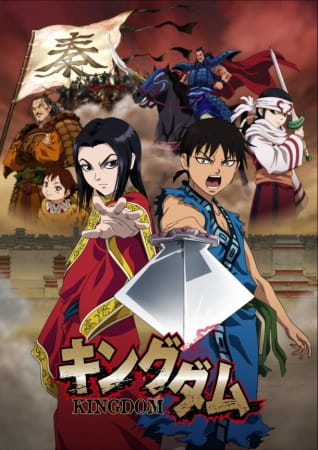
MyAnimeList has this 38-episode 2012 adaptation at 7.86. Anime Codex has it at 6.98. That gap is not the usual mystery. Kingdom's consensus reputation is built on the thing the show genuinely does best — a Warring States political thriller in a demographic that almost never delivers one — and on the assumption that reaching for scale should count almost as much as achieving it. The MAL score reads like a grade for scope: seven kingdoms, real Qin history, generals with actual strategic logic, a war orphan and a contested king carrying a unification arc across a manga that has since crossed 120 million volumes in circulation.
The rubric grants most of that. World-building lands at 8.0, which is the highest single number on the scorecard and the reason the show clears seven at all. The problem is that a seinen historical war epic weights animation heavily, and the animation criterion here sits at 4.5. That is not a bad score. It is a critical score — the kind that pulls a rising tide back into the average. The gap between Kingdom's reputation and its rubric number is the story of one criterion the crowd waves through and the rubric will not.
The Warring States Setting Is Doing Almost All the Work
Start with what earns the 8.0. Hara's map is not decorative. The seven states, the internal politics of Qin, the mechanics of general-tier warfare with figures like Wang Yi standing in as strategic archetypes — this is a functioning political system rendered with the discipline you get from a creator who actually researched his period. The military hierarchy operates as the show's power system, and it does so more coherently than most shonen power systems built from scratch. When the Coalition Invasion arc arrives late in this first cour, the geopolitics have been laid in carefully enough that the stakes register without a lore dump.
That world-building carries the story score to 7.5. The opening palace coup structurally sets up the Battle of Bayou, and Xin's alliance with Yang Duan He and the mountain people pays off political groundwork with real tactical consequence. Naruhisa Arakawa's series composition compresses Hara's manga efficiently — that's a real skill, and it's under-credited when we talk about early-run adaptations. But even inside the story score, the cracks are visible. Transitional episodes sag. Battles too often resolve through a strategic reveal that the audience wasn't given the pieces to anticipate, which is the seinen war-drama equivalent of a shonen power-up: satisfying in the moment, corrosive to the tension model over 38 episodes.
The 4.5 Animation Score Is Load-Bearing Criticism
This is where the crowd looks away and the rubric doesn't. Studio Pierrot's decision to render crowd and battle scenes in early-2012 CGI — stiff, low-polygon, poorly integrated with the 2D character animation — is not a matter of aesthetic taste that softens with nostalgia. It is a structural failure in a show whose entire narrative promise is large-scale warfare. The Bayou engagement is the clearest indictment: the direction during the assault relies on wide shots of armies that read as plastic figurines shuffling, and every time the camera pulls out to sell scale, the scale collapses. Only the quieter dialogue scenes, where the 2D character work isn't fighting the CG, hold up.
This is the same criterion problem that recurs across the Codex. Fist of the North Star's 0.94-point MAL-Codex gap is partly Toei corner-cutting the crowd forgives. Kingdom's 0.88 is Pierrot's CG the crowd has trained itself to see past. The rubric will not train itself past it. A seinen war drama that cannot show you the war is being graded on what it aired, not what its later seasons — with Studio Signpost eventually sharing production duties from season three onward — would eventually salvage.
Character Depth Is Front-Loaded and the Cast Knows It
Character lands at 7.0, and that number is doing polite work. Xin's arc from war orphan to Hi Shin Unit commander is the spine, and it's a satisfying spine — Piao's death frames the whole run and gives Xin's motivational engine real weight. Ying Zheng's half of the show is the stronger half; his confrontation with his half-brother Cheng Jiao is the political drama at its sharpest, and the calculated ambition of the young king reads as adult in a way Xin often doesn't.
The problem is durability. Xin spends long stretches locked into a single volume setting — loud, forward, undifferentiated — and the side cast the show introduces with intrigue, Ten and Kyoukai chief among them, don't get the runway they need in 38 episodes. Their development is deferred to later seasons, which means the 2012 adaptation is grading itself on IOUs. The Codex only scores what aired. This is a familiar problem across long-running seinen and shonen alike — Naruto's Codex 7.28 is dragged by the same trick, where the crowd credits a character arc the aired product hasn't finished paying for.
Themes Retreat Into Speeches Rather Than Sit With the Cost
The 7.0 on themes tells the honest version of Kingdom's philosophical project. The material is there: the dream of unifying China as inherited burden, Piao's death as the founding wound, merit versus birthright dramatized through Xin's slave origins running parallel to Zheng's contested throne. That is a real thematic architecture, and it puts Kingdom above the seinen average on ambition.
But the show flinches from its own subject. Kingdom is about the cost of constant warfare, and its default rhetorical move at the climax of a battle is a rousing motivational speech from Xin or a commander. The show wants the emotional payoff of war without sitting inside the moral cost, and it repeatedly retreats to shonen-adjacent inspirational cadence when the seinen framing demands it hold still. The scenes where it does hold still — Zheng's cold political calculation, the quiet aftermath of Bayou — are why the score is 7.0 and not 6.0.
The Steelman: The Manga Is a Masterpiece and the Adaptation Is a Loyal Vessel
The strongest defense of the 7.86 is that Kingdom the property is genuinely great, and this anime is the doorway. The Tezuka Award-winning manga is one of the best long-form historical works in the medium. The live-action films have been commercial events. Later seasons of the anime, once the CG toolchain matured and Studio Signpost joined the production, deliver on battles this 2012 season could only gesture at. The crowd is scoring the doorway generously because the room beyond it is real.
The rubric's answer is that a doorway is not the room. The Codex grades this entry — Studio Pierrot, 2012, 38 episodes — and by that constraint the animation cost is not amortized across six seasons. It is charged in full to the season that shipped it.
Kingdom is not a bad show. It is a genuinely strong political-war drama trapped in a 2012 production pipeline that couldn't render its own premise, carrying a 4.5 animation score into a genre that weights animation heavily. The 6.98 is the honest number. The 7.86 is a promise the manga keeps and the first anime season doesn't.
Featured in the Codex





More from The Codex
The Seven Deadly Sins Is a 6.60 Wearing a 7.60 Costume: A One-Point Gap Earned by Groping Gags and Convenient Flashbacks
The Seven Deadly Sins scores 6.60 on the Codex against MyAnimeList's 7.60 because the crowd is grading a Netflix breakout and a Ban-and-King friendship, not the 24 episodes A-1 Pictures actually broadcast in 2014.
The 10.0 That Built a Sunday: How Sazae-san's Cultural Score Carries a 6.58 Scorecard
Sazae-san is a case study in how a single criterion — cultural — can define how a show is remembered, and the 10.0 the Codex hands Eiken's 1969 institution is doing every bit of the heavy lifting its other five scores refuse to.
The Sebastian Problem: Why Black Butler Sits 1.10 Below Its MAL Line and the Crowd Refuses to Notice
Black Butler (Kuroshitsuji) posts a 1.10-point gap between MyAnimeList's 7.65 and the Codex 6.55 because the crowd is grading Sebastian's silhouette and a Phantomhive aesthetic, not the anime-original finale A-1 Pictures actually shipped in 2009.
Discussion
Set a display name above to post.
Loading discussion…