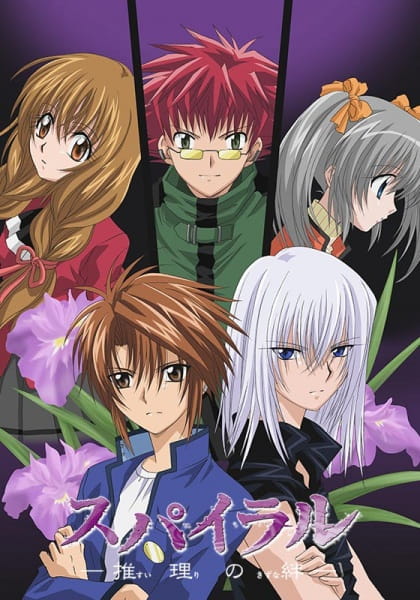
Spiral: The Bonds of Reasoning
Is Spiral: The Bonds of Reasoning worth watching?
Mixed — depends what you want. Anime Codex rates Spiral: The Bonds of Reasoning 6.05 out of 10 — scored on six criteria (story, characters, themes, world-building, animation, and cultural impact), not crowd votes. 205th of 226 on the Codex rubric — bottom 10% of the catalogue. The crowd rates it 1.20 higher than the rubric does — the Codex is harder on it than on 81% of the catalogue.
Where to watch
Streaming availability varies by region — check your local services.
What the data says
Computed from the Codex rubric across the whole catalogue.
Summary
Spiral: The Bonds of Reasoning stands out within shonen for trading fists for deduction, anchoring its drama in a brother's disappearance and the cursed 'Blade Children' rather than escalating combat. Ayumu Narumi is a more introspective protagonist than the demographic average—masking intelligence behind weariness while wrestling with his idolized brother's shadow—and his banter with Hiyono plus the chilly rivalry with Eyes Rutherford give the cast genuine texture. The fatalism-versus-free-will theme lends its cat-and-mouse games real philosophical weight. Its fatal flaw is structural: the anime adapts an unfinished manga and stops dead before resolving the Blade Children's destiny or Kiyotaka's truth, leaving viewers with elaborate setup and no payoff. The puzzles, too, sometimes substitute contrivance for fair-play logic, and J.C.Staff's 2002 production is functional rather than striking, leaning heavily on dialogue scenes with limited animation. As a mystery-thriller shonen it is intelligent and atmospheric in its strongest stretches, but it cannot be judged among the best of its kind because it never finishes the story it so carefully builds—a frustrating near-miss that rewards the patient yet ultimately demands the manga for closure.
Criterion breakdown
Story & narrative
The mystery-thriller premise built around the Blade Children and Kiyotaka's disappearance is genuinely compelling for a Shonen Gangan title, and the early framing-for-murder arc establishes strong intrigue. However, the anime adapts an incomplete manga and ends on a notorious non-resolution—the central mystery of the Blade Children's fate and Kiyotaka's truth is never delivered, leaving the narrative feeling like a setup without a payoff. The 'logic battles' also frequently rely on contrivance rather than fair-play deduction, undercutting the detective conceit it leans on.
Character writing & growth
Ayumu's arc—stepping out of his brother's shadow while masking his competence behind apathy—gives him more interiority than the typical shonen lead, and his dynamic with Hiyono provides genuine warmth. Kanone and Eyes Rutherford are intriguing as Blade Children antagonists, with Eyes's reluctant rivalry standing out. But many supporting Blade Children remain underdeveloped sketches, and the truncated ending freezes most growth arcs mid-progress, robbing the cast of resolution.
Themes & emotional resonance
The show's strongest thematic thread is fatalism versus free will—the Blade Children are 'destined' to die, and Ayumu's insistence on defying that predestination gives the cat-and-mouse games real stakes. The motif of living in a sibling's shadow and forging one's own identity resonates throughout Ayumu's characterization. Emotional resonance is real but blunted by the abrupt cutoff, which prevents these themes from reaching catharsis.
World-building & power system
As a near-contemporary setting, the depth lies in the Blade Children mythology—their cursed lineage, the hunters pursuing them, and Kiyotaka's web of manipulation—which is an original premise for a deduction-driven shonen. The 'power system' is intellectual gamesmanship rather than abilities, which is refreshing, but the internal logic of the puzzles is inconsistent, and crucial worldbuilding answers about the Blade Children's origins are simply never provided in the anime.
Animation & direction
J.C.Staff delivers serviceable but unremarkable 2002 TV production—clean character designs and occasionally moody lighting during confrontations like the rooftop standoffs, but limited motion and frequent reliance on static dialogue framing. Direction handles suspense competently in early episodes but cannot generate visual spectacle from a talk-heavy mystery, and the budget shows in repetitive backgrounds and stiff action beats.
Cultural impact
Spiral retains a modest cult following and is fondly remembered by mystery-anime fans, with the 7.25 MAL score reflecting durable appreciation. However, its influence is limited, partly because the unresolved ending soured many viewers and pushed them toward the more complete manga; it never achieved the genre-defining reach of contemporaries.
Synopsis (from MAL)
Ayumu Narumi has lived all his life in the shadow of his famous detective brother, Kiyotaka. However, Kiyotaka disappeared two years ago, leaving behind his wife Madoka and Ayumu himself, along with a cryptic message about the "Blade Children." One day, a girl at Ayumu's school suddenly dies. What seemed like a suicide at first glance turns out to be a murder, and Ayumu is the prime suspect. While investigating the person responsible for framing him, he discovers that the mysterious Blade Children are involved—and they somehow know Kiyotaka personally. Ayumu soon finds out just how dangerous the Blade Children are and learns that, in reality, he and Kiyotaka are intertwined more closely than he had ever believed. [Written by MAL Rewrite]
Ranked nearby


Explore rankings
Discussion
Set a display name above to post.
Loading discussion…