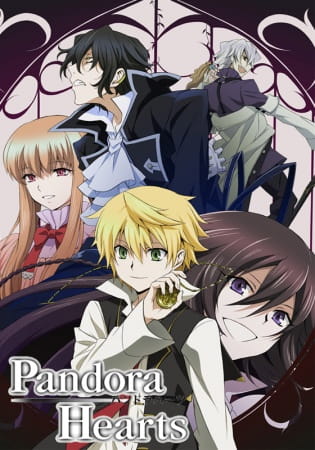
Pandora Hearts
Is Pandora Hearts worth watching?
Mixed — depends what you want. Anime Codex rates Pandora Hearts 5.95 out of 10 — scored on six criteria (story, characters, themes, world-building, animation, and cultural impact), not crowd votes. 213th of 226 on the Codex rubric — bottom 7% of the catalogue. The crowd rates it 1.70 higher than the rubric does — the Codex is harder on it than on 96% of the catalogue.
Where to watch
Trailer
What the data says
Computed from the Codex rubric across the whole catalogue.
Summary
Pandora Hearts is a gothic fantasy shonen that stands out for its melancholic Alice in Wonderland aesthetic, intricate conspiracy plotting, and emotionally bruised central trio of Oz, Alice, and Gilbert. Within its demographic it aims higher than typical contract-monster fare, weaving themes of guilt, memory, and the right to exist through Jun Mochizuki's puzzle-box premise of the Abyss and its Chains. Yuki Kajiura's score and the elegant Victorian design work give it a distinctive atmosphere. Its fatal weakness is structural: at 25 episodes the Xebec adaptation covers only the manga's opening movement and ends without resolving any of its central mysteries, so the narrative momentum and thematic payoffs it carefully constructs are left hanging. Pacing wobbles between exposition-heavy dialogue and quieter detours, and the animation, while clean, rarely matches the eerie ambition of the setting. Character arcs—especially Alice's—stop well short of their intended growth. The result is a handsome, intriguing, but frustratingly incomplete work: a strong recommendation toward the manga rather than a self-contained achievement. Judged against the best gothic and mystery-driven shonen, it is good but conspicuously flawed by its truncation, earning solid mid-tier marks rather than excellence.
Criterion breakdown
Story & narrative
The Alice-in-Wonderland-inflected mystery of the Abyss, the Tragedy of Sablier, and the Baskerville conspiracy is genuinely intriguing, and the early Cheshire's Dimension arc shows real narrative ambition with its layered memories. However, the 25-episode adaptation covers only the manga's opening stretch and ends without resolution, leaving the core mysteries of Jack, the Will of the Abyss, and Oz's true nature dangling. The pacing also stumbles between dense exposition dumps and slower episodic detours, so the plot never builds to a satisfying payoff within the anime itself.
Character writing & growth
The Oz-Alice-Gilbert trio carries the show, with Gilbert's anxious devotion and Oz's deceptively cheerful self-loathing being the strongest threads. Oz's gradual reveal as a boy who masks deep self-hatred behind a smiling facade is the most affecting writing here, and Break's enigmatic mentor role adds welcome edge. The trouble is that the anime cuts off before most arcs of growth complete, so Alice in particular remains underdeveloped and several supporting Baskervilles are introduced without resolution.
Themes & emotional resonance
Memory, guilt, the value of one's own existence, and inherited sin are the emotional spine, and the show handles Gilbert's and Oz's intertwined trauma with real tenderness. The recurring motif of 'do you have the right to exist?' gives the melancholy genuine weight beyond typical shonen stakes. Yet the truncated ending blunts the emotional resonance the source builds toward, leaving these themes raised but not fully delivered.
World-building & power system
The Abyss, Chains, Contractors and their incuse seals form an inventive gothic-fairytale system layered with Alice in Wonderland symbolism, and the aristocratic four-dukedom politics add texture. The fragmented, time-jumbled Abyss is a striking original premise that distinguishes it from contract-monster contemporaries. The internal rules, however, are explained patchily within these episodes, and much of the lore's depth only exists in the unadapted manga.
Animation & direction
Xebec delivers competent but unremarkable production; the gothic-Victorian costume and set design is the visual highlight, and Yuki Kajiura's score elevates many scenes considerably. Action involving Chains like B-Rabbit is functional rather than spectacular, with limited fluidity in the climactic fights. Character art stays on-model but the direction rarely achieves the atmospheric dread the premise invites.
Cultural impact
Pandora Hearts retains a devoted fanbase largely on the strength of Jun Mochizuki's manga, which later fueled interest in The Case Study of Vanitas. The anime itself, however, had modest impact and is widely regarded as an incomplete advertisement for a superior source, so its standalone footprint is limited.
Synopsis (from MAL)
To young Oz Vessalius, heir to the Vessalius Duke House, the perilous world called the Abyss is nothing more than a folktale used to scare misbehaving children. However, when Oz's coming-of-age ceremony is interrupted by the malicious Baskerville Clan intent on banishing him into the depths of the Abyss, the Vessalius heir realizes that his peaceful life of luxury is at its end. Now, he must confront the world of the Abyss and its dwellers, the monstrous "Chains," which are both not quite as fake as he once believed. Based on the supernatural fantasy manga of the same name, Pandora Hearts tells the story of fifteen-year-old Oz's journey to discover the meaning behind the strange events that have overtaken his life. Assisted by a mysterious Chain named Alice, whose nickname is "Bloodstained Black Rabbit," and members of a clandestine organization known as "Pandora," Oz begins to realize his existence may have more meaning than he could have ever imagined. [Written by MAL Rewrite]
Ranked nearby
Explore rankings
Discussion
Set a display name above to post.
Loading discussion…