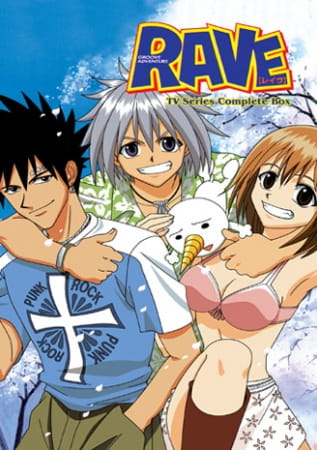
Rave Master
Is Rave Master worth watching?
Mixed — depends what you want. Anime Codex rates Rave Master 6.00 out of 10 — scored on six criteria (story, characters, themes, world-building, animation, and cultural impact), not crowd votes. 208th of 226 on the Codex rubric — bottom 9% of the catalogue. The crowd rates it 1.24 higher than the rubric does — the Codex is harder on it than on 82% of the catalogue.
Where to watch
Streaming availability varies by region — check your local services.
What the data says
Computed from the Codex rubric across the whole catalogue.
Summary
Rave Master is best understood as Hiro Mashima's prototype: a competent, charming shonen adventure that visibly contains the DNA of his later hit Fairy Tail. Its strengths lie in imaginative world flavor—the Overdrive cataclysm, the Rave/Dark Bring duality, and creature designs like Plue—paired with Mashima's reliable comedic instincts and a genuinely likable core party. The Sieg Hart and Lucia arcs supply its best dramatic and thematic material. Yet the show is held back by significant weaknesses. Studio Deen's animation is budget-constrained and inconsistent, with static fights and weak direction. The narrative leans hard on formulaic quest structure and padding, and the anime's truncated, anime-original ending fails to deliver on the emotional payoffs—especially Ellie's amnesia—that the source material builds toward. Themes of destiny, revenge, and found family are present but rarely probed deeply, and tonal swings blunt emotional resonance. Judged against the best shonen of its era, it lands as solidly mid-tier: enjoyable for fans of classic adventure questing and essential as a curiosity for Fairy Tail enthusiasts, but lacking the polish, ambition, or cultural footprint to stand among the demographic's standouts.
Criterion breakdown
Story & narrative
The Rave Stone collection quest is serviceable but heavily formulaic, leaning on the standard shonen 'travel, find McGuffin, fight Demon Card lieutenant' loop, and the anime adaptation suffers from infamous pacing problems and an anime-original ending that cuts the manga's arc short. Stronger beats like the Sieg Hart confrontation and the tragedy surrounding Lucia's backstory give it occasional weight, but the early Plue/Demon Card episodes drag and feel padded. It tells a coherent adventure without the structural ambition of its peers.
Character writing & growth
Haru is a likable but archetypal hot-blooded protagonist whose growth is mostly incremental, and Ellie's amnesia arc is a real emotional anchor that the anime never fully pays off due to its truncated run. Supporting players like Let, the reformed Demon Card warrior, and Musica's loyalty add texture, and Hiro Mashima's comedic timing gives the cast charm. However, several antagonists remain thinly motivated and redemptions land too quickly.
Themes & emotional resonance
The series gestures at themes of inherited destiny, the cost of revenge through Demon Card's victims, and found family among the traveling party, but rarely interrogates them with depth. The Sieg Hart arc briefly explores fanatical devotion to a cause, which is the show's most thematically interesting stretch. Emotional resonance is undercut by tonal whiplash between gag comedy and drama.
World-building & power system
The Overdrive premise and the Dark Bring versus Rave duality is a clean, evocative hook, and Mashima's imaginative location and creature design (Plue, the various towns) shows the worldbuilding flair he'd refine in Fairy Tail. Internal consistency around how Rave Stones and Dark Brings function is decent but loosely enforced, and the power scaling is fuzzy. It's original in flavor more than in mechanical rigor.
Animation & direction
Studio Deen's production is modest, with flat color work, limited animation in many fight scenes, and inconsistent character models across the 51 episodes. Direction is functional but unremarkable, rarely using staging or pacing to elevate key moments, and battle choreography is often static compared to contemporaries. The opening sequences carry more energy than the episodes themselves.
Cultural impact
Rave Master is historically notable mainly as Hiro Mashima's debut serialization, the proving ground for the style and character templates that would explode with Fairy Tail. The anime had modest international reach via early-2000s dubs but never became a tentpole franchise. Its legacy is largely as a footnote and prototype rather than an influential work in its own right.
Synopsis (from MAL)
Fifty years ago, malevolent stones known as Dark Brings brought about the "Overdrive," a calamitous event that destroyed one-tenth of the world. In the present day, the nefarious organization Demon Card seeks the Dark Brings' power for their all but innocent intentions. Haru Glory, a sword-wielding silver-haired teenager, inherits the title of Rave Master: the person who wields the power of the legendary Rave Stones, artifacts capable of destroying the Dark Brings. However, the many Rave Stones were scattered across the globe as a result of the Overdrive, allowing Demon Card to continue their malpractices. Groove Adventure Rave follows Haru, his strange dog Plue, the fiery blonde Ellie, and the infamous thief Musica, as they embark on a great journey that will take them around the vast world, searching for the Rave Stones that will finally end Demon Card's injustice. [Written by MAL Rewrite]
Ranked nearby
Explore rankings
Discussion
Set a display name above to post.
Loading discussion…