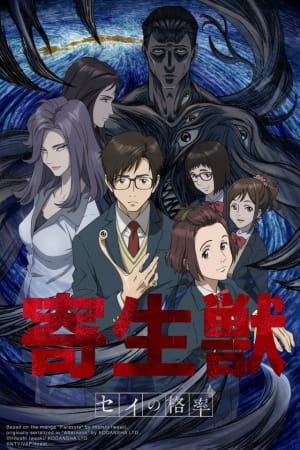
Parasyte: The Maxim
Is Parasyte: The Maxim worth watching?
Yes, it's worth watching. Anime Codex rates Parasyte: The Maxim 7.93 out of 10 — scored on six criteria (story, characters, themes, world-building, animation, and cultural impact), not crowd votes. 53rd of 226 on the Codex rubric — top 23% of the catalogue. The crowd rates it 0.39 higher than the rubric does — the Codex is harder on it than on 40% of the catalogue.
Where to watch
Trailer
What the data says
Computed from the Codex rubric across the whole catalogue.
Summary
Parasyte: The Maxim stands as one of the stronger modern seinen body-horror adaptations, distinguished by an original premise that weaponizes biological horror in service of a serious meditation on what makes us human. Its greatest strength is Shinichi's psychological arc — his post-trauma emotional deadening and gradual recovery of empathy are written with real maturity, and Migi makes for one of anime's best non-human foils. The Tamura Reiko arc is a genuine highlight, transforming a cold predator into the series' most poignant figure. The show's escalation from intimate survival to a broader human-versus-parasite conflict is well-paced for most of its run. Weaknesses emerge in the final act: the Uragami subplot feels grafted on, the ecological themes turn preachy, and supporting characters like Satomi remain thin. Madhouse's modernized aesthetic — contemporary styling and an electronic soundtrack — is a polarizing choice that sometimes undercuts the grim source material. Despite these flaws, the visceral transformations, consistent internal rules, and emotional payoffs make it a memorable, thematically ambitious entry that rewards viewers seeking horror with philosophical weight rather than pure spectacle. It is a very good, if not flawless, seinen worth its reputation.
Criterion breakdown
Story & narrative
The narrative tightly escalates from intimate body-horror survival to a larger conflict involving the parasite-controlled mayor Hirokawa and the human serial killer Uragami, expanding scope without losing thematic focus. The Tamura Reiko/Tamiya Ryouko arc is the structural high point, using her cold maternal experiment to interrogate what 'humanity' means. The final stretch sags slightly with the Uragami detour feeling tacked on, and the Goto fight resolution leans on a convenient environmental contrivance.
Character writing & growth
Shinichi's arc is the spine of the show — his gradual emotional numbing after his mother's death, the loss of his 'human' empathy, and his slow reintegration are tracked with genuine psychological care. Migi is an excellent foil whose pragmatic logic evolves into something resembling affection, and Tamura Reiko's growth from predator to self-sacrificing mother is the series' most affecting transformation. Satomi is comparatively underwritten, functioning more as a barometer for Shinichi's humanity than a full character.
Themes & emotional resonance
The show interrogates humanity's own predatory relationship with nature, pointedly framing humans as the 'parasite' devouring the planet through Hirokawa's monologue. The meditation on coexistence, identity, and what separates man from monster is genuine, though the ecological messaging occasionally turns didactic and on-the-nose in the back half. Tamura's death and Shinichi's reaction deliver the strongest emotional payoff.
World-building & power system
The premise is strikingly original — parasites that hijack brains and morph flesh into blades create a uniquely grounded horror grammar with consistent biological rules. The 'power system' is internally coherent: parasites have limited cell mass, sense each other, and can be killed by severing the host body, which the show respects in its fights. It stops short of deeper societal world-building about how humanity at large would realistically respond beyond the localized police-and-mayor plotline.
Animation & direction
Madhouse delivers fluid, visceral parasite transformations and the body-horror morphing is genuinely unsettling, with Migi's facial contortions a standout in design. Direction handles tension well, though the controversial modernized aesthetic — contemporary fashion, the electronic/dubstep soundtrack like 'Next to You' — divides viewers and occasionally clashes tonally with the grim material. Character art is solid but rarely exceptional outside the horror set-pieces.
Cultural impact
The 2014 adaptation introduced Iwaaki Hitoshi's acclaimed 1980s-90s manga to a mass global audience, cementing Parasyte as a gateway seinen alongside its live-action films. 'Right hand' Migi and the series' body-horror imagery remain widely recognized, though its footprint is more that of a respected modern classic than a genre-defining landmark.
Synopsis (from MAL)
All of a sudden, they arrived: parasitic aliens that descended upon Earth and quickly infiltrated humanity by burrowing into the brains of vulnerable targets. These insatiable beings acquire full control of their host and are able to morph into a variety of forms in order to feed on unsuspecting prey. Sixteen-year-old high school student Shinichi Izumi falls victim to one of these parasites, but it fails to take over his brain, ending up in his right hand instead. Unable to relocate, the parasite, now named Migi, has no choice but to rely on Shinichi in order to stay alive. Thus, the pair is forced into an uneasy coexistence and must defend themselves from hostile parasites that hope to eradicate this new threat to their species. [Written by MAL Rewrite]
Ranked nearby


Explore rankings
Discussion
Set a display name above to post.
Loading discussion…