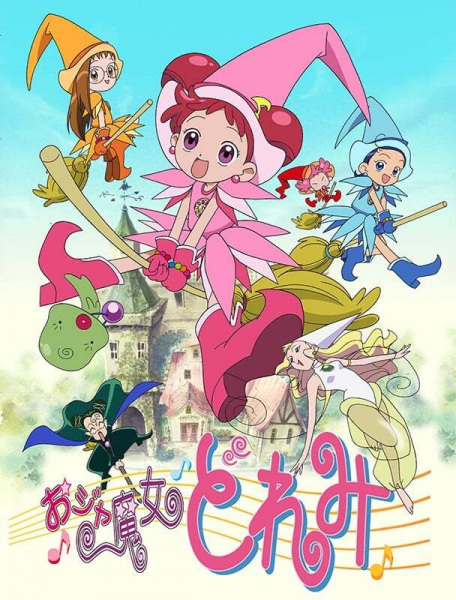
Ojamajo Doremi
Is Ojamajo Doremi worth watching?
Yes, it's worth watching. Anime Codex rates Ojamajo Doremi 7.68 out of 10 — scored on six criteria (story, characters, themes, world-building, animation, and cultural impact), not crowd votes. 73rd of 226 on the Codex rubric — top 32% of the catalogue. The Codex rates it Δ +0.32 above its MAL score — more underrated than 94% of the catalogue.
Where to watch
Streaming availability varies by region — check your local services.
What the data says
Computed from the Codex rubric across the whole catalogue.
Summary
Ojamajo Doremi stands among the strongest entries in the kodomomuke magical-girl tradition because it inverts the genre's wish-fulfillment formula: Doremi is a hopeless apprentice working off a debt, and magic is repeatedly shown to be no substitute for empathy and effort. Its greatest strength is character writing—Doremi, Hazuki, Aiko, and the morally complicated Onpu are distinct, growing individuals, and the show engages real childhood anxieties like parental conflict, class difference, and absent mothers with surprising tenderness. The episodic problem-of-the-week structure is purposeful rather than aimless, anchored by the witch-exam progression and the late-season Hana-chan arc. Weaknesses are those typical of the format and era: repetitive transformation beats, occasional mid-season padding, and TV-budget animation that relies on stock footage. The witch-world lore is charming and internally consistent but lightly developed within this first season. As a foundation for one of anime's most beloved magical-girl franchises and an influence on the genre's later direction, it carries genuine cultural weight. Judged against the best children's anime, it is a warm, intelligent, and emotionally honest show that respects its young audience without talking down to them—good but bound by its format's conventions.
Criterion breakdown
Story & narrative
The episodic structure—each chapter centered on a townsperson's small problem solved through Doremi's clumsy magic—is well-suited to kodomomuke and avoids the filler aimlessness that plagues many children's shows. The overarching witch-exam progression and Majorika's debt give the season a clear forward spine, and the introduction of Hana-chan as a baby the girls must raise late in the run smartly escalates stakes. It occasionally leans on repetitive transformation-and-resolution beats, which is the genre's expected rhythm rather than a flaw, though a few mid-season episodes feel like padding.
Character writing & growth
Doremi, Hazuki, and Aiko are sharply differentiated—Doremi's brash impulsiveness, Hazuki's timid bookishness, Aiko's tomboyish self-reliance rooted in her single-father household—and each gets genuine growth rather than static archetypes. Aiko's episodes dealing with her absent mother and working-class pride carry real weight for a children's show, and Onpu's later introduction as a morally grey rival who uses forbidden magic adds welcome friction. The supporting cast, including Majorika and the SOS Trio classmates, are given coherent personalities rather than being mere props.
Themes & emotional resonance
The show consistently teaches empathy through its problem-of-the-week format—learning to understand others' feelings rather than fixing things with raw magic—which is unusually thoughtful for the demographic. Episodes touching divorce anxiety (Doremi's bickering parents), grief, and class differences treat young viewers with respect. The recurring lesson that magic cannot substitute for honest effort or emotional understanding is reinforced without being preachy, giving genuine resonance within its target audience.
World-building & power system
The Maho-do magic shop, the witch world's internal rules, the leveled crystal-ball exam system, and the cursed-frog penalty for revealing one's witch identity form a consistent, charming framework that rewards regular viewing. The premise of failing apprentices working off a debt is a fresh inversion of the wish-fulfillment magical-girl norm. It is not especially deep lore, and the witch world remains lightly sketched this season, but it is internally coherent and original within the mahou shoujo lineage.
Animation & direction
Toei's late-90s production is bright, rounded, and expressive with strong character-acting in the comedic beats, and the henshin sequences are appealingly designed if economical. The musical-instrument-themed transformations and tap-dance call-outs give the magic a distinct visual identity. It is clearly a TV-budget show with limited animation in non-key moments and repeated stock footage for transformations, which is standard for the format but keeps it short of theatrical polish.
Cultural impact
Ojamajo Doremi became a defining magical-girl franchise spanning multiple sequel seasons (Sharp, Motto, Dokkan), films, and a later novel/film revisiting the cast as adults, cementing lasting fan devotion. It is frequently cited as a formative influence by creators and is staffed by talent (including writers later central to Precure and Mahou Shoujo Ojamajo's lineage) who shaped the genre's evolution. Its reach within the kodomomuke mahou shoujo space is substantial, if not globally mainstream.
Synopsis (from MAL)
Harukaze Doremi considers herself to be the unluckiest girl in the world. Her parents are always fighting, her little sister makes fun of her, and her crush pines after another girl. If only Doremi could just wave a magic wand, she would have a much better life—or so she used to think. After a mishap with a real witch, Doremi becomes an apprentice witch herself, and it turns out she's pretty horrible at that, too. Now she and her two friends must study to become better at magic so they can become good witches. That is, if they can focus on their magic studies! The three apprentices will need all the luck they can get if they want to pass the witch exams and become full-fledged witches. Only then will Doremi's debt to the witch Majorika be repaid. Until then, Doremi will remain a useless little witch girl!
Ranked nearby


Explore rankings
Discussion
Set a display name above to post.
Loading discussion…