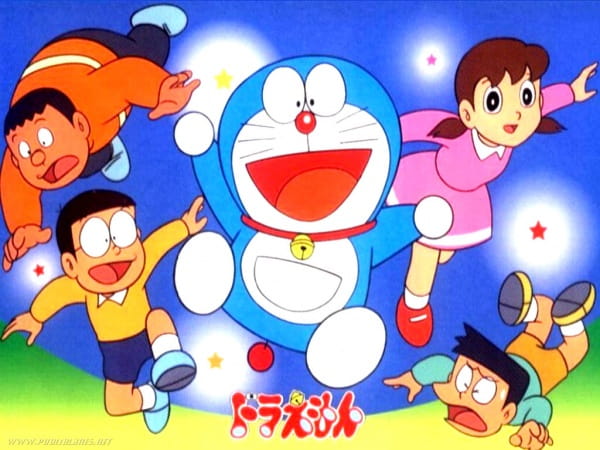
Doraemon
Is Doraemon worth watching?
Yes, it's worth watching. Anime Codex rates Doraemon 7.69 out of 10 — scored on six criteria (story, characters, themes, world-building, animation, and cultural impact), not crowd votes. 69th of 226 on the Codex rubric — top 31% of the catalogue. The crowd rates it 0.21 higher than the rubric does — the Codex is harder on it than on 30% of the catalogue.
Where to watch
Streaming availability varies by region — check your local services.
What the data says
Computed from the Codex rubric across the whole catalogue.
Summary
Doraemon is a foundational pillar of kodomomuke anime, and judged against the best of its own kind it largely succeeds at what it sets out to do. Its episodic morality-play formula — Nobita's laziness, a future gadget, predictable misuse, and a gentle lesson — is reliably constructed and ideal for young viewers, while its themes about effort, consequences, and the limits of convenience run deeper than the genre usually demands. The four-dimensional pocket is a brilliant premise-engine that keeps the show endlessly inventive, and the ensemble, especially the honestly flawed Nobita, gives the comedy emotional grounding that peaks in stories like 'Goodbye Doraemon.' Its cultural footprint is virtually unmatched in animation history. The weaknesses are inherent to its format: the status-quo reset blunts lasting character growth, the gadget logic bends to whatever each lesson requires, and the weekday animation is functional rather than ambitious, with the theatrical films carrying most of the visual and narrative reach. Across nearly 1800 episodes the formula rarely surprises. None of this undermines its excellence within its demographic — it is a definitive children's series whose ceiling is set deliberately low for accessibility, not by failure of craft.
Criterion breakdown
Story & narrative
The episodic structure is near-perfect for its kodomomuke audience: most episodes follow a tight formula where Nobita's laziness prompts a gadget, the gadget is misused, and consequences follow — the Anywhere Door and Time Machine fueling self-contained morality plays. This reliability is a strength for young viewers but a ceiling for narrative ambition; across 1787 episodes the formula rarely surprises, and the long-form annual film arcs (like the dinosaur and underworld stories) show far more narrative reach than the weekday episodes ever attempt.
Character writing & growth
Nobita is one of children's animation's most honestly drawn protagonists — genuinely flawed, cowardly, and lazy rather than aspirationally heroic, which makes his small moments of courage land. Doraemon's exasperated-but-loyal dynamic, Gian's bullying tempered by film-arc bravery, Suneo's sycophancy, and Shizuka's steadiness form a stable ensemble. The deliberate weakness, by genre design, is the near-absence of permanent growth: the reset-to-status-quo format means Nobita rarely retains his lessons week to week.
Themes & emotional resonance
Beneath the gadget comedy sits a consistent and surprisingly mature message: shortcuts and technology cannot substitute for character, effort, and kindness. Episodes repeatedly punish Nobita's reliance on the four-dimensional pocket, and the recurring future-poverty framing gives the whole series a quiet stakes about consequences. The emotional peaks — particularly the recurring 'Goodbye Doraemon' stories and Nobita's grandmother episode — achieve genuine poignancy rare in the demographic.
World-building & power system
The four-dimensional pocket is an inspired premise-engine, generating limitless inventive gadgets (Take-copter, Small Light, Translation Konjac) while keeping internal rules loose enough for comedy yet consistent enough that gadget abuse reliably backfires. The 22nd-century framing and time-travel logic add genuine setting depth for a kids' show. The trade-off is inconsistency: gadget powers scale to whatever each episode's lesson requires, so the 'system' is thematic rather than rigorously coherent.
Animation & direction
Shin-Ei's production is clean, warm, and instantly legible — exactly what a daily children's broadcast needs — with expressive, rounded character designs and clear comic timing. But for most of its run the weekday animation is functional and budget-conscious, with limited movement and repeated stock cuts; the theatrical films are where direction and visual ambition genuinely shine. Judged against the best of its demographic, it is dependable rather than dazzling.
Cultural impact
Doraemon is effectively a national institution in Japan and across Asia, an official 'Anime Ambassador' and a cultural touchstone spanning generations. The blue cat is among the most recognizable characters ever produced by the medium, and the franchise's reach into merchandise, education, and annual films is enormous. Within and beyond its demographic, its impact is essentially unmatched.
Synopsis (from MAL)
Nobita Nobi is a normal fourth grade student. This all changes, however, when a blue robotic cat appears from his desk drawer. Calling himself Doraemon, this robot tells Nobita that his future descendants from the 22nd century live in poverty because of all the mistakes he made. Therefore, they have sent Doraemon to serve as a guide and mentor to Nobita, so that their future may change for the better. What Doraemon comes to learn, though, is that Nobita is the weakest and laziest student in the whole school. To assist in his quest, Doraemon has a four-dimensional pocket with him, in which he keeps various machines and gadgets from the future. Unfortunately, these often result in even more trouble for Nobita. Will Doraemon really be able to achieve his mission of changing Nobita, or will he remain as he is? [Written by MAL Rewrite]
Ranked nearby


Explore rankings
Discussion
Set a display name above to post.
Loading discussion…