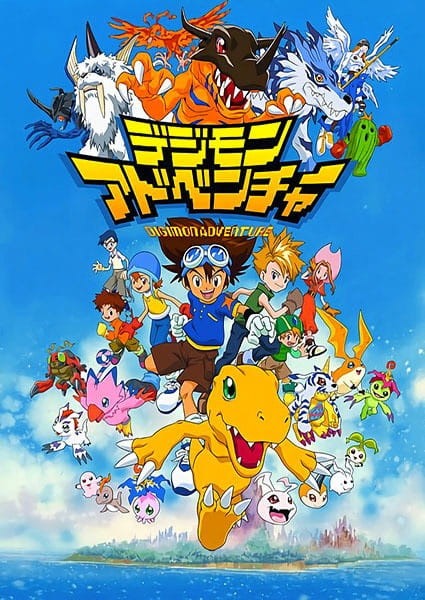
Digimon Adventure
Is Digimon Adventure worth watching?
Yes, it's worth watching. Anime Codex rates Digimon Adventure 7.60 out of 10 — scored on six criteria (story, characters, themes, world-building, animation, and cultural impact), not crowd votes. 78th of 226 on the Codex rubric — top 35% of the catalogue. The crowd rates it 0.19 higher than the rubric does — the Codex is harder on it than on 28% of the catalogue.
Where to watch
What the data says
Computed from the Codex rubric across the whole catalogue.
Summary
Digimon Adventure stands as one of the most emotionally ambitious kodomomuke titles of its era, elevating what could have been a Pokémon-chasing monster franchise into a genuine coming-of-age ensemble drama. Its great strength is character: eight children each carry a distinct psychological wound—abandonment, anxiety, adoption, vanity—that the Crest system externalizes, so digivolution functions as emotional catharsis rather than empty spectacle. The arc structure is unusually bold, pivoting midway from a fantasy island quest to an invasion of the children's real-world Odaiba, raising personal stakes few shows for this age bracket attempt. Wizardmon's death and the Tai-Matt rivalry deliver real weight. Its weaknesses are familiar to the demographic and budget: early episodic filler, heavily recycled digivolution and attack animation, dipping production quality in lesser episodes, and a Digital World whose internal rules bend freely for drama. The Apocalymon finale resolves too quickly given the buildup. Still, judged against the best children's adventure anime, it is a standout—balancing accessible action with sincere themes of courage and friendship that resonate beyond its target audience. Its enormous, lasting cultural footprint cements its status as the genre's benchmark monster-partner narrative, flawed in craft but exceptional in heart and structural ambition.
Criterion breakdown
Story & narrative
The arc structure is unusually sophisticated for kodomomuke, escalating through Devimon, Etemon, Myotismon's invasion of the real world, and finally the Dark Masters and Apocalymon. The mid-series shift back to Odaiba (around episode 21 onward) cleverly raises stakes by threatening the children's actual homes, and Tai's panic-driven choice to fight before everyone gathered grounds the plot in character flaw rather than convenience. It sags in episodic filler during the early island wandering and resolves Apocalymon somewhat abruptly, but the overall momentum and willingness to restructure midway are strong.
Character writing & growth
Each of the eight children is built around a Crest virtue tied to a genuine psychological wound: Matt's resentment and overprotectiveness toward T.K., Joe's anxious sense of responsibility, Izzy's fear after learning he was adopted, and Mimi's growth from selfishness toward compassion. The Tai-Matt rivalry, especially their fistfight at the Dark Masters' base, carries real emotional weight, and Tai's reckless leadership has consequences he must learn from. This depth of individualized arcs across an ensemble is rare and excellent for the demographic.
Themes & emotional resonance
The Crest system literalizes themes of Courage, Friendship, Knowledge, and Sincerity, letting digivolution serve as emotional metaphor rather than mere power-up. Wizardmon's sacrifice and Leomon arcs deliver genuine grief, and the show treats childhood fear, divorce, and adoption with surprising candor. The thematic delivery is sometimes heavy-handed and over-explained, which slightly dulls the resonance, but the emotional sincerity lands consistently for its young audience.
World-building & power system
The Digital World's premise—a realm born of network data with corrupted programs as villains—is original and the digivolution tiers (Rookie/Champion/Ultimate/Mega) give clear, escalating structure. However, internal consistency is loose: the geography is arbitrary, the rules of digivolution and de-digivolution shift to suit drama, and the data-world logic is rarely explored with rigor. It is imaginative and distinctive but not tightly built.
Animation & direction
Hisashi Hirai's character designs and the digimon designs are memorable, and digivolution sequences are dynamic centerpieces. But the production relies heavily on reused stock evolution footage and recycled attack cuts, and frame rates dip noticeably in lesser episodes. Direction during the Myotismon and Dark Masters arcs is competent and occasionally striking, but the show is workmanlike rather than visually exceptional even by 1999 TV standards.
Cultural impact
Digimon Adventure launched a multimedia franchise spanning decades, and its dub became a defining childhood touchstone for a generation internationally. Its '99 button-mashing-meets-emotional-storytelling formula influenced the monster-partner genre and remains the most fondly remembered entry, sustaining sequels, reboots (tri., Last Evolution Kizuna), and enduring fandom.
Synopsis (from MAL)
When a group of seven children go to summer camp, the last thing that they expect is snow falling in July. In the confusion that follows this phenomenon, they each receive an odd device that transports them to another world. As soon as they wake up in this new world, they encounter strange creatures who call themselves "Digimon." The Digimon tell them that they've landed in the "Digital World," far from home. With only the Digimon and the "Digivices" as protection, the seven children set off to find their way home and learn the reason why they were brought here. Led by the impulsive Taichi Yagami and his hungry Digimon partner Agumon, this group will have to fight unknown evils as they discover more about this outlandish Digital World. [Written by MAL Rewrite]
Ranked nearby


Explore rankings
Discussion
Set a display name above to post.
Loading discussion…