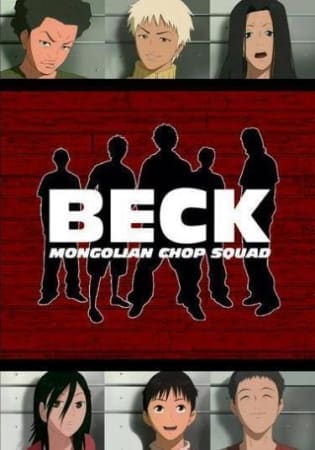
Beck: Mongolian Chop Squad
Is Beck: Mongolian Chop Squad worth watching?
Worth a look. Anime Codex rates Beck: Mongolian Chop Squad 7.40 out of 10 — scored on six criteria (story, characters, themes, world-building, animation, and cultural impact), not crowd votes. 101st of 226 on the Codex rubric — top 45% of the catalogue. The crowd rates it 0.90 higher than the rubric does — the Codex is harder on it than on 69% of the catalogue.
Where to watch
Trailer
What the data says
Computed from the Codex rubric across the whole catalogue.
Summary
Beck is a standout among shonen precisely because it abandons the demographic's usual machinery—no tournaments, no escalating powers—in favor of a grounded, patient coming-of-age story rooted in the Japanese underground rock scene. Its greatest strength is Koyuki's believable evolution from a listless teenager into a musician, supported by an authentic depiction of practice, stage fright, and the tension between artistic integrity and commercial success. The character writing and emotional honesty rival the best slice-of-life dramas, and Ryuusuke makes for a refreshingly flawed mentor figure. Its themes of self-belief and authenticity give it lasting resonance. However, the show is hampered by real weaknesses: the animation of its musical performances is stiff and relies on still frames, and the production's decision to mute or awkwardly dub the vocals undercuts the emotional climaxes of a series built around sound. The pacing also falters in the final stretch, compressing the band's American breakthrough into an unsatisfyingly rushed conclusion, and the central romance treads water. Despite these flaws, Beck remains a formative, distinctive entry in the music-anime space—measured against the best grounded shonen dramas, it succeeds far more than it stumbles, even if it never quite reaches definitive greatness.
Criterion breakdown
Story & narrative
The slow-burn coming-of-age structure—Koyuki picking up guitar, the band's grinding ascent from garage practice to the Greatful Sound festival—earns its payoffs through patient, realistic pacing rather than contrivance. However, the narrative leans heavily on melodramatic obstacles like Ran's gang harassment and the Eddie/Leon Sykes copyright subplot, and the final episodes rush the band's American breakthrough, leaving the manga's longer arc feeling truncated and abrupt.
Character writing & growth
Koyuki's transformation from a passive, directionless middle-schooler into a quietly confident vocalist-guitarist is one of the genre's more believable growth arcs, measured in small victories rather than tournament wins. Ryuusuke embodies aspirational mentorship without becoming a flawless idol, and supporting members like Saku and Chiba get genuine interiority, though Maho's romance with Koyuki stalls in repetitive will-they-won't-they beats and Izumi feels like a disposable rival.
Themes & emotional resonance
The show captures adolescent insecurity, the terror of performing, and the gulf between admiration and self-belief with rare honesty—Koyuki's stage fright and the recurring 'can I actually do this' anxiety resonate deeply. Its meditation on authenticity versus commercial success (the indie-vs-label tension, Ran's selling out) gives it thematic weight beyond a simple band-success story, even if it occasionally states these ideas too plainly.
World-building & power system
The grounded depiction of Japan's underground rock scene—cramped studios, live-house culture, the logistics of demos and label politics—is unusually authentic and specific for a shonen, lending real texture. The bilingual angle and western rock worship (Dylan, Nirvana, Red Hot Chili Peppers references) is distinctive, though the setting stays narrow and the music-industry mechanics sometimes serve plot convenience over realism.
Animation & direction
Madhouse delivers solid character art and expressive direction in dramatic moments, but the music performances—the very heart of the show—are undermined by stiff, repetitive guitar animation and an infamous reliance on still frames and crowd reaction shots. The notorious dub-over of vocals (Koyuki's singing reduced or muted in places, with awkward English) is a significant production weakness for a series about sound.
Cultural impact
Beck became a touchstone for music-anime fans and helped popularize the band-formation drama before the genre's later boom, and its English-language soundtrack gained a cult following. Its impact remains niche compared to action-shonen juggernauts, but it is consistently cited as a gateway and a benchmark for grounded musical storytelling.
Synopsis (from MAL)
Fourteen-year-old Yukio "Koyuki" Tanaka is a dispirited young boy with no goals in life. However, this all changes when Koyuki saves a strange-looking dog named Beck from being harassed by a group of local kids. The dog's owner, 16-year-old Ryuusuke "Ray" Minami, is an emerging guitarist and the former member of a popular rock band. After Koyuki meets Ray again in a diner, the older boy leads him to his former band's meeting place and dazzles Koyuki with his amazing guitar skills. Slowly becoming interested in the glamour of western rock culture, Koyuki decides to start playing the guitar while helping Ray achieve his dream of leading the ultimate rock band. Together with Ray's younger sister Maho and a few other members, the two boys launch their career into the world of rock by forming a band called BECK. Beck follows the group's struggles and successes as they spread their fame across Japan. [Written by MAL Rewrite]
Ranked nearby



Explore rankings
Discussion
Set a display name above to post.
Loading discussion…