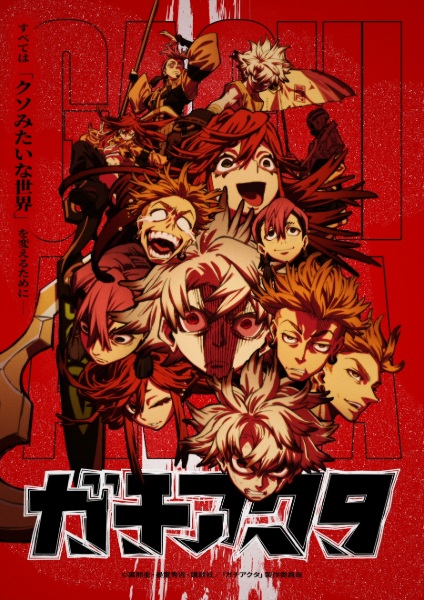
Gachiakuta
Is Gachiakuta worth watching?
Worth a look. Anime Codex rates Gachiakuta 7.40 out of 10 — scored on six criteria (story, characters, themes, world-building, animation, and cultural impact), not crowd votes. 100th of 226 on the Codex rubric — top 44% of the catalogue. The crowd rates it 0.81 higher than the rubric does — the Codex is harder on it than on 65% of the catalogue.
Where to watch
Trailer
What the data says
Computed from the Codex rubric across the whole catalogue.
Summary
Gachiakuta stands out in the shonen field through its premise and aesthetic far more than its plotting. Converting a society's discarded waste into both a literal underworld and a power system — Vital Instruments born from emotional attachment to objects — gives the show a thematic spine (class disposability, grief, what we deem worthless) that is unusually integrated into its action mechanics. Bones Film's grimy, graffiti-inflected art direction is the production's biggest asset, making the Pit feel tactile and the combat visually singular. Rudo's vengeance-fueled grief is a sharper emotional driver than the standard genki protagonist. Where it falters is the back half: once the world is established, the narrative settles into recognizable shonen escalation — mentor figures, faction villains with thin motives, and arcs that prioritize setup over payoff. Supporting characters are introduced more as ability showcases than fully realized people, and the central murder mystery defers resolution. The result is a confidently made, distinctive-looking action shonen that punches above average on premise, theme, and visual identity, while remaining a notch below the genre's best in narrative depth and character transformation. A strong, stylish entry with clear room to deepen in future seasons.
Criterion breakdown
Story & narrative
The wrongful-accusation-and-exile setup is a clean, propulsive hook, and the descent into the Pit recontextualizes the surface-town's disposable culture into a literal underclass mystery. However, the back half leans on familiar shonen escalation beats — tournament-adjacent Cleaner hierarchies, the Hoiku raid, and a villain faction (the Hito-Hito) whose motives stay schematic — which dulls the originality the premise promised. The Regto murder mystery is paced well as a throughline but resolves into setup for future arcs rather than a satisfying contained payoff.
Character writing & growth
Rudo's rage-driven grief is a more emotionally specific engine than the typical cheerful shonen lead, and his attachment to objects-as-memory gives his fights genuine stakes. Enjin functions as an entertaining but somewhat archetypal mysterious mentor, and the supporting Cleaners (Riyou, Zanka) are introduced more as power-set showcases than as people. Growth is present but incremental — Rudo learns to temper vengeance with purpose — yet by episode 24 most of the cast feels established rather than transformed.
Themes & emotional resonance
The 'one society's trash is another's lifeblood' metaphor is unusually pointed for shonen, tying class disposability, environmental waste, and grief into the literal mechanics of the world. The Vital Instruments — weapons born from cherished objects — make the theme of attachment and worth structurally inseparable from the action, which is the show's smartest move. It occasionally states its message too bluntly rather than trusting the imagery to carry it.
World-building & power system
The Pit as both garbage dump and penal colony, the Trash Beasts, and the Givers/Cleaner structure form a cohesive and genuinely fresh setting that converts mundane refuse into mythology. Vital Instruments are a standout power system: powers derived from emotional bonds to objects gives the combat a personal-inventory logic distinct from elemental or stand-based systems. Some internal rules (how Vital Instruments are awakened, the social order above) remain underexplained by season's end.
Animation & direction
Bones Film delivers a textured, graffiti-and-grime aesthetic with thick linework and a kinetic, street-art sensibility that suits the trash-world premise perfectly. Fight choreography — particularly Rudo's early Pit survival and the cleaning sequences — is fluid and impactful, with strong debris-physics and color contrast between the gray Pit and bursts of Vital Instrument energy. A few mid-cour episodes show a dip in detail, but the OP and key set-pieces are visually distinctive.
Cultural impact
Strong manga sales momentum and the high MAL score (8.21 across 500k+ members) signal a healthy, hyped fanbase, and the Kei Urana/Andou Hideyuki pedigree drew attention. It has carved a visible niche as a stylish 2025 action title but has not yet generated the cross-cultural footprint or merchandising ubiquity of the genre's defining hits.
Synopsis (from MAL)
The inhabitants of a certain wealthy town think nothing of throwing objects away. However, their waste is priceless to Rudo, a resident of the town's slums. Despite the constant warnings from his adoptive father Regto, Rudo spends his days searching for reusable materials that would otherwise be sent to the giant disposal area known as the Pit. Due to its vastness, the Pit doubles as a means of criminal punishment; those dropped in are never to return again. When Regto is murdered by a mysterious assailant, Rudo is falsely accused of the crime and thrown into the Pit. To his surprise, he awakens in a trash-filled area inhabited by enormous monsters formed from the junk. As the toxic air and Trash Beasts push Rudo to the brink of death, he is saved by Enjin, one of the Cleaners who wield weapons known as Vital Instruments to fight the monstrosities. Having gained his own Vital Instrument, Rudo soon joins the Cleaners in the hopes of finding a way to escape the Pit and avenge his father. [Written by MAL Rewrite]
Ranked nearby
Explore rankings
Discussion
Set a display name above to post.
Loading discussion…