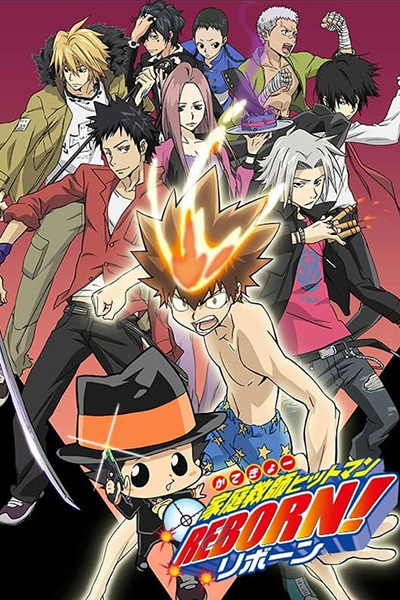
Katekyo Hitman Reborn!
Is Katekyo Hitman Reborn! worth watching?
Worth a look. Anime Codex rates Katekyo Hitman Reborn! 6.98 out of 10 — scored on six criteria (story, characters, themes, world-building, animation, and cultural impact), not crowd votes. 129th of 226 on the Codex rubric — bottom 44% of the catalogue. The crowd rates it 1.14 higher than the rubric does — the Codex is harder on it than on 77% of the catalogue.
Where to watch
Trailer
What the data says
Computed from the Codex rubric across the whole catalogue.
Summary
Katekyo Hitman Reborn! is a notable mid-2000s Shonen Jump title that famously transformed from a throwaway gag-comedy into a structured battle-shonen, with the Varia Ring Battles and the Future arc cementing its reputation. Its strengths are a genuinely original power system—the Dying Will Flames, Box Weapons, and Vongola Rings—and a deep, distinctive supporting cast; Hibari, Mukuro, and Xanxus rank among the more memorable shonen designs and personalities of their era. Tsuna's growth from a hopeless loser into a reluctant leader is earned and emotionally satisfying. Its weaknesses are real: a sluggish, episodic opening stretch, recurring filler and pacing drag, badly underwritten female characters, and shallow engagement with the moral implications of its mafia setting. Animation under Artland is inconsistent and rarely ambitious. Most damagingly, the anime ends mid-story after the Inheritance arc, never adapting the manga's conclusion or resolving the central succession premise. Judged against the best of battle shonen, it sits comfortably in the upper-middle tier—creative and beloved, particularly for its character roster and flame system, but held back by pacing and an incomplete adaptation rather than any failure of concept.
Criterion breakdown
Story & narrative
The series begins as an episodic gag-comedy that meanders for its first 20-odd episodes before the Kokuyo and especially the Varia arc reorganize it into a genuine tournament-style shonen with clear stakes. The Future arc is its narrative peak, introducing time-travel, the Millefiore conflict, and Byakuran as a credible antagonist, but the later Inheritance Ceremony (Shimon) arc sags under recycled tournament beats and an anime-original ending that leaves the central succession plot unresolved. Pacing is the recurring weakness—strong escalations are buffered by filler and slow-build setup.
Character writing & growth
Tsuna's arc from 'Dame-Tsuna' to a reluctant but resolved boss is well-paced and earns its payoffs, especially his Dying Will resolve against Xanxus and Byakuran. The supporting Guardians are the show's real strength: Gokudera, Yamamoto, and particularly Hibari and Mukuro have distinct voices, though Tsuna's harem-adjacent romance with Kyouko stalls and the female cast (Haru, Kyouko) is badly underwritten. Xanxus and the Varia provide some of the genre's better antagonist characterization, with Xanxus's birthright resentment giving the Ring Battles emotional weight.
Themes & emotional resonance
Themes of inherited duty, found family, and protecting one's friends are sincerely handled, with Tsuna repeatedly rejecting the mafia's violence-first logic in favor of loyalty—his refusal to kill and his bonds with his Guardians anchor the emotional core. The Future arc's exploration of fate and sacrifice (Uni, the Arcobaleno) reaches for something heavier than the early gags suggest. However, the show rarely interrogates the inherent darkness of glamorizing a crime syndicate, leaving its thematic ambitions shallower than its premise allows.
World-building & power system
The Dying Will Flame system is genuinely distinctive—Sky/Storm/Rain/Sun/Lightning/Cloud/Mist attributes tied to Box Weapons and Vongola Rings give battles a strategic identity beyond raw power levels. The Vongola lineage, the Varia, Arcobaleno, and Millefiore factions build a coherent mafia mythology with internal rules. Originality is high for its demographic, though the proliferation of rings, flames, and upgrade gimmicks occasionally tips into convoluted power-creep that strains consistency.
Animation & direction
Artland's production is serviceable but rarely exceptional; the Ring Battle and Future arcs feature competent fight choreography, but quality fluctuates noticeably and many episodes show flat, budget-conscious animation. Character designs are sharp and distinctive—Hibari, Mukuro, and the Varia are visually memorable—and key sequences like Tsuna vs. Xanxus or Mukuro's introduction land well. Direction is functional rather than stylish, leaning on freeze-frames and recap padding.
Cultural impact
A significant fandom staple of the mid-to-late 2000s, especially popular among female fans drawn to its large, shippable male cast, which kept it commercially durable across 203 episodes and a long Jump run. Its Dying Will Flame system and characters like Hibari and Mukuro remain recognizable in fan circles, though its anime never received a proper finale, capping its mainstream legacy compared to its Jump contemporaries.
Synopsis (from MAL)
There is no putting it lightly—Tsunayoshi Sawada is just no good. He is clumsy, talentless, and desperately in love with the school idol Kyouko Sasagawa, a girl so completely out of his league. Dubbed "Loser Tsuna" by his classmates, he seems to be the very personification of failure in the guise of a middle-schooler. Tsuna's boring life takes an extraordinary twist when he encounters the mysterious Reborn, who happens to be a hitman... and shockingly, a baby! Sent from the strongest Mafia family in Italy, Reborn is assigned the daunting mission of preparing the dull middle schooler to succeed the ninth boss of the notorious Vongola family, who is on the brink of retirement. The dull boy has a grueling road ahead, but with the help of his new criminal affiliates and his peculiar home tutor, perhaps even Loser Tsuna can achieve greatness. [Written by MAL Rewrite]
Ranked nearby
Explore rankings
Discussion
Set a display name above to post.
Loading discussion…