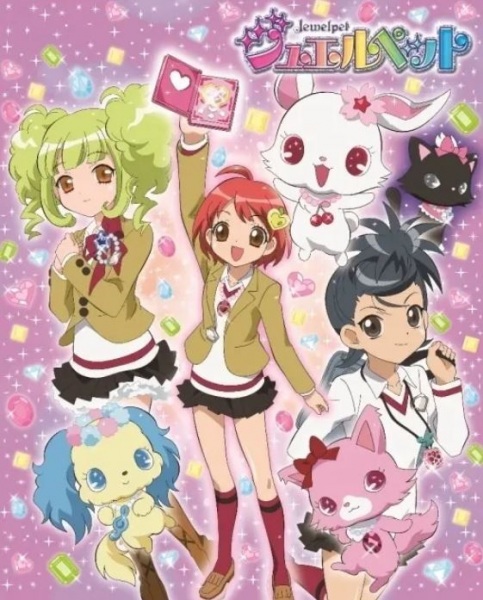
Jewelpet
Is Jewelpet worth watching?
Mixed — depends what you want. Anime Codex rates Jewelpet 6.28 out of 10 — scored on six criteria (story, characters, themes, world-building, animation, and cultural impact), not crowd votes. 195th of 226 on the Codex rubric — bottom 15% of the catalogue. The crowd rates it 0.57 higher than the rubric does — the Codex is harder on it than on 51% of the catalogue.
Where to watch
Streaming availability varies by region — check your local services.
What the data says
Computed from the Codex rubric across the whole catalogue.
Summary
Jewelpet (2009) is the foundational entry of a durable Sanrio/Sega franchise, and it works best when read as exactly that: a polished, sincere kodomomuke title built to introduce a roster of collectible mascots. Its strengths lie in Ruby, a lead with actual flaws to outgrow, and in the unexpectedly honest friendship strain between Rinko and Minami over a shared crush, which gives the series emotional stakes beyond merchandising. The charm-collecting premise provides a tidy episodic engine and a fairy-tale logic that neatly justifies the toy line. Its weaknesses are the familiar ones of the format: a padded, filler-heavy midsection, monster-of-the-week repetition, loose and convenient magic rules, and a deep bench of one-note Jewelpets who rarely earn arcs. Studio Comet's animation is clean and on-model but visually unambitious, conserving budget through recycled transformation cuts. Against the best of its demographic — the emotional depth of an Ojamajo Doremi — it falls short, but it clears the bar for warm, well-intentioned children's entertainment with a likable protagonist pair. Its lasting significance is commercial: it launched a multi-series franchise and cemented Ruby as a recognizable mascot, securing a legacy more of endurance than of artistic distinction.
Criterion breakdown
Story & narrative
The collect-the-charms premise gives the first Jewelpet series a clear episodic engine, but it leans heavily on monster-of-the-week structure with thin connective tissue between Rinko and Minami's wish-driven goals. The 52-episode run pads its midsection with filler-grade Jewelpet introductions, though the later episodes earn some momentum as the friendship-versus-jealousy tension between the girls becomes the actual plot rather than the charm hunt. Compared to standout kodomomuke like Ojamajo Doremi, the narrative arc is serviceable but underdeveloped.
Character writing & growth
Ruby is a genuinely strong lead for the demographic — her mischievousness and laziness give her flaws to grow past rather than being a flat mascot, and her bond with the shy Rinko has real warmth. The Rinko-Minami friendship strain, tied to romantic rivalry over a shared crush, is handled with more emotional honesty than the format usually allows. Secondary Jewelpets, however, are largely defined by a single gimmick and rotate in and out without meaningful arcs.
Themes & emotional resonance
The show's core message about honesty in friendship and confronting jealousy is delivered with surprising sincerity, particularly when Rinko must reconcile her own wish with Minami's feelings. It avoids the cynicism of pure merchandising shows by giving its young audience genuine emotional stakes about loyalty and self-acceptance. Still, the resolutions are tidy and repetitive, rarely pushing past comfortable reassurance into anything memorable.
World-building & power system
Jewel Land and the charm-transformation conceit are a charming framework that cleverly justifies the merchandise tie-in, and the magician trio plus the pelican delivery mishap give the premise a light fairy-tale logic. However, the internal rules of charm magic are loose and inconsistently applied, used more as plot convenience than a coherent system. The Earth-versus-Jewel-Land setting stays shallow, never developing the texture of richer magical-girl worlds.
Animation & direction
Studio Comet delivers clean, bright, on-model character work suited to its young audience, with appealing Jewelpet designs that read clearly as Sanrio/Sega product but retain expressiveness. Direction is functional and economical, conserving budget through repeated transformation cuts and static dialogue scenes typical of long-running kids' shows. There are no standout sequences, but the consistent color palette and gentle pacing serve the tone well.
Cultural impact
As the launch title of a Sanrio-Sega franchise, the 2009 series successfully seeded a multi-year run of sequels (Sunshine, Kira Deco, Happiness, Magical Change) and a substantial toy and gashapon line. Its commercial endurance is its real legacy rather than critical acclaim, anchoring Ruby as a recognizable mascot. Outside Japan its footprint is modest, limiting broader impact.
Synopsis (from MAL)
When what looks to be a cluster of shooting stars appear in the sky, Rinko Kougyoku and her friend Minami each make a wish. What the girls truly saw were not stars, but 'Jewel Charms' falling to the Earth. These charms were created by three magicians in a magical world names Jewel Land, each housing one of its many native Jewelpets. Although these creatures are free to roam the world in their original form, the magicians sometimes turn them into charms so that they can be carried around with great ease. Most Jewelpets don't find this troublesome, but once a mischievous bunny by the name of Ruby feels overly claustrophobic, she devises her escape. One day, the magicians decide to move the Jewelpets, and task a pelican with delivering them to the Dream Forest. All is well until a strong gust of wind disorients the bird, who then drops all of the charms that he was carrying. Instead of heading towards the Dream Forest, all the Jewelpets but Ruby fall to Rinko's home city on Earth. Someone must go and retrieve them all, and as Ruby was the worst-behaved of the bunch, she is given the task of going to Earth. When Ruby reaches Earth in the form of a red Jewel Charm, she falls into Rinko's water glass, and thus begins a rather unexpected adventure. Rinko, Minami, and Ruby form an alliance to search and gather all of the fallen charms, encountering strange creatures and tons of helpful allies along the way. Will they be able to succesfully bring the Jewelpets home safely, or is Earth full of more danger than they had expected?
Ranked nearby


Explore rankings
Discussion
Set a display name above to post.
Loading discussion…