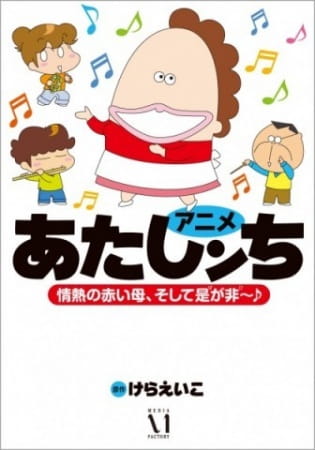
Atashin'chi
Is Atashin'chi worth watching?
Mixed — depends what you want. Anime Codex rates Atashin'chi 6.28 out of 10 — scored on six criteria (story, characters, themes, world-building, animation, and cultural impact), not crowd votes. 196th of 226 on the Codex rubric — bottom 14% of the catalogue. The crowd rates it 1.16 higher than the rubric does — the Codex is harder on it than on 79% of the catalogue.
Where to watch
Streaming availability varies by region — check your local services.
What the data says
Computed from the Codex rubric across the whole catalogue.
Summary
Atashin'chi is a faithful, durable adaptation of Eiko Kera's Yomiuri Shimbun 4-koma, translating newspaper-strip observational comedy into 330 episodes of domestic misadventure. Its standout asset is characterization: Haha, the scheming, vain, frugal housewife, ranks among anime's better comic mothers, and the contrast between deadpan Yuzuhiko, lazy Mikan, and the cipher-like Chichi powers consistently sharp household humor. Judged within the kodomomuke gag-family lineage of Sazae-san and Chibi Maruko-chan, it succeeds on its own terms—warm, recognizable, and reliably funny without leaning on sentiment. Its weaknesses are structural and visual: by design there is no narrative arc or character growth, so engagement depends entirely on gag quality, and the deliberately crude, economical Shin-Ei animation looks cheap and dated even against its 2002 peers. The themes resonate as affectionate familiarity rather than emotional depth, and its cultural footprint—respected in Japan, niche abroad—falls short of the genre's giants. The result is a solidly crafted comfort comedy that excels at character-driven observational humor while remaining modest in ambition, animation, and reach. It is a very good example of its kind, not a definitive one.
Criterion breakdown
Story & narrative
As a 4-koma adaptation rooted in the Yomiuri Shimbun, Atashin'chi has no overarching narrative by design—each episode is a string of self-contained vignettes about mundane domestic friction like Haha haggling at the supermarket or Yuzuhiko avoiding homework. This episodic structure is faithful to its newspaper-strip origins and sustains 330 episodes without overstaying any single gag, but the absence of cumulative stakes or seasonal arcs keeps it pleasant rather than gripping. Within the kodomomuke gag-family tradition (Sazae-san, Chibi Maruko-chan), its tight observational comedy holds up well.
Character writing & growth
The show's real strength is Haha (Mom), one of the more vividly drawn comic housewives in anime—her stinginess, theatrical logic, and curly-perm vanity make her a genuine character rather than a sitcom type. Yuzuhiko's deadpan elementary-school cynicism plays beautifully against Mikan's lazy, snack-driven teenage chaos, and the near-silent Chichi (Dad) becomes funny precisely through his blankness. Characters don't grow—this is by genre design—but their established personalities are consistent and exploited cleverly across hundreds of episodes.
Themes & emotional resonance
Its emotional core is the recognizable warmth and irritation of an ordinary family, and episodes about Haha's frugal scheming or sibling pettiness land because they mirror real household dynamics. It rarely reaches for sentiment the way Chibi Maruko-chan sometimes does, staying committed to dry comedy over emotional payoff. The resonance is real but modest—affectionate familiarity rather than anything moving.
World-building & power system
The premise—an 'almost normal' family whose ordinariness is the joke—is well-executed but inherently limited in scope, confined largely to the apartment, school, and local shops. Its internal consistency is excellent: Haha's economics, the family's furniture, the neighborhood routines all stay coherent across the run. The distinctive flat, slightly grotesque character designs (oversized features, Haha's helmet hair) give it strong visual identity, though the 'setting' itself is deliberately mundane.
Animation & direction
Shin-Ei keeps production economical and intentionally simple, with limited movement, static backgrounds, and a deliberately ugly-cute art style that suits the comic timing but offers little visual ambition. Direction is competent at landing punchlines through reaction cuts and Haha's exaggerated facial work, which is the medium's bread and butter. It looks dated and cheap even for 2002 kodomomuke, lagging behind the cleaner long-runners in the category.
Cultural impact
Adapted from Eiko Kera's popular long-running newspaper strip, the franchise spawned a film and a later 2009 series, giving it a steady presence in Japanese family programming. Its 7.44 MAL score from only ~6,600 members reflects a fond but niche international footprint—it never achieved the household-name status of Sazae-san or Crayon Shin-chan. A respected, durable title domestically rather than a defining cultural force.
Synopsis (from MAL)
Outrageous misadventures of an almost normal family with a housewife, her husband, and their two kids Yuzuhiko and Mikan. Wacky humor about this weird family's daily life. (Source: AniDB)
Ranked nearby


Explore rankings
Discussion
Set a display name above to post.
Loading discussion…