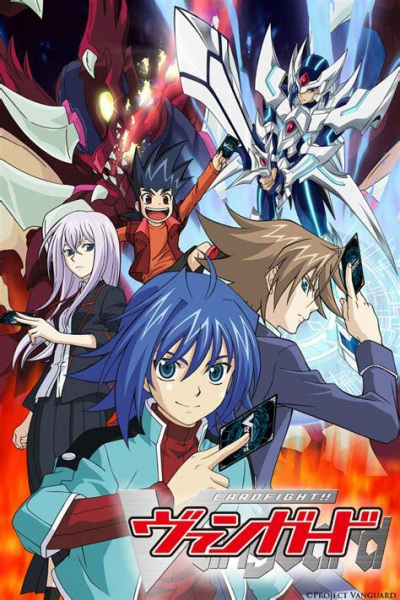
Cardfight!! Vanguard
Is Cardfight!! Vanguard worth watching?
Mixed — depends what you want. Anime Codex rates Cardfight!! Vanguard 6.41 out of 10 — scored on six criteria (story, characters, themes, world-building, animation, and cultural impact), not crowd votes. 185th of 226 on the Codex rubric — bottom 19% of the catalogue. The crowd rates it 0.64 higher than the rubric does — the Codex is harder on it than on 57% of the catalogue.
Where to watch
What the data says
Computed from the Codex rubric across the whole catalogue.
Summary
Cardfight!! Vanguard is a competent, well-constructed entry in the card-game kodomomuke tradition that knows exactly what it is: a Bushiroad vehicle designed to sell its TCG while telling a sincere coming-of-age story. Its greatest strength is Aichi Sendou's arc — a bullied, timid boy who finds courage through the game and the friendship of rival-turned-ally Toshiki Kai — anchored by the emotionally effective Blaster Blade motif. The tournament structure escalates satisfyingly from card-shop fights to the national VF Circuit, and the Psyqualia/Ren Suzugamori subplot injects welcome darkness. The imagined planet Cray and clan system give the game more setting depth than the format demands. Its weaknesses are those of its commercial mandate: padded pacing, recycled summon animation, filler opponents, blunt thematic messaging, and a supporting cast of static archetypes who mostly exist to lose. Judged against the best of children's card anime — not against seinen or shonen drama — it clears the bar comfortably without redefining it. It is more polished and emotionally grounded than much of its competition, and it launched a hugely successful franchise, making it notable as a foundational and durable, if formulaic, example of its kind.
Criterion breakdown
Story & narrative
The narrative follows a clean, satisfying tournament escalation typical of card-game kodomomuke: Aichi's quest to reclaim Blaster Blade from Kai grows into shop tournaments, the regional, and the national VF Circuit, with the Team Q4 formation giving the back half clear stakes. However, the pacing is padded by the format's commercial obligation to showcase new cards, and mid-arc fights against filler opponents (the AL4 buildup, various throwaway challengers) slow momentum considerably. It hits its genre beats reliably but rarely surprises.
Character writing & growth
Aichi's arc from bullied, timid boy to confident fighter is genuinely earned across the 65 episodes, and Kai's gradual thaw from cold rival to reluctant teammate gives the central relationship real weight. Supporting cast like Misaki and the comic-relief Kamui and Morikawa serve their roles competently, though many remain static archetypes who exist to lose fights. The Ren Suzugamori antagonist arc adds welcome depth via the Psyqualia subplot, but secondary characters rarely grow beyond their introductions.
Themes & emotional resonance
The show leans hard on courage, friendship, and self-belief — Blaster Blade as a symbol of Aichi's worth is an effective emotional anchor early on. The Psyqualia arc flirts with a darker theme of power corrupting and isolation, briefly elevating the material above pure product. But the emotional resonance is fairly surface-level and repetitive, with messaging delivered bluntly as befits its young target audience rather than developed with subtlety.
World-building & power system
The Cardfight Vanguard game itself is rendered with strong internal consistency — the unit/vanguard/rear-guard mechanics, the 'Stand Up, Vanguard!' imagining of the planet Cray are coherent and the rules are explained clearly enough to follow fights. The Cray world-within-a-card framing (clans like Royal Paladin, Kagero, Shadow Paladin) gives surprising setting depth for a promotional anime. Still, the world primarily exists to sell cards, so its lore is functional rather than richly imaginative.
Animation & direction
TMS delivers serviceable but unremarkable 2011 TV animation, with the imagined Cray battlefield sequences providing the visual highlights when units clash. Direction during key matches like Aichi vs. Kai or the Q4 finals builds tension adequately through reaction shots and dramatic card reveals. However, recycled stock animation for summons, flat off-model background characters, and budget-conscious static talking scenes are frequent, keeping it below the better-looking shows of its era.
Cultural impact
As Bushiroad's flagship launch title, Cardfight!! Vanguard succeeded enormously at its actual purpose — it established a globally successful TCG and a long-running multi-season franchise, genuinely popularizing card-game culture among children. Within the card-anime lineage following Yu-Gi-Oh!, it carved out a durable niche and spawned numerous sequels and spinoffs. Its influence is real but largely confined to its commercial sphere rather than the broader medium.
Synopsis (from MAL)
Taking the world by storm, the card game Cardfight Vanguard has influenced many to integrate card games into their everyday lives. Players of the popular game are called "cardfighters," and they frequently battle each other in card shops. The game has inspired many people, one of which is the quiet and timid Aichi Sendou who is often ridiculed and bullied by his peers. Whenever he feels down, he takes a glance at Blaster Blade—a legendary rare card given to him when he was young—and gains the motivation to move on with his life. However, one day, school bully Katsumi Morikawa notices Aichi's treasure and snatches the card away from him. After a turn of events, Aichi soon discovers that the card is now in the hands of Toshiki Kai, a cardfighter who has become the strongest in town despite having only recently arrived. To make matters worse, Kai refuses to return the card unless Aichi defeats him in a cardfight. Much to everyone's surprise, Aichi rises up to the occasion. As he musters up his courage and pictures himself winning this decisive battle, Aichi begins to find his way into the adventurous world of Cardfight Vanguard. [Written by MAL Rewrite]
Ranked nearby



Explore rankings
Discussion
Set a display name above to post.
Loading discussion…