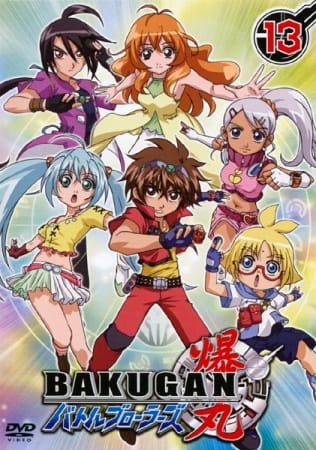
Bakugan Battle Brawlers
Is Bakugan Battle Brawlers worth watching?
Mixed — depends what you want. Anime Codex rates Bakugan Battle Brawlers 6.20 out of 10 — scored on six criteria (story, characters, themes, world-building, animation, and cultural impact), not crowd votes. 202nd of 226 on the Codex rubric — bottom 12% of the catalogue. The crowd rates it 0.31 higher than the rubric does — the Codex is harder on it than on 35% of the catalogue.
Where to watch
Streaming availability varies by region — check your local services.
What the data says
Computed from the Codex rubric across the whole catalogue.
Summary
Bakugan Battle Brawlers is one of the more competent entries in the toy-tie-in kodomomuke space, distinguished by an unusually ambitious premise: a children's card game secretly entangled with the collapse of the Bakugan homeworld, Vestroia. Its strongest assets are the elemental attribute system, which holds together with real internal logic, and the Alice/Masquerade arc, a psychological identity twist handled with more weight than the demographic typically attempts. Dan and Drago's evolving partnership gives the show an emotional spine, and the first-half climb up the world ranking is paced with genuine momentum. The weaknesses are familiar to the genre: the supporting Brawlers are locked into single-note personalities, the back half settles into a repetitive escalate-and-power-up rhythm, and themes of friendship and responsibility are stated rather than dramatized. The animation is bright and clean but the CG Bakugan often look weightless, and battle direction grows static through recycled summon sequences. As a franchise it achieved solid global success without reaching Pokemon-tier saturation. Judged against the best children's adventure anime, it is a well-constructed, above-average example that punches slightly above its merchandising mandate, but stops short of the genre's most resonant heights.
Criterion breakdown
Story & narrative
The dual-layer premise of a children's card game secretly tied to the collapsing dimension of Vestroia gives the show more narrative ambition than most toy-tie-in kodomomuke. The first half's structure, ascending the world ranking while gathering the six Brawlers (Dan, Runo, Marucho, Julie, Shun, and the conflicted Alice/Masquerade), is paced well, and the Masquerade identity twist is a genuinely effective midpoint reveal. However, the back half leans heavily on repetitive escalation, with each new Doom Being and Vestroia battle following the same challenge-defeat-power-up loop, and the resolution against Naga resolves the cosmic stakes too tidily.
Character writing & growth
Dan's rivalry-into-partnership arc with Drago carries real warmth, and Shun's backstory as the lapsed prodigy gives the cast more texture than the genre usually bothers with. The Alice/Masquerade duality is the standout, an actual psychological burden handled with surprising gravity for the demographic. That said, Runo, Julie, and Marucho stay locked into single-note roles (the hot-tempered girl, the cheerful one, the rich kid) and grow little once introduced.
Themes & emotional resonance
The show earns points by insisting that the 'game' has real consequences, which lets it touch on responsibility, friendship, and the cost of obsession with winning, most clearly through Masquerade's redemption. Themes of teamwork and trust are delivered competently but bluntly, restated in dialogue rather than dramatized. It rarely reaches the emotional depth that the best children's adventure shows achieve through quieter moments.
World-building & power system
Vestroia and the attribute system (Pyrus, Aquos, Subterra, Haos, Ventus, Darkus) is one of the better-realized power frameworks in toyetic anime, with the elemental triangle and G-power mechanics maintaining reasonable internal consistency across battles. The conceit of cards literally falling from a merging dimension grounds the gameplay in the cosmology rather than treating it as mere flavor. It loses points because much of the worldbuilding exists to sell the physical toy line, leaving Vestroia's deeper history underexplored.
Animation & direction
TMS delivers clean, bright character animation and the early CG Bakugan transformations are serviceable for 2007, with Dragonoid's designs being memorable. Battle direction is functional but static, relying on stock summon sequences and recycled impact frames as episodes pile up. The fusion of 2D cast work and 3D creatures is uneven, with the CG often looking weightless against the painted backgrounds.
Cultural impact
Bakugan became a significant post-Beyblade/Yu-Gi-Oh toy-and-anime franchise, launching multiple sequel series, a long-running marble-based toy line, and a recognizable global brand throughout the late 2000s. Its Western penetration was particularly strong via Cartoon Network. It never reached the cultural saturation of Pokemon or Yu-Gi-Oh, keeping it a notable second-tier success rather than a defining one.
Synopsis (from MAL)
Mysterious cards came down from the sky one day. Capable of summoning powerful creatures from another dimension, they became the centerpiece of a new game called Bakugan. The game gained instant popularity among children and teenagers, with the best of them competing in a worldwide ranking. Meanwhile, war for domination over Vestroia, the homeland of Bakugan cards, rages on. Invaded by the White Dragon Naga and his servants, the Doom Beings, the realm becomes increasingly destabilized. Dimensions begin to merge and many Bakugan players come to realize that their pastime is not merely a game. Danma Kuusou, one such Bakugan player, intends to become the World Ranking's leader someday. However, during one of his fights he experiences a vision of a clash in Vestroia. The fight suddenly moves to Earth, where Danma comes into possession of a talking, mighty fire Bakugan, Pyrus Dragonoid. He soon gets dragged into the conflict, and together with his Bakugan Brawlers team, must traverse the dimensions and restore balance in a ravaged world. [Written by MAL Rewrite]
Ranked nearby


Explore rankings
Discussion
Set a display name above to post.
Loading discussion…