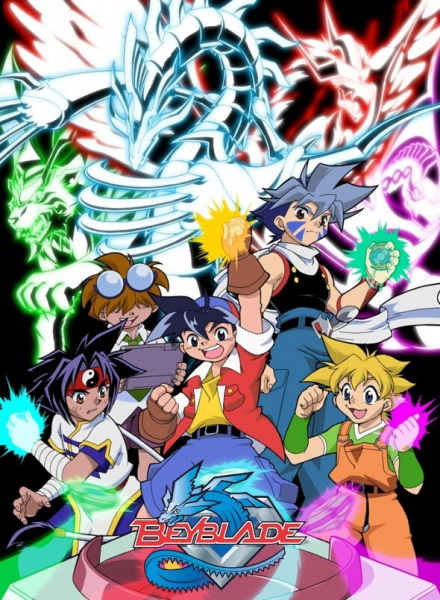
Beyblade (Bakuten Shoot Beyblade)
Is Beyblade (Bakuten Shoot Beyblade) worth watching?
Worth a look. Anime Codex rates Beyblade (Bakuten Shoot Beyblade) 6.60 out of 10 — scored on six criteria (story, characters, themes, world-building, animation, and cultural impact), not crowd votes. 171st of 226 on the Codex rubric — bottom 25% of the catalogue. The crowd rates it 0.21 higher than the rubric does — the Codex is harder on it than on 30% of the catalogue.
Where to watch
What the data says
Computed from the Codex rubric across the whole catalogue.
Summary
Bakuten Shoot Beyblade is a near-textbook example of CoroCoro toy-driven kids' anime done competently: it takes a spinning-top toy and elevates it into a creature-battler through the BitBeast gimmick, giving Dragoon, Dranzer, Driger, and Draciel enough personality to anchor a 51-episode tournament arc. Its strongest material is the Demolition Boys finale and Kai's defection-and-return arc, which inject genuine stakes and the only real emotional ambivalence in an otherwise sunny friendship-and-teamwork narrative. Madhouse keeps the duels legible and energetic, leaning on summon animations and dramatic angles to make two tops in a dish feel exciting. Its weaknesses are typical of the demographic: a padded, predictable win-the-next-match structure, flat off-battle animation with reused stock footage, and a supporting cast (Max, Ray, Kenny) frozen in single-note roles. Themes of camaraderie over cold perfection are sincere but stated rather than earned. Judged against the best kodomomuke battlers, it is a solid, formative entry — engaging for its target audience and hugely successful as a merchandising and cultural property — but it lacks the narrative ambition or character depth that would push it toward the top of its class.
Criterion breakdown
Story & narrative
The tournament-ladder structure (regional qualifiers, Asian Tournament, American Tour, European leg, and the World Championships against the Demolition Boys) gives the series a clear escalating spine that suits its kodomomuke audience. However, the early village-and-qualifier episodes are heavily padded and formulaic, and the Kai-betrayal-and-redemption beat tied to Boris and the Abbey is the only genuine narrative complication in an otherwise predictable win-the-next-match progression. It tells its story competently for its age bracket but rarely surprises.
Character writing & growth
Kai is the standout, with a defection to the Demolition Boys and a backstory at Balkov Abbey that gives him the only real arc with stakes and ambivalence. Tyson grows from a cocky, undisciplined kid into a more team-minded leader, but Max, Ray, and especially Kenny stay locked in fixed roles (the cheerful one, the calm one, the laptop exposition machine). Rival teams like the White Tigers and Ray's history with them add some texture, though most opponents are defined by a single trait.
Themes & emotional resonance
Friendship, teamwork, and sportsmanship over raw power are delivered earnestly, and the Demolition Boys arc positions warm camaraderie against cold, machine-trained perfection — a real emotional contrast for kids. The Tyson-versus-Kai and Ray-versus-his-old-team confrontations carry sincere weight about loyalty. Still, the messaging is repetitive and stated outright rather than felt, capping its resonance at solid-for-demographic.
World-building & power system
The BitBeast concept — spirits sealed inside spinning tops like Dragoon, Dranzer, Driger, and Draciel — is a clever hook that turns a children's toy into a creature-battler with personality and stakes. Kenny's stat-readouts and the attack/endurance/balance typing give the matches a pseudo-technical internal logic. The setting itself is thin, though, mostly a string of generic international locales serving as tournament backdrops rather than a developed world.
Animation & direction
Madhouse keeps the spinning-top duels legible and dynamic, using the BitBeast summon animations and dramatic camera angles to inject spectacle into what is mechanically two tops in a dish. Battle highlights and signature moves are well-staged, but off-battle animation is flat with frequent stills and reused stock summon footage, and the character designs are functional rather than distinctive for the era.
Cultural impact
Beyblade became a global toy-and-anime phenomenon, with the tops themselves a massive merchandising success that rivaled Bakugan and helped define the early-2000s 'toy-driven shonen-style' boom alongside its CoroCoro siblings. The franchise's longevity across multiple sequel series testifies to a real and lasting footprint, especially among the generation that grew up with it.
Synopsis (from MAL)
Thirteen-year-old Tyson Granger (Takao Kinomiya), along with his fellow teammates, Kai Hiwatari, Max Tate (Max Mizuhura), and Ray Kon (Rei Kon), strive to become the greatest Beybladers in the world. With the technical help of the team's resident genius, Kenny (Kyouju), and with the powerful strength of their BitBeasts, the Bladebreakers armed with their tops (AKA: Blades) attempt to reach their goal. (Source: ANN)
Ranked nearby


Explore rankings
Discussion
Set a display name above to post.
Loading discussion…