Pluto at 8.96: Where Urasawa's Eight-Episode Netflix Adaptation Actually Sits on the Seinen Map
Ranking a show only means something relative to its peers — so place Pluto on the seinen map and explain the coordinates.
Ranking a show only means something relative to its peers — so place Pluto on the seinen map and explain the coordinates.
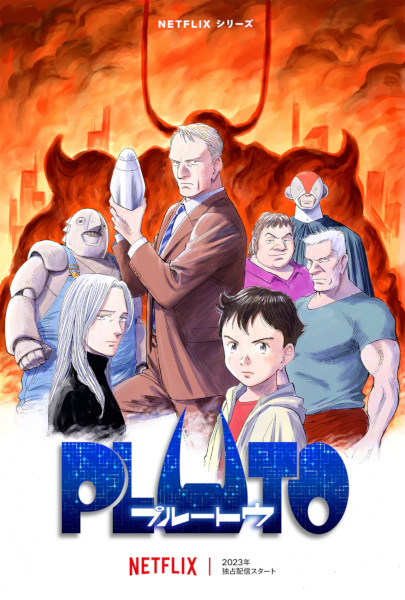
Studio M2's eight-episode adaptation of Urasawa's Pluto scores 8.96 on the Codex rubric, which puts it inside the seinen upper tier but a clean step below the genre's structural benchmarks. That gap is not noise. It is the difference between a near-flawless thriller compressed into a Netflix release window and the long-form seinen masterworks the genre is actually judged against.
The Consensus Position, and Why It Is Incomplete
The MyAnimeList crowd scores Pluto 8.44, which is the kind of number that gets a show filed under "modern prestige adaptation, watch it, move on." That score is not wrong in the way MAL scores are usually wrong — it is wrong in a quieter way. It treats Pluto as a freestanding object, divorced from the seinen tradition it is consciously extending. When you actually situate the show against the best seinen anime on the Codex, the 8.44 reads as undervaluing the writing while overlooking the production ceiling. The Codex 8.96 corrects in both directions: it grades the story and themes higher than the consensus does, and it refuses to round up the animation past what Studio M2 actually delivered.
That is the coordinate problem. Pluto is not "an 8.44 anime." It is a show whose story scores 9.2, whose themes score 9.3, and whose animation score of 8.3 is the load-bearing wall that prevents it from climbing into the 9.2+ tier where Monster and Vinland Saga's strongest stretches live.
The Writing Is Doing Almost All the Work
The story justification on the Codex entry is blunt about what makes the script function: Urasawa took a children's arc from Tezuka's Astro Boy and restructured it as a procedural murder mystery threaded through the 39th Central Asian War, with the Bora Inquiry standing in as a 9/11-and-Iraq allegory that never collapses into op-ed. Gesicht hunting the robot-killer is the spine; the late pivot to Dr. Tenma, Abullah, and the Sahad/Pluto reveal is the payoff. The 9.2 is earned because the conspiracy actually lands — the revelation reframes the procedural without retroactively breaking it.
The compression problem is the only thing keeping this score out of the 9.4+ band. Eight manga volumes into eight episodes means connective tissue gets thinned. Abullah's villainy in particular is undernourished relative to the standalone episodes, and Atom's resurrection arrives with less weight than the manga affords it. Compare this to the 74-episode runtime Madhouse gave Monster, where Urasawa's pacing is allowed to breathe at its native tempo, and the structural cost of the Netflix episode order becomes visible.
The Themes Score Is the Highest Number on the Card
Themes at 9.3 is the criterion doing the heaviest lifting, and it is doing it because Pluto refuses to dramatize its ideas through monologue. North No. 2 learning piano under the blind composer is not a thesis statement about robot personhood — it is the question rendered as scene. Gesicht's frozen tears at the moment his suppressed memory surfaces are not a metaphor for grief; they are grief, mechanically expressed, which is the only honest way the show could ask whether emotional acquisition is a gift or a curse.
The hatred-as-virus thread connecting Gesicht, Pluto, and Atom is the kind of thematic architecture seinen is supposed to be good at and frequently is not. It is anti-war without being a pamphlet, anti-revenge without being a sermon. The Bora Inquiry beats land because the show has already taught you to read robot interiority as fully equivalent to human interiority — so when geopolitics enters, it enters through characters who have earned standing.
Character at 9.0 Is the Vignette Score, Not the Protagonist Score
Gesicht is a strong central protagonist — the suppressed-memory architecture, the murdered adopted son, the capacity for hatred he was engineered to forget — and his brutal payoff is the show's most devastating beat. But the 9.0 is really paid for by the standalone episodes. North No. 2 and the composer. Brando and Hercules' rivalry rendered in single-episode strokes. Atom at the dying Gesicht's bedside. These are the moments where the rubric recognizes Urasawa's ensemble instinct: minor robots given full interior lives in twenty minutes, without shortcut.
The score does not climb higher because Abullah, as already noted, is the show's thinnest major figure, and Atom's resurrection arc cannot quite carry the back half the way Gesicht carried the front. This is a top-down problem common to compressed adaptations and not unique to Pluto, but the rubric does not grade on a curve.
The Animation Score Is the Ceiling
Studio M2 produced the show with restrained, deliberate direction that suits a slow-burn drama, and the muted palette is the right choice for the material. The quiet character beats are handled with competence. The tornado-summoning Pluto setpieces function. None of this is a problem. The 8.3 reflects the fact that the CG integration is merely serviceable, and the action choreography never reaches the medium's visual benchmarks. This is the criterion that separates Pluto from the seinen titles sitting above it on the Codex leaderboard.
The world score of 8.7 follows similar logic: the near-future of working androids, marrying robots, anti-robot hate groups, and the singular no-kill rule that drives the mystery is internally coherent and texturally rich. It loses a fraction because it is built on Tezuka's existing Astro Boy scaffolding rather than constructed wholesale.
The Steelman: Maybe Eight Episodes Is the Point
The strongest opposing argument is that Pluto's compression is a feature, not a bug — that the eight-episode discipline produces a thriller density seinen rarely achieves, and the rubric is penalizing a show for being lean. This is not a frivolous position. The procedural pacing is tighter than the manga's, and several standalone episodes work better as television than as comics precisely because the runtime forces commitment.
The rubric reads it differently because the compression cost is visible in the character and story justifications themselves. Abullah's thinness, Atom's underweighted resurrection, the rushed connective tissue — these are not stylistic choices, they are consequences. A twelve-episode Pluto would almost certainly score higher on story and character without sacrificing the procedural discipline. The eight-episode version is excellent. It is not optimal.
Verdict
Pluto's 8.96 places it in the upper tier of the seinen leaderboard — above the genre's competent prestige work, below its structural benchmarks like Monster, and earning its position almost entirely on writing rather than production. The 8.44 consensus undersells the script and overlooks the ceiling; the Codex score names both. If the question is whether Pluto belongs in the conversation about the best seinen anime, the answer is yes. If the question is whether it tops it, the animation criterion answers for the rubric.
Featured in the Codex



More from The Codex
The Seven Deadly Sins Is a 6.60 Wearing a 7.60 Costume: A One-Point Gap Earned by Groping Gags and Convenient Flashbacks
The Seven Deadly Sins scores 6.60 on the Codex against MyAnimeList's 7.60 because the crowd is grading a Netflix breakout and a Ban-and-King friendship, not the 24 episodes A-1 Pictures actually broadcast in 2014.
The 10.0 That Built a Sunday: How Sazae-san's Cultural Score Carries a 6.58 Scorecard
Sazae-san is a case study in how a single criterion — cultural — can define how a show is remembered, and the 10.0 the Codex hands Eiken's 1969 institution is doing every bit of the heavy lifting its other five scores refuse to.
The Sebastian Problem: Why Black Butler Sits 1.10 Below Its MAL Line and the Crowd Refuses to Notice
Black Butler (Kuroshitsuji) posts a 1.10-point gap between MyAnimeList's 7.65 and the Codex 6.55 because the crowd is grading Sebastian's silhouette and a Phantomhive aesthetic, not the anime-original finale A-1 Pictures actually shipped in 2009.
Discussion
Set a display name above to post.
Loading discussion…