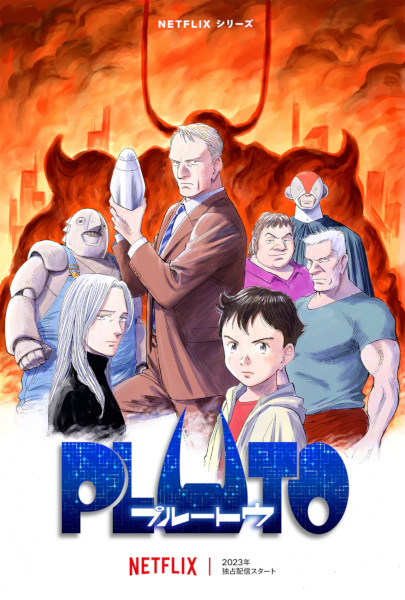
Pluto
Is Pluto worth watching?
Yes — a standout. Anime Codex rates Pluto 8.96 out of 10 — scored on six criteria (story, characters, themes, world-building, animation, and cultural impact), not crowd votes. 9th of 226 on the Codex rubric — top 4% of the catalogue. The Codex rates it Δ +0.52 above its MAL score — more underrated than 98% of the catalogue.
Where to watch
Trailer
What the data says
Computed from the Codex rubric across the whole catalogue.
Summary
Pluto is among the strongest seinen adaptations of recent years, transforming a Tezuka children's story into a mature murder mystery and war allegory carried by Urasawa's signature humanism. Its greatest strength is character: Gesicht anchors the series with a grief-laden arc, while self-contained episodes about North No. 2, Brando, and Hercules deliver disproportionate emotional impact, exploring robot personhood, vengeance, and the contagion of hatred with sophistication rarely matched in the demographic. The mystery plotting is disciplined and the anti-war themes resonate without preaching. Weaknesses are modest but real. Compressing eight manga volumes into eight episodes leaves some connective material rushed, and the late-game revelations around Abullah, Dr. Tenma, and Atom's resurrection feel comparatively thinner than the show's best standalone chapters. The animation, while faithful and atmospheric under M2's restrained direction, is serviceable rather than dazzling, with occasionally stiff CG and unremarkable action. The world-building, though coherent and richly textured, builds on Tezuka's existing framework rather than original invention. Judged against the best seinen drama, Pluto is a deeply intelligent, emotionally devastating work that prioritizes theme and character over spectacle — a near-essential watch for viewers seeking thoughtful science fiction, slightly held back by pacing compression and merely competent visual execution.
Criterion breakdown
Story & narrative
Adapting Urasawa's reimagining of Tezuka's 'The Greatest Robot on Earth,' Pluto restructures a children's arc into a taut murder mystery and geopolitical thriller, weaving the Bora Inquiry and the 39th Central Asian War as a clear 9/11 and Iraq War allegory. The procedural spine of Gesicht hunting a robot-killer is consistently gripping, and the late pivot to Dr. Tenma, Abullah, and the Sahad/Pluto revelation lands the conspiracy with genuine weight. Compressing eight manga volumes into eight episodes occasionally rushes connective tissue, but the plotting remains remarkably disciplined for its length.
Character writing & growth
Gesicht is a superb protagonist whose suppressed memories, grief over his murdered adopted child, and capacity for hatred make him the emotional core, and his arc's brutal payoff is devastating. The standalone vignettes — North No. 2 and the composer, the blind musician; Brando and Hercules' rivalry; Atom and the dying Gesicht — give even minor robots full interior lives in minutes. The hatred-as-virus thread connecting Gesicht, Pluto, and Atom is thematically rich, though Atom's resurrection and Abullah's villainy feel slightly thinner than the standout episodes.
Themes & emotional resonance
The show interrogates grief, vengeance, and the cyclical nature of hatred with rare maturity, asking whether robots' acquisition of 'human' emotion is a gift or a curse. Episode beats like North No. 2 learning the piano, or Gesicht's frozen tears, render the question of robot personhood viscerally. Its anti-war and anti-revenge messaging never collapses into preachiness, sustaining genuine emotional resonance throughout.
World-building & power system
The setting is a coherent near-future where androids hold jobs, marry, and lobby for rights, built on internally consistent rules — robots cannot kill humans, and the singular exception drives the entire mystery. Details like robot families adopting children, anti-robot hate groups, and the political machinery of the Bora Inquiry give the world texture beyond its premise. It loses a fraction for leaning on Tezuka's existing Astro Boy scaffolding rather than originating wholesale.
Animation & direction
Studio M2's production faithfully renders Urasawa's detailed, grounded art style with restrained, deliberate direction suited to a slow-burn drama. Quiet character moments and the tornado-summoning Pluto setpieces are handled competently, and the muted palette reinforces the somber tone. However, some CG integration and action choreography feel merely serviceable rather than spectacular, falling short of the medium's visual benchmarks.
Cultural impact
As a long-awaited adaptation of a landmark Naoki Urasawa manga reinterpreting Osamu Tezuka, Pluto carried significant prestige and earned strong critical reception as a Netflix release. Its 8.44 MAL score reflects respect among seinen audiences, though its limited episode count and quieter genre kept it from the broad fandom footprint of major shonen titles.
Synopsis (from MAL)
Gesicht, an android police detective of Europol, is tasked with finding the murderer of Montblanc, a retired war hero robot. Although it appears that only a robot could have committed this crime, the murder of a renowned robot rights activist casts doubts on the criminal's identity. Indeed, outside of an isolated and unexplained incident that occurred eight years ago, robots are programmed to be unable to kill human beings. However, the lack of human evidence on the crime scene and the similarity of modus operandi lead Gesicht to suspect that the two murderers might be the same being—be they man or robot. Shortly after Montblanc's passing, another retired elite war robot is mysteriously eliminated. Gesicht notices a pattern in the choice of murder victim: both dead robots belonged to a group of the seven most powerful war machines ever designed. Determined to stop the murderer from eliminating the five remaining veterans, Gesicht seeks help from Atom, a cutting-edge android who resembles a human boy. The duo must now hunt down the rogue killer before the series of murders is carried on, lest the very fabric of society suffer irremediable damage. [Written by MAL Rewrite]
Ranked nearby

Explore rankings
Discussion
Set a display name above to post.
Loading discussion…