I Made Friends with the Second Prettiest Girl in My Class Review: A 7.38 That Lives on Asanagi and Pays for It in Middle-Episode Drift
Judged against one consistent rubric, this Connect production is best understood by which criteria carry it and which drag it down — not by the 7.93 the crowd handed it.
Judged against one consistent rubric, this Connect production is best understood by which criteria carry it and which drag it down — not by the 7.93 the crowd handed it.
The most honest thing about I Made Friends with the Second Prettiest Girl in My Class is its title, which promises a low-ceiling premise and then refuses to overreach. The dishonest thing is treating that restraint as achievement. Connect's twelve-episode 2026 adaptation lands a Codex 7.38 against MyAnimeList's 7.93 — a 0.55-point gap that isn't the crowd being wrong so much as the crowd grading the good half twice.
The MyAnimeList Consensus and What It Isn't Counting
The MyAnimeList crowd scores it 7.93 from roughly 130,000 members, which puts it comfortably above the comfort-romance median. Engage that number directly: it reflects a real strength — the show's specific texture of two people doing nothing together on a Friday — inflated by the affection viewers extend to any seinen slice-of-life that treats its female lead as a person instead of a prize. The rubric can credit the first thing without waving through the second. Anime Codex departs from the crowd on two axes: world-building, where the show mistakes a good sanctuary for a built setting, and cultural, where its footprint is genuinely contained to seasonal discourse and the "second girl wins" meme cycle. Everything else lands roughly where the numbers suggest.
This is the pattern the Codex has flagged elsewhere in the comfort-romance space — see the Recovery of an MMO Junkie review for a title where character carries a scorecard the production can't match. Kuranika isn't that show, exactly. Its production is stronger. But the shape of the gap — a rubric quietly discounting what the crowd inflates — is the same.
Where Asanagi Carries the Scorecard
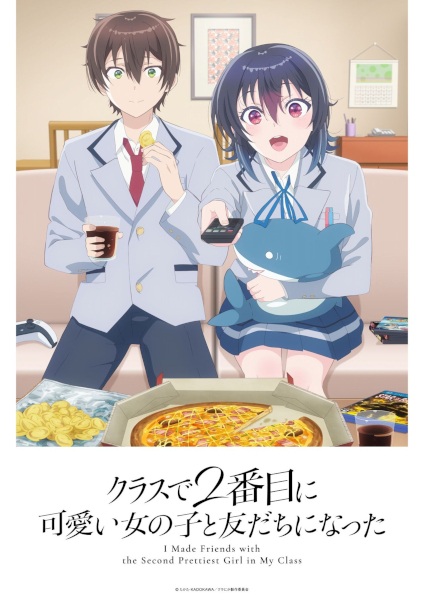
Character posts a 7.8, and it earns it in a single specific choice: Asanagi's Friday defection from her best friend is given interiority rather than played as quirk. The show lets her sprawl on Maki's floor, junk-food sated, hair unstyled, and treats that unglamorous version as the real one rather than the reveal. This is the "messy to the outside world" thesis the premise gestures at, and unlike most seinen leads in this lane, she isn't performing lowered guard — she just has one. Maki's social anxiety is rendered with matching restraint, no comic exaggeration, no rubber-faced panic sequences. His arc — a gradual willingness to be perceived — is the emotional spine, and it holds.
The problem is Amami. The show introduces her as the "cutest girl" counterweight and then leaves her underwritten as a person, functioning almost entirely as a structural obstacle to the Friday ritual until very late in the run. When the back third finally activates her — the tension of whether Maki and Asanagi's hidden time survives exposure — she's asked to carry weight the writing hasn't invested in her. That's the ceiling on the character score. Two of three principals are excellent; one is a device with a name.
The Middle Episodes Are the Story Score
Story lands at 7.2 and the reason is midsection drift. The premise wisely sidesteps harem mechanics — no contrived romantic escalation, no love-triangle theatrics imported to manufacture stakes — and lets episodes breathe through pizza deliveries, co-op sessions, and shared manga. When this works, in the early Friday sequences and again in the back third, it works genuinely. The slow-burn structure pays off when Amami's presence introduces the first real question the show has asked: can this hidden time survive being seen.
But between the setup and that payoff sit two episodes that recycle the same comfort beats without advancing anything. Same apartment, same rituals, same emotional register — the show mistakes repetition for texture. Director Hideki Tachibana's preference for static, lingering shots and naturalistic pacing is a strength when there's subtext to sit with and a liability when there isn't. The resolution is warm and predictable, and the show declines the harder question its own framing raised: whether such private worlds are actually sustainable, or just delayed. It resolves by reassurance. That's the ceiling.
Themes Reach Higher Than the Story Does
Themes score 7.5 — the show's second-strongest criterion — because the central idea is genuinely uncommon in this lane. Being unseen by the world is framed as refuge, not tragedy. The hidden time is worth protecting, not escaping toward some public romance climax. In the quiet scenes where neither character performs for anyone — the wordless stretches of co-op play, the late-night manga passes — the show captures a specific loneliness-into-belonging arc that seinen comfort dramas usually only gesture at.
Where it pulls its punch is the same place the story pulls its punch: the endgame trades the harder question (does this survive adulthood, or exposure, or graduation) for reassurance that it will. The rubric can credit the reach and dock the retreat. 7.5 is exactly where that math lands.
Connect Delivers a Room, Not a World
Animation at 7.6 and world at 6.8 tell one story between them. Connect delivers warm, soft-lit interiors, tactile food animation, and small physical comedy — the specific weight of two people lounging — that make Maki's apartment feel lived-in. Asanagi's face-acting is the load-bearing performance work, carrying whole scenes that have no plot to lean on. Tachibana's static compositions suit that intimacy.
The palette is conservative, though, and a couple of episodes betray budget with held frames and repeated layouts. And the world criterion — read as setting depth rather than fantasy scale — catches the show's real limit. The apartment is fully realized. The classroom hierarchy ("second cutest," "cutest") is a sharp observation of status economies that the show never actually interrogates; it uses the label and moves on. Originality is modest. This is a refinement of a familiar slice-of-life mold, not a new one.
The Steelman: The Crowd Is Reading the Craft Correctly
The strongest defense of the 7.93 is that comfort-romance is supposed to be judged on whether the room feels warm, and this room does. On that reading, the mid-run repetition isn't a flaw — it's the point, the rhythm of a genuine friendship rather than a plotted one. Amami's thinness is a feature: the show is about the two people who matter to each other, not the third.
The rubric hears that argument and still marks it down, because a criterion-based score has to distinguish between a room that's warm because it's carefully built and a room that's warm because the same shot has been reused. Cultural at 6.5 is the honest number: real reception, contained impact, no redefinition of the form. This isn't the Chibi Maruko-chan case where one criterion rewrites a scorecard. It's a show where every criterion pays its own weight, and most of them pay in the 7s.
Verdict
I Made Friends with the Second Prettiest Girl in My Class is a 7.38 that Asanagi and the apartment earn, and that Amami, the middle episodes, and a conservative palette pay for. The gap with MyAnimeList isn't the crowd overrating a bad show — it's the crowd rewarding the good half without deducting for the drift. Watch it for the Fridays. Don't mistake the warmth for weight.
Featured in the Codex



More from The Codex
The Seven Deadly Sins Is a 6.60 Wearing a 7.60 Costume: A One-Point Gap Earned by Groping Gags and Convenient Flashbacks
The Seven Deadly Sins scores 6.60 on the Codex against MyAnimeList's 7.60 because the crowd is grading a Netflix breakout and a Ban-and-King friendship, not the 24 episodes A-1 Pictures actually broadcast in 2014.
The 10.0 That Built a Sunday: How Sazae-san's Cultural Score Carries a 6.58 Scorecard
Sazae-san is a case study in how a single criterion — cultural — can define how a show is remembered, and the 10.0 the Codex hands Eiken's 1969 institution is doing every bit of the heavy lifting its other five scores refuse to.
The Sebastian Problem: Why Black Butler Sits 1.10 Below Its MAL Line and the Crowd Refuses to Notice
Black Butler (Kuroshitsuji) posts a 1.10-point gap between MyAnimeList's 7.65 and the Codex 6.55 because the crowd is grading Sebastian's silhouette and a Phantomhive aesthetic, not the anime-original finale A-1 Pictures actually shipped in 2009.
Discussion
Set a display name above to post.
Loading discussion…