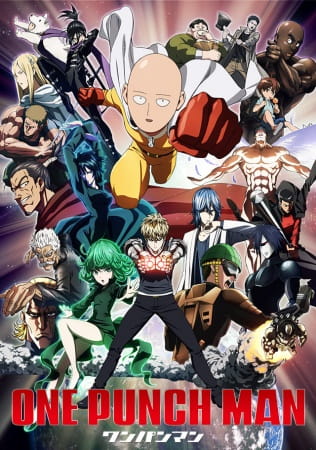
One Punch Man
Is One Punch Man worth watching?
Worth a look. Anime Codex rates One Punch Man 7.28 out of 10 — scored on six criteria (story, characters, themes, world-building, animation, and cultural impact), not crowd votes. 113th of 226 on the Codex rubric — top 50% of the catalogue. The crowd rates it 1.19 higher than the rubric does — the Codex is harder on it than on 81% of the catalogue.
Where to watch
What the data says
Computed from the Codex rubric across the whole catalogue.
Summary
One Punch Man's 2015 Madhouse season is notable for weaponizing a single joke — an invincible hero bored by his own omnipotence — into both effective comedy and genuine commentary on purpose, recognition, and the mythology of heroism. Within seinen action, it distinguishes itself by relocating tension away from Saitama's inevitable victories toward the people who must actually struggle, most poignantly in Mumen Rider's doomed stand and Genos's revenge arc. Its greatest achievement is craft: Shingo Natsume's direction and Madhouse's sakuga produce action set-pieces, particularly against the Deep Sea King and Boros, that remain reference points for the medium. The weaknesses are structural. The cast beyond Saitama and Genos are largely gag archetypes, the world is deliberately thin, and the narrative is a loose episodic build toward one climax rather than a tightly woven plot. The static protagonist is a feature, not a bug, but it caps how much emotional depth the story can reach in a single cour. Judged against the best seinen, it is a brilliantly executed, visually definitive satire that prioritizes tone and spectacle over narrative and thematic ambition — good-to-excellent, but not the deepest of its demographic.
Criterion breakdown
Story & narrative
The premise inverts the shonen power-fantasy structure with genuine wit: the protagonist is already unbeatable, so tension is relocated from 'will he win' to 'will he be recognized' and 'who does the actual struggling.' However, the 12-episode arc is essentially a single build-up to the Boros fight, and its narrative momentum leans heavily on parody and episodic villain-of-the-week structure rather than a tightly plotted throughline. The Hero Association ranking subplot adds welcome stakes but is only lightly developed by season's end.
Character writing & growth
Saitama is deliberately a static character — that flatness is the joke and the thematic point, which limits conventional growth by design. Genos carries the actual arc energy with his revenge quest and hero-worship, and side figures like Mumen Rider and Speed-o'-Sound Sonic land memorably, but most of the cast are gag archetypes with little interiority. The show is smart about using Saitama's boredom as characterization rather than treating it as a flaw, though it rarely digs deeper than that single note in this season.
Themes & emotional resonance
The satire of hero culture, celebrity, and the hollowness of achieving one's dream is sharper than most action series attempt — Saitama's ennui is a real meditation on purpose after victory. The Mumen Rider stand against the Deep Sea King crystallizes the theme that heroism is about will, not strength, which resonates precisely because Saitama lacks the struggle everyone else faces. It stops short of interrogating these ideas as deeply as top-tier seinen, keeping the tone comedic.
World-building & power system
The Hero Association ranking system is a clever bureaucratic framework that generates comedy and structure, satirizing merit and reputation more than building a coherent power system. Monster and threat-level classifications (Wolf to Dragon) give fights legible stakes, but the setting is intentionally thin and generic-city, more canvas for parody than a richly realized world. Originality lies in premise and tone rather than lore depth.
Animation & direction
Madhouse's production is the season's defining strength: the fluid, weighty sakuga of the Saitama–Genos versus Deep Sea King and the climactic Boros exchange in episode 12 rank among the best action animation of the decade. Direction by Shingo Natsume uses exaggerated detail and speed for the serious fights, then flat, deadpan gag-art for Saitama, making the visual contrast itself a joke. The spectacle earns its reputation without ever feeling like empty flash.
Cultural impact
One Punch Man became a genre-defining meme and a mainstream entry point to anime, with Saitama's design and 'one punch' concept achieving broad recognition well beyond core fandom. It popularized the overpowered-satire subgenre and set a benchmark for TV action animation that later productions were measured against. Its cultural footprint far exceeds its 12-episode runtime.
Synopsis (from MAL)
The seemingly unimpressive Saitama has a rather unique hobby: being a hero. In order to pursue his childhood dream, Saitama relentlessly trained for three years, losing all of his hair in the process. Now, Saitama is so powerful, he can defeat any enemy with just one punch. However, having no one capable of matching his strength has led Saitama to an unexpected problem—he is no longer able to enjoy the thrill of battling and has become quite bored. One day, Saitama catches the attention of 19-year-old cyborg Genos, who witnesses his power and wishes to become Saitama's disciple. Genos proposes that the two join the Hero Association in order to become certified heroes that will be recognized for their positive contributions to society. Saitama, who is shocked that no one knows who he is, quickly agrees. Meeting new allies and taking on new foes, Saitama embarks on a new journey as a member of the Hero Association to experience the excitement of battle he once felt. [Written by MAL Rewrite]
Ranked nearby
Explore rankings
Discussion
Set a display name above to post.
Loading discussion…