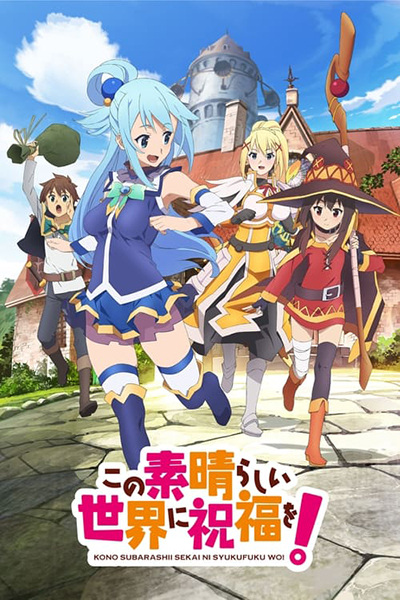
KonoSuba~
Is KonoSuba~ worth watching?
Worth a look. Anime Codex rates KonoSuba~ 7.28 out of 10 — scored on six criteria (story, characters, themes, world-building, animation, and cultural impact), not crowd votes. 114th of 226 on the Codex rubric — top 50% of the catalogue. The crowd rates it 0.81 higher than the rubric does — the Codex is harder on it than on 65% of the catalogue.
Where to watch
What the data says
Computed from the Codex rubric across the whole catalogue.
Summary
KonoSuba is one of the sharpest comedy-isekai ever made, notable for gleefully inverting a genre it arrived to mock: instead of a triumphant power fantasy, Kazuma is stuck in a broke, bureaucratic fantasy world with a party of magnificently dysfunctional teammates. Its strength is character chemistry—the interplay between Kazuma's cynical straight-man and Aqua, Megumin, and Darkness's escalating uselessness generates comedy that still holds up. Studio Deen's loose, off-model animation is unconventionally an asset, weaponized by expressive direction and impeccable comic timing into a hallmark of the show's identity. Its weaknesses are inherent to its design: the plot is thin and episodic, with the Demon King quest reduced to a perpetual punchline, and there is little dramatic stakes or meaningful character growth across its ten episodes. Thematic depth is intentionally shallow, offering only faint undercurrents of found-family and escapist disillusionment. Judged against the best seinen comedies rather than plot-driven epics, KonoSuba excels at exactly what it sets out to do, and its cultural footprint on the isekai boom is significant. It is a near-definitive comedy that trades narrative ambition for consistent, character-driven laughs—an excellent execution of a deliberately narrow aim.
Criterion breakdown
Story & narrative
KonoSuba's narrative is deliberately anti-epic: the Demon King quest is a running joke while the actual episodes revolve around debt collection, avoiding work, and low-stakes disasters like the Dullahan Beldia and the flood-god Kaibaitzu. This episodic, punchline-driven structure is a strength for its comedic goals but means there's little dramatic momentum or overarching tension across the 10 episodes. It parodies isekai conventions cleverly rather than building a compelling plot of its own.
Character writing & growth
The four leads are the show's engine: Kazuma's cynical, morally-flexible straight-man reactions anchor the absurdity of Aqua's uselessness, Megumin's explosion obsession, and Darkness's masochism. What elevates it above one-note gag characters is how their flaws mutually amplify—Kazuma's petty pragmatism is genuinely funny precisely because his party actively sabotages every situation. Growth is minimal by design, though Kazuma's occasional competence (the Beldia fight, the winter survival) hints at more than pure comedy.
Themes & emotional resonance
The show mostly disclaims deeper themes, which suits its parody intent, but there are undercurrents of found-family and the gap between escapist fantasy and grinding reality. Kazuma's dead-end NEET status and the mundane hardship of adventuring life carry a wry, relatable melancholy beneath the jokes. It never pursues these seriously, so emotional resonance is intentionally shallow relative to seinen that mine comedy for pathos.
World-building & power system
The premise—an isekai where the fantasy world is bureaucratic, broke, and unglamorous—is a genuinely fresh inversion of a saturated genre in 2016. The mechanics are internally consistent and used for comedy: Aqua's overpowered but situationally-useless divine skills, Megumin's one-shot-per-day explosion limitation, and the quest-guild economy all pay off as jokes. It's less about depth and more about wittily subverting isekai expectations rather than expanding them.
Animation & direction
Studio Deen's production is famously loose and off-model, but director Takaomi Kanasaki weaponizes this: the expressive, exaggerated facial distortions and rubbery reaction shots (Aqua's ugly-crying, Kazuma's deadpan glares) are central to the comic timing. It's not polished in the technical sense, yet the direction and voice performances—especially Sora Amamiya and Jun Fukushima's rapid-fire exchanges—make the deliberate scrappiness feel like a feature. Action scenes are functional at best.
Cultural impact
KonoSuba became a defining comedic touchstone of the isekai boom, proving the genre could thrive through parody rather than power fantasy, and spawning a lasting franchise with multiple seasons, a film, and spin-offs. Megumin in particular achieved iconic fandom status. Its influence on subsequent comedy-isekai is substantial despite the modest first-season episode count.
Synopsis (from MAL)
After dying a laughable and pathetic death on his way back from buying a game, high school student and recluse Kazuma Satou finds himself sitting before a beautiful but obnoxious goddess named Aqua. She provides the NEET with two options: continue on to heaven or reincarnate in every gamer's dream—a real fantasy world! Choosing to start a new life, Kazuma is quickly tasked with defeating a Demon King who is terrorizing villages. But before he goes, he can choose one item of any kind to aid him in his quest, and the future hero selects Aqua. But Kazuma has made a grave mistake—Aqua is completely useless! Unfortunately, their troubles don't end here; it turns out that living in such a world is far different from how it plays out in a game. Instead of going on a thrilling adventure, the duo must first work to pay for their living expenses. Indeed, their misfortunes have only just begun! [Written by MAL Rewrite]
Ranked nearby
Explore rankings
Discussion
Set a display name above to post.
Loading discussion…