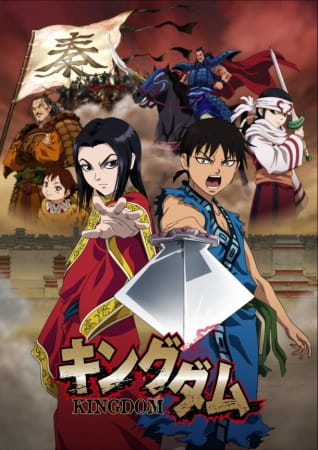
Kingdom
Is Kingdom worth watching?
Worth a look. Anime Codex rates Kingdom 6.98 out of 10 — scored on six criteria (story, characters, themes, world-building, animation, and cultural impact), not crowd votes. 130th of 226 on the Codex rubric — bottom 43% of the catalogue. The crowd rates it 0.88 higher than the rubric does — the Codex is harder on it than on 69% of the catalogue.
Where to watch
What the data says
Computed from the Codex rubric across the whole catalogue.
Summary
Kingdom stands out in seinen for grounding its epic in genuine Warring States history, building a politically literate world where strategy, feudal hierarchy, and the brutal logic of conquest carry as much weight as individual heroics. Its dual narrative—Xin's bloody climb from slave to general alongside Ying Zheng's chess game for the throne—gives the series both visceral battlefield momentum and political intelligence, peaking in the Battle of Bayou and the Coalition Invasion. The themes of inherited dreams and merit over birthright resonate, anchored by Piao's death. Its fatal flaw is the 2012 Studio Pierrot CGI: the stiff, artificial armies sabotage the spectacle a war epic demands, making the show's greatest set pieces its weakest-looking. Xin's relentless loudness and some underbaked supporting characters also hold the writing back from the genre's best. Yet the source material's strength carries it: this is intelligent, large-scale historical fiction that respects its audience, rewarding viewers willing to look past the visuals. Within seinen, it is a good-but-flawed entry whose ambition and worldbuilding outrun its production, and whose reputation would be properly cemented by later, better-animated seasons rather than this initial adaptation alone.
Criterion breakdown
Story & narrative
The first season's structure is strong, moving from the palace coup that opens the series into the Battle of Bayou, where Xin's mountain-people alliance with Yang Duan He pays off the political setup with real tactical stakes. The adaptation compresses Hara's manga efficiently and the Coalition Invasion arc late in the run delivers genuine large-scale war narrative, though the pacing sags in transitional episodes and some battles resolve via convenient strategic reveals rather than earned tension.
Character writing & growth
Xin's arc from reckless slave to commander of the Hi Shin Unit is satisfying, and Ying Zheng's calculated ambition gives the political half real weight, especially during his confrontation with half-brother Cheng Jiao. However, Xin remains fairly one-note in his loudness for long stretches, and several side characters like Ten/Kyoukai are introduced with intrigue but underdeveloped within these 38 episodes, leaving growth feeling front-loaded onto the leads.
Themes & emotional resonance
The dream of unifying China and the cost of ambition resonate, with Piao's death framing the entire series as a meditation on inherited dreams and brotherhood. The exploration of merit versus birthright through Xin's slave origins and Zheng's contested throne is genuine, though the show often retreats to rousing motivational speeches rather than sitting with the moral cost of its constant warfare.
World-building & power system
The Warring States setting is a standout: grounded in actual Qin history with the seven states, the structure of armies, generals, and feudal politics rendered with real depth and internal consistency. The military hierarchy and battlefield tactics function as the 'power system' and feel authentic, with figures like Wang Yi and the strategic logic of formations giving the world genuine texture rarely seen in the demographic.
Animation & direction
This is the show's glaring weakness: Studio Pierrot's heavy reliance on early-2012 CGI for crowd and battle scenes produces stiff, plasticky armies that clash badly with the 2D character work, undercutting the very large-scale warfare the story is built around. Direction during major engagements like Bayou suffers most, and only quieter dialogue scenes hold up visually.
Cultural impact
Kingdom is a massive commercial property in Japan with a long-running, award-winning manga and multiple anime seasons plus live-action films, sustaining a devoted fanbase. However, this first season's notorious CGI limited its international breakout, and its broader cultural footprint grew more from later seasons and the manga than from this 2012 adaptation specifically.
Synopsis (from MAL)
China’s Warring States period, a raging dragon that would raze the land for 500 years, saw many kingdoms rise and fall, making way for the next generation of kings and generals to fight for supremacy. Eventually, seven powerful states emerged from the endless cycle of warfare. In the kingdom of Qin, Xin, a war-orphaned slave, trains vigorously with fellow slave and best friend, Piao, who shares his proud dream of one day becoming a Great General of the Heavens. However, the two are suddenly forced to part ways when Piao is recruited to work in the royal palace by a retainer of the King. After a fierce coup d'état unfolds, Piao returns to Xin, half dead, with a mission that will lead him to a meeting with China's young King, Ying Zheng, who bears a striking resemblance to Piao. Kingdom follows Xin as he takes his first steps into the great blood-soaked pages of China's history. He must carve his own path to glory on his long quest to become a Great General of the historic Seven Warring States. [Written by MAL Rewrite]
Ranked nearby

Explore rankings
Discussion
Set a display name above to post.
Loading discussion…