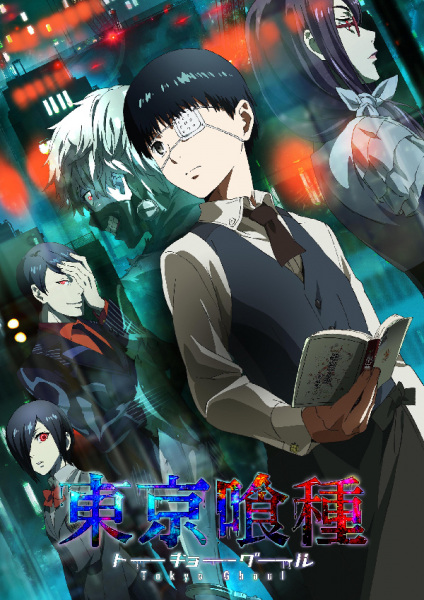
Tokyo Ghoul
Is Tokyo Ghoul worth watching?
Worth a look. Anime Codex rates Tokyo Ghoul 6.93 out of 10 — scored on six criteria (story, characters, themes, world-building, animation, and cultural impact), not crowd votes. 137th of 226 on the Codex rubric — bottom 40% of the catalogue. The crowd rates it 0.86 higher than the rubric does — the Codex is harder on it than on 68% of the catalogue.
Where to watch
Trailer
What the data says
Computed from the Codex rubric across the whole catalogue.
Summary
Tokyo Ghoul stands as a landmark mid-2010s seinen horror-action title whose strongest asset is its premise: an unwilling human-ghoul hybrid forced to navigate the moral gray zone between predator and prey. Kaneki's psychological disintegration under Yamori's torture — culminating in the iconic episode 12 transformation — is the adaptation's high point, and the kagune/quinque power system gives the world a coherent, grimly original biology. Themes of dehumanization and the symmetry of violence between ghouls and the CCG are well-suited to the demographic and genuinely resonate. Its cultural footprint is outsized, propelled by Yamada's score and the 'Unravel' opening. The chief weaknesses are structural: 12 episodes cannot carry Ishida's dense source material, so supporting characters and the broader political conflict are underdeveloped, and the pacing rushes its back half. Studio Pierrot's inconsistent production and heavy violence-censorship further undercut the action and atmosphere. Judged against the best seinen — works like Monster or Vinland Saga — it lacks their narrative patience and craftsmanship, but as an accessible, atmospheric horror entry point it succeeds more than it fails, leaving a memorable protagonist arc that the franchise's later seasons largely squandered.
Criterion breakdown
Story & narrative
The first season's adaptation of Kaneki's transformation and his integration into Anteiku is compelling, with the Aogiri Tree arc and Jason's torture sequence serving as a strong climactic turning point. However, the 12-episode run compresses Ishida's source material aggressively, rushing through character motivations and leaving the conflict between ghouls and the CCG underdeveloped; the pacing in the back half sacrifices narrative coherence for momentum, and the finale prioritizes spectacle over the manga's more deliberate buildup.
Character writing & growth
Kaneki's arc from timid bookworm to hardened hybrid is the show's spine, and his torture-induced break in episode 12 — the white-hair transformation and the centipede hallucination with Yamori — is a genuinely effective psychological pivot. Touka and Hide add emotional texture, but supporting figures like the Tsukiyama and the CCG investigators (Amon, Mado) are introduced faster than they can earn weight, leaving some growth feeling asserted rather than dramatized within the limited runtime.
Themes & emotional resonance
The central tension — what it means to retain humanity while becoming a monster, and the moral symmetry between ghoul predation and human hunting — is genuinely resonant and well-suited to seinen. Mado's vendetta and Amon's worldview complicate any easy victim/villain binary, and Kaneki's mantra-counting during torture crystallizes the theme of self-loss. The compressed runtime undercuts deeper exploration, but the emotional core lands.
World-building & power system
The ghoul biology is a strong original premise: kagune as predatory organs, the RC cell system, kakugan eyes, and the CCG's quinque weapons forged from ghoul corpses give the setting internal logic and a grim symmetry. The wards-and-doves structure of ghoul society and Anteiku as a sanctuary add texture, though the anime only gestures at the full depth of Ishida's world, leaving political and organizational layers thin.
Animation & direction
Director Shuhei Morita delivers striking imagery — the monochrome torture sequence, the bleeding 'TK' colorization, and Yutaka Yamada's haunting score elevate key moments. However, Studio Pierrot's production is inconsistent: action choreography is often muddy, the infamous censorship and heavy shadow-masking obscure violence to the point of distraction, and several fight sequences feel budget-constrained rather than artistically restrained.
Cultural impact
Tokyo Ghoul became a defining horror-action title of the mid-2010s, with Kaneki's mask and white hair entering the broader anime iconography and the 'Unravel' opening becoming one of the most recognized OPs of the decade. Its massive MAL membership reflects genuine cross-demographic reach, even as later adaptations damaged the franchise's critical reputation.
Synopsis (from MAL)
A sinister threat is invading Tokyo: flesh-eating "ghouls" who appear identical to humans and blend into their population. Reserved college student Ken Kaneki buries his nose in books and avoids the news of the growing crisis. However, the appearance of an attractive woman named Rize Kamishiro shatters his solitude when she forwardly asks him on a date. While walking Rize home, Kaneki discovers she isn't as kind as she first appeared, and she has led him on with sinister intent. After a tragic struggle, he later awakens in a hospital to learn his life was saved by transplanting the now deceased Rize's organs into his own body. Kaneki's body begins to change in horrifying ways, and he transforms into a human-ghoul hybrid. As he embarks on his new dreadful journey, Kaneki clings to his humanity in the evolving bloody conflict between society's new monsters and the government agents who hunt them. [Written by MAL Rewrite]
Ranked nearby

Explore rankings
Discussion
Set a display name above to post.
Loading discussion…