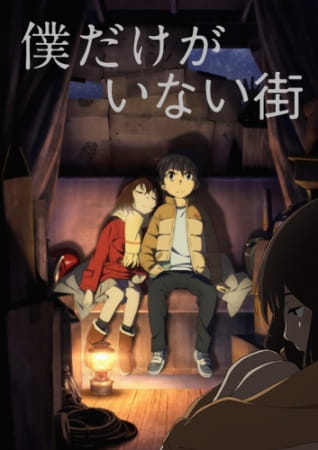
Erased
Is Erased worth watching?
Worth a look. Anime Codex rates Erased 6.91 out of 10 — scored on six criteria (story, characters, themes, world-building, animation, and cultural impact), not crowd votes. 141st of 226 on the Codex rubric — bottom 39% of the catalogue. The crowd rates it 1.39 higher than the rubric does — the Codex is harder on it than on 89% of the catalogue.
Where to watch
What the data says
Computed from the Codex rubric across the whole catalogue.
Summary
Erased is a tightly atmospheric time-travel thriller that stands out in seinen for its emotional sincerity rather than plot ingenuity. Its greatest strengths are Tomohiko Ito's assured direction — the wintry 1988 Hokkaido setting, deliberate visual motifs, and dread-laden pacing — and the deeply affecting relationship between Satoru and the abused, withdrawn Kayo Hinazuki, whose arc delivers the series' most moving moments. Sachiko, Satoru's perceptive mother, adds warmth and grounding. Yuki Kajiura's score and A-1's polished production reinforce a consistently tense, melancholic mood. The show falters, however, where it matters most for a mystery: the culprit is telegraphed far too early, the antagonist is a shallow, cartoonishly motivated sociopath, and the final act abandons the careful groundwork for a contrived confrontation and a lengthy coma time-skip that deflates the tension. Supporting classmates remain thin. Judged against the best seinen thrillers, Erased is emotionally resonant and beautifully directed but narratively flawed — a strong character-drama-with-a-thriller-frame rather than a masterful whodunit. It earns its popularity as an accessible, affecting gateway title, and its treatment of childhood neglect lingers, even as its mystery mechanics disappoint. Watch it for Kayo and the atmosphere, not the twist.
Criterion breakdown
Story & narrative
The time-travel-thriller premise is gripping for its first two-thirds — the 1988 arc built around saving Kayo Hinazuki generates real tension, and the parallel between past abductions and the present-day murder is elegantly constructed. However, the mystery cheats: the culprit's identity is telegraphed early through obvious framing and character behavior, and the final act collapses into a contrived rooftop confrontation and an 15-year coma skip that undercuts the careful pacing. As a seinen thriller it is competent and compelling but not tightly plotted enough to rank among the genre's best.
Character writing & growth
Satoru is an effective if somewhat passive protagonist whose adult-mind-in-child-body perspective is used well, and Kayo Hinazuki is the show's genuine triumph — her abused, guarded interiority and the warm-milk and birthday-party scenes are handled with unusual tenderness. Sachiko, Satoru's mother, is a standout supporting character. But the antagonist is a hollow cardboard 'sociopath' with cartoonish motivation, and secondary classmates like Kenya are underdeveloped, weakening the ensemble.
Themes & emotional resonance
The exploration of child abuse, neglect, and the impulse to intervene in others' suffering is emotionally potent, especially through Kayo's arc and the recurring 'reaching out' motif. Themes of adult regret and second chances resonate strongly in the 1988 sections. The resonance dilutes in the finale, where the neat resolution and villain's flat menace sap the moral weight the earlier episodes earned.
World-building & power system
The 1988 Hokkaido setting is richly evoked — snow-laden streets, period detail, and the cold isolation that makes Kayo's plight believable. 'Revival' is a deliberately vague, low-mechanic device that serves narrative tension rather than a rule-system, and the show wisely never over-explains it. Internal consistency around the power is loose, but the premise's originality and atmospheric setting carry this category.
Animation & direction
Tomohiko Ito's direction is the show's strongest technical asset — the desaturated winter palette, the recurring butterfly and film-frame motifs, and the tense cross-cutting during the river and abduction sequences are memorable. A-1's production is clean and controlled, and Yuki Kajiura's score amplifies the dread effectively. Some CG and background flatness appear, but the directorial craft is consistently above genre average.
Cultural impact
Erased was a breakout hit of Winter 2016, widely discussed and earning a live-action film and Netflix adaptation, which extended its reach beyond typical anime audiences. It remains a frequently recommended 'gateway' thriller. Its impact is real but not genre-defining — it did not reshape seinen thrillers the way landmark titles have.
Synopsis (from MAL)
When tragedy is about to strike, Satoru Fujinuma finds himself sent back several minutes before the accident occurs. The detached, 29-year-old manga artist has taken advantage of this powerful yet mysterious phenomenon, which he calls "Revival," to save many lives. However, when he is wrongfully accused of murdering someone close to him, Satoru is sent back to the past once again, but this time to 1988, 18 years in the past. Soon, he realizes that the murder may be connected to the abduction and killing of one of his classmates, the solitary and mysterious Kayo Hinazuki, that took place when he was a child. This is his chance to make things right. Boku dake ga Inai Machi follows Satoru in his mission to uncover what truly transpired 18 years ago and prevent the death of his classmate while protecting those he cares about in the present. [Written by MAL Rewrite]
Ranked nearby

Explore rankings
Discussion
Set a display name above to post.
Loading discussion…