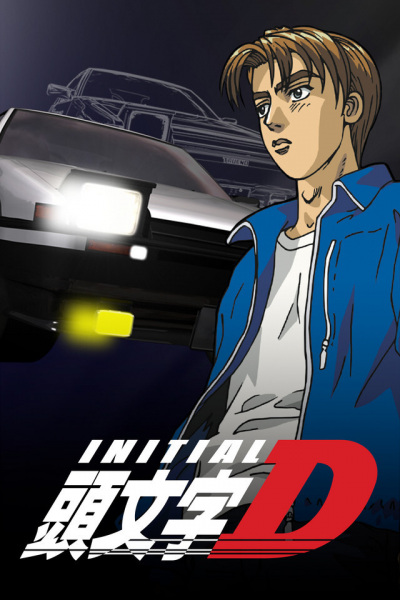
Initial D
Is Initial D worth watching?
Worth a look. Anime Codex rates Initial D 6.83 out of 10 — scored on six criteria (story, characters, themes, world-building, animation, and cultural impact), not crowd votes. 150th of 226 on the Codex rubric — bottom 35% of the catalogue. The crowd rates it 1.53 higher than the rubric does — the Codex is harder on it than on 92% of the catalogue.
Where to watch
Trailer
What the data says
Computed from the Codex rubric across the whole catalogue.
Summary
Initial D's First Stage is a landmark of the racing seinen, distinctive for treating street racing with near-documentary technical seriousness rather than fantasy spectacle. Its premise — an apathetic tofu-delivery teen whose years of mindless mountain runs have secretly forged elite driving skill — is a genuinely original take on hidden mastery, and its grounded portrayal of real touge passes, accurate car physics, and FR-versus-FF dynamics gives the racing real stakes and internal logic. Ryousuke's analytical mind and Bunta's silent mentorship provide texture, while the escalating ladder of rival challengers keeps momentum strong. The series is rightly celebrated for its outsized cultural impact, popularizing drift culture, the AE86, and Eurobeat worldwide. Its weaknesses are real, however: the episodic formula grows repetitive, most rivals are disposable, and Takumi remains deliberately flat, so character growth feels more situational than psychological. The romance subplot is undercooked and tonally clumsy. Most glaringly, Gallop's 1998 CG cars are stiff and dated, clashing with the hand-drawn art and weakening visual immersion despite excellent sound design and pacing. Judged against the best racing and sports seinen, it is a genuinely influential and well-conceived work held back by uneven execution and aged animation.
Criterion breakdown
Story & narrative
First Stage builds an effective episodic challenge structure, with each rival team (Akagi Red Suns, the Akina SpeedStars, Nakazato's GT-R, Shingo's Civic) escalating tension toward the marquee Keisuke and then Ryousuke duels. The narrative momentum is genuine, but it leans heavily on a repetitive formula of pre-race trash talk, downhill confrontation, and a technical revelation (the gutter-running trick, blind-attack braking), and the Natsuki subplot feels underdeveloped and tonally awkward against the racing through-line.
Character writing & growth
Takumi's arc from disinterested tofu-delivery teen to a driver who consciously embraces racing is quietly well-handled, and Ryousuke's analytical 'theory' personality and Itsuki's comic-relief enthusiasm give the cast texture. However, most rivals exist only to be defeated and lack interiority, and Takumi himself remains deliberately flat and reactive, so growth is more situational than psychological — strong for the genre but not deep by seinen standards.
Themes & emotional resonance
The show resonates around mastery born from mundane repetition — Takumi's thousands of routine downhill runs becoming elite skill is a genuinely satisfying thesis about hidden discipline. Father-son legacy through Bunta's silent mentorship adds weight, but the emotional palette is narrow, and the romance and adolescent themes feel perfunctory next to the racing philosophy.
World-building & power system
The premise is highly original and rigorously consistent: real touge passes, accurate car specs, weight transfer, tire grip, and FR-versus-FF dynamics are treated with documentary seriousness rather than hand-waved spectacle. The AE86 underdog framing against newer machines gives the 'power system' real internal logic, and the grounding in authentic Gunma mountain-road culture is a genuine strength.
Animation & direction
Gallop's 1998 production is the weakest pillar: the early CG cars are stiff, low-poly, and clash jarringly with cel-drawn backgrounds and character art. Direction compensates with strong use of Eurobeat scoring, drift sound design, and effective POV and tachometer cuts that convey speed, but the visuals have aged poorly and undercut tension in wide racing shots.
Cultural impact
Initial D is foundational to global car and drift culture, popularizing the touge, the AE86, gutter-running technique, and Eurobeat to a worldwide audience for decades. Its influence extends far beyond anime into automotive enthusiasm, arcade games, and meme longevity, making its cultural footprint enormous relative to its size.
Synopsis (from MAL)
Unlike his friends, Takumi Fujiwara is not particularly interested in cars, with little to no knowledge about the world of car enthusiasts and street racers. The son of a tofu shop owner, he is tasked to deliver tofu every morning without fail, driving along the mountain of Akina. Thus, conversations regarding cars or driving in general would only remind Takumi of the tiring daily routine forced upon him. One night, the Akagi Red Suns, an infamous team of street racers, visit the town of Akina to challenge the local mountain pass. Led by their two aces, Ryousuke and Keisuke Takahashi, the Red Suns plan to conquer every racing course in Kanto, establishing themselves as the fastest crew in the region. However, much to their disbelief, one of their aces is overtaken by an old Toyota AE86 during a drive back home from Akina. After the incident, the Takahashi brothers are cautious of a mysterious driver geared with remarkable technique and experience in the local roads—the AE86 of Mount Akina. [Written by MAL Rewrite]
Ranked nearby


Explore rankings
Discussion
Set a display name above to post.
Loading discussion…