The My Hero Academia Watch Order, Ranked by What Actually Advances the Plot
Franchise watch-order confusion is real; this lays out the [My Hero Academia](/shows/my-hero-academia) entries in release order with what actually matters — and what you can skip without losing a beat.
Franchise watch-order confusion is real; this lays out the My Hero Academia entries in release order with what actually matters — and what you can skip without losing a beat.
Eighteen entries across nine years, and roughly a third of them are promotional artifacts. The My Hero Academia franchise has calcified into a shape common to Weekly Shonen Jump properties: a spine of TV seasons doing the actual adaptation work, a ring of theatrical films that Horikoshi supervises but keeps carefully non-canonical, and a shell of OVAs and ONAs that exist because Bones needed a Blu-ray bonus or Jump Festa needed a screening. Sorting the essential from the ornamental is the entire job of a watch-order guide, and the franchise's promotional churn has made that job harder than it should be.
What the Consensus Gets Wrong About the My Hero Academia Watch Order
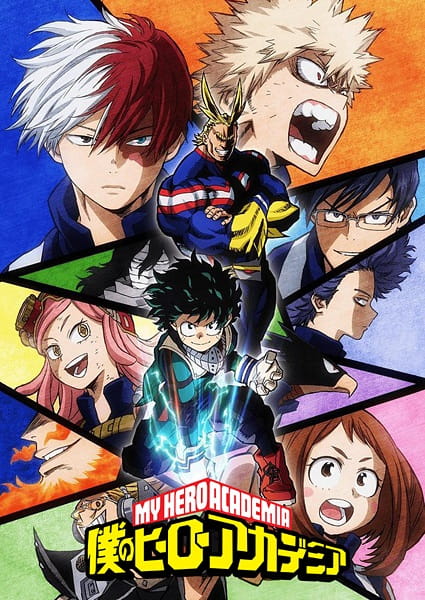
The dominant recommendation on Reddit and MyAnimeList is "watch it all in release order, movies included." That's not wrong, exactly — release order is the correct spine — but it treats a three-minute Jump Festa short and a 25-episode Bones production as equivalent units of viewing time, and it collapses the distinction between what Horikoshi wrote and what a movie committee greenlit around him. The Codex position is narrower. The Anime Codex score of 8.40 attaches to the 2017 broadcast — the 25-episode Season 2 run under Bones, which MyAnimeList grades at 8.05 — and the rubric's strong marks on character (9.0) and animation (8.7) belong to the television spine, not the theatrical detours. The films sit outside the story engine that earned those numbers.
That distinction matters because MHA's films are structurally identical to the Naruto and Bleach film tradition: a self-contained villain, a location Deku will never revisit, an emotional beat that gets referenced in a single line of dialogue at the top of the next TV season, if at all. Two Heroes gestures at All Might's American backstory. Heroes Rising ends with a power transfer that the manga explicitly walks back. World Heroes' Mission introduces a character you will not see again. Everything else in the ancillary tier — the OVAs, the ONAs, the epilogue specials — is bonus material in the literal Blu-ray-extra sense.
The Spine: Seasons One Through Seven Are the Only Non-Negotiables
Start with My Hero Academia (2016, 13 episodes). It's the shortest season and the most compressed adaptation, ending on Deku vs. Bakugo at the training-exercise level. Essential. My Hero Academia Season 2 (2017, 25 episodes) is the Codex-scored entry — the Sports Festival and Stain arcs, the Todoroki backstory in episode 23, the Hero Killer confrontation that reframes the entire vigilante-society question the show has been dancing around. The 9.0 character score is doing real work here, and the 8.7 animation mark reflects Yutaka Nakamura's contributions to the Todoroki-Deku fight. Essential.
The two 2017 OVAs — Training of the Dead and Sukue! Kyuujo Kunren! — are Class 1-A hangout episodes bundled with Blu-ray volumes. Skippable. Nothing that happens in either is referenced again.
My Hero Academia Season 3 (2018) contains the Forest Training Camp, the Kamino raid, and All Might vs. All For One — arguably the peak of the entire adaptation on the animation criterion. Essential. Two Heroes (2018) is the first theatrical outing, competent Bones spectacle, non-canonical. Skippable unless you want the All Might-Melissa material.
Season 4 (2019) is where the pacing critique starts to bite: the Overhaul arc is strong, the Shie Hassaikai raid delivers, but the Culture Festival back half dilutes it. Still essential. Heroes Rising (2019) is the better of the first two films — the Deku-Bakugo climax on Nabu Island is the closest the movies get to mattering — but Horikoshi confirmed it's not canonical. Skippable, worth watching if you like the characters.
The 2019 Two Heroes Specials, the 2020 Make It! Do-or-Die Survival Training ONA, and the 2020 Heroes Rising Epilogue Plus special are all promotional shorts running between two and fifteen minutes. Skippable in every meaningful sense.
Season Five and Six Are the Franchise's Inflection Point
Season 5 (2021) is the season the discourse turned on — the Joint Training arc is fine, the My Villain Academia arc reframes Shigaraki, but the pacing is the weakest in the run. Still essential; you cannot skip to Season 6 without it. World Heroes' Mission (2021) is the third and most disposable film. Skippable.
Season 6 (2022) is the payoff — the Paranormal Liberation War arc is what the show has been building toward since Season 3, and Bones' animation team deliver the franchise's best action stretch since the Kamino raid. Essential, non-negotiable. The three 2022–2023 supplementary pieces — the Season 5 OVA, the World Heroes' Mission Tabidachi short, and UA Battle Heroes — are all promotional. Skippable.
Season 7 (2024, 21 episodes) begins the Final War. Essential, though the production strain is visible in a way it wasn't in Season 3. This is the same tier of shonen franchise-management the Bleach recommendations piece tracks — a property whose animation grammar is being asked to carry more weight than the schedule allows.
The Films Are a Coherent Skip
Two Heroes, Heroes Rising, World Heroes' Mission — three films, three villains-of-the-week, three power-ups that don't transfer to the TV canon. The Codex rubric doesn't score them individually, but the pattern is the one the Yu Yu Hakusho analysis identifies in long-running Jump properties: theatrical entries function as merchandise for the fandom, not as story. Heroes Rising is the one with a legitimate argument — the Nabu Island climax is genuinely animated with care, and if you're a Bakugo-Deku partnership reader, it's the cleanest expression of that dynamic in the whole franchise. But the manga's actual resolution of that dynamic supersedes it.
The Counter-Argument: Completionism Has a Case
The strongest opposing position is that Horikoshi storyboarded elements of Heroes Rising and Two Heroes personally, that the films exist in a soft-canonical space he consulted on, and that skipping them means missing the only extended looks at Melissa Shield, Rody Soul, and the American hero apparatus the manga gestures at but never explores. That's true. If your interest in MHA is world-building — the criterion the rubric scores lowest at 7.5 — the films are the only place the setting gets textured beyond U.A. and the Japanese hero commission.
The rubric reads this differently because world-building that doesn't feed back into character or story is decorative. The films add locations; they don't add stakes. The 7.5 world score isn't going up because Nabu Island exists.
Verdict
Watch the seven TV seasons in order. Watch Heroes Rising if you want a strong standalone Deku-Bakugo piece. Skip everything else without guilt — the OVAs are Blu-ray extras, the specials are convention shorts, and the other two films are competent filler that Horikoshi himself declines to canonize. The 8.40 is earned by the spine, not the ornaments.
Featured in the Codex

More from The Codex
The Seven Deadly Sins Is a 6.60 Wearing a 7.60 Costume: A One-Point Gap Earned by Groping Gags and Convenient Flashbacks
The Seven Deadly Sins scores 6.60 on the Codex against MyAnimeList's 7.60 because the crowd is grading a Netflix breakout and a Ban-and-King friendship, not the 24 episodes A-1 Pictures actually broadcast in 2014.
The 10.0 That Built a Sunday: How Sazae-san's Cultural Score Carries a 6.58 Scorecard
Sazae-san is a case study in how a single criterion — cultural — can define how a show is remembered, and the 10.0 the Codex hands Eiken's 1969 institution is doing every bit of the heavy lifting its other five scores refuse to.
The Sebastian Problem: Why Black Butler Sits 1.10 Below Its MAL Line and the Crowd Refuses to Notice
Black Butler (Kuroshitsuji) posts a 1.10-point gap between MyAnimeList's 7.65 and the Codex 6.55 because the crowd is grading Sebastian's silhouette and a Phantomhive aesthetic, not the anime-original finale A-1 Pictures actually shipped in 2009.
Discussion
Set a display name above to post.
Loading discussion…