Is Chainsaw Man Worth Watching? An 7.90 That Hands You Half a Story and a Cinematic Pilot Reel
MAPPA's 2022 adaptation is worth twelve episodes for viewers who treat it as a directorial showcase and a character prologue — not as a complete season of television.
MAPPA's 2022 adaptation is worth twelve episodes for viewers who treat it as a directorial showcase and a character prologue — not as a complete season of television.
The first cour of Chainsaw Man is a 12-episode pilot dressed up as a season finale, and the Codex score of 7.90 reflects exactly that: a production with two near-elite criteria propping up a story that ends mid-sentence. Ryū Nakayama's adaptation closes on a beat that would be Act One in any feature screenplay, then goes dark for three years until the Reze Arc film. That's the deal on the table. Whether you take it depends on what you came for.
The Question, Answered First
Most people just want to know: is Chainsaw Man worth your time, and for whom? Yes — if you watch for direction, character texture, and worldbuilding craft, and you can tolerate a season that refuses to deliver a third act. No — if you need narrative closure inside a single cour, or if you came in expecting the manga's raw, scrappy energy translated one-for-one.
That's the verdict. The rubric does the rest.
Engaging the 8.43
The MyAnimeList crowd scores it 8.43. That's the number to engage directly, because it's the gravitational center of the discourse, and it's wrong in a specific way. An 8.43 implies a near-canonical work — the same neighborhood as multi-season giants that have actually finished telling you something. Chainsaw Man, in its 2022 form, has not. The Codex puts it at 7.90, and the half-point gap is almost entirely a referendum on story (7.5) and themes (7.5) — the two criteria where "seeded but not yet harvested" is a real cost the crowd seems unwilling to charge.
This is the same structural problem we flagged in the Heavenly Delusion writeup: a season that hands you a first act and calls it done. The difference is that Heavenly Delusion knows what it's doing with the open question. Chainsaw Man, as aired, is a setup machine — and the setup is good enough that the deferred payoff is bearable, but not invisible.
What Carries It: MAPPA's Restraint
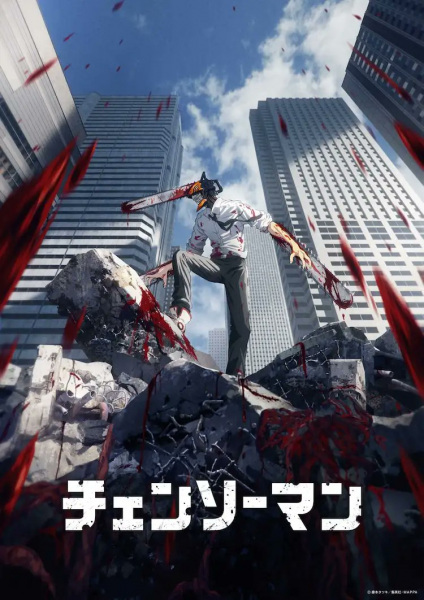
Animation pulls 8.5, and it earns the number through directorial discipline rather than sakuga flexing. Nakayama's choice — backed by chief episode director Makoto Nakazono and action director Tatsuya Yoshihara — is to grade the show in muted, film-grain palettes and let weight, not speed, sell the violence. The Katana Man two-parter in episodes 10 and 11 is the clearest case: the fight choreography is kinetic, but the framing keeps Denji grounded, dirty, exhausted. Power's transformations carry physical heft because the camera treats her as flesh first and devil second. Kensuke Ushio's score sits underneath the grime instead of selling it.
The rotating ED sequences — a different artist and director each week — are the kind of production decision that signals confidence. MAPPA produced this solo, without a committee, and the absence of corporate hedging shows on screen. Whether you prefer this register to the manga's louder, scrappier energy is a real argument, and the Codex doesn't dismiss the readers who found the adaptation over-polished. It's a fair criticism. But "different from the source" is not the same as "worse," and the production craft on display is the strongest single reason to spend the four hours.
What Carries It: A Cast That Doesn't Want to Save the World
Character pulls 8.0, and the score would be higher if the season had room to finish what it starts. Denji is the rare shonen lead whose stated desires — food, sleep, touching a chest — are taken seriously by the writing rather than treated as comic relief before the "real" motivation arrives. The show is honest about the fact that Makima exploits exactly those desires, and Hiroshi Seko's scripts trust the audience to read manipulation without flagging it.
Power's arc from blood-obsessed parasite to grudging loyalty — locked in by the cat rescue — gives the trio its internal tension. Aki's grief discipline, especially the coffee-cup beat after Himeno's death in the Eternity Devil hotel arc, is the season's single most economical character moment. Twelve episodes is not enough to land any of these arcs; Makima remains opaque by design, and most of the relational work is still in setup. But the writing knows where it's going, and the performances are calibrated for the long game.
This is the inverse of the Gungrave problem, where character work has to carry a back half the production can't support. Chainsaw Man has the production. It just doesn't have a back half yet.
Worldbuilding That Refuses the Stat Sheet
The 8.0 on worldbuilding is where the show separates from genre defaults. Devils named for human fears, growing stronger the more they are feared, with contracts that demand bodily sacrifice — this is a cosmology with internal economic logic, not a power-ranking exercise. The Eternity Devil's looping hotel space and the Gun Devil's offscreen geopolitical body count both gesture at a world larger than the frame, without the rigid stat-system bookkeeping that kneecaps so much modern shonen. The system leaves things unexplained on purpose, and the show is comfortable with that.
The Steelman: The 8.43 Crowd Isn't Wrong, They're Early
The honest version of the opposing view: Chainsaw Man is a long-form work, and judging a single cour against shows that have finished telling their stories is structurally unfair. Score the production, the character introductions, the cultural footprint (8.5 on the Codex, and deservedly — Power and Makima became reference points the moment they aired), and you do arrive somewhere in the mid-8s.
The rubric's answer is that the score is for what aired in 2022, not what the franchise might become after the Reze Arc film and the announced Assassins adaptation. Story (7.5) and themes (7.5) are graded on delivered payload, not promised. The crowd is scoring potential. The Codex is scoring the object on the table. Both are defensible exercises. Only one of them is a review.
The Call
Chainsaw Man at 7.90 is a directorial showcase, a worldbuilding success, and a character prologue — and an incomplete narrative that knows it. Watch it for Nakayama, Ushio, and the trio. Don't watch it expecting the season to land. The payoff is in a different building, and MAPPA hasn't unlocked the door yet.
Featured in the Codex





More from The Codex
The Seven Deadly Sins Is a 6.60 Wearing a 7.60 Costume: A One-Point Gap Earned by Groping Gags and Convenient Flashbacks
The Seven Deadly Sins scores 6.60 on the Codex against MyAnimeList's 7.60 because the crowd is grading a Netflix breakout and a Ban-and-King friendship, not the 24 episodes A-1 Pictures actually broadcast in 2014.
The 10.0 That Built a Sunday: How Sazae-san's Cultural Score Carries a 6.58 Scorecard
Sazae-san is a case study in how a single criterion — cultural — can define how a show is remembered, and the 10.0 the Codex hands Eiken's 1969 institution is doing every bit of the heavy lifting its other five scores refuse to.
The Sebastian Problem: Why Black Butler Sits 1.10 Below Its MAL Line and the Crowd Refuses to Notice
Black Butler (Kuroshitsuji) posts a 1.10-point gap between MyAnimeList's 7.65 and the Codex 6.55 because the crowd is grading Sebastian's silhouette and a Phantomhive aesthetic, not the anime-original finale A-1 Pictures actually shipped in 2009.
Discussion
Set a display name above to post.
Loading discussion…