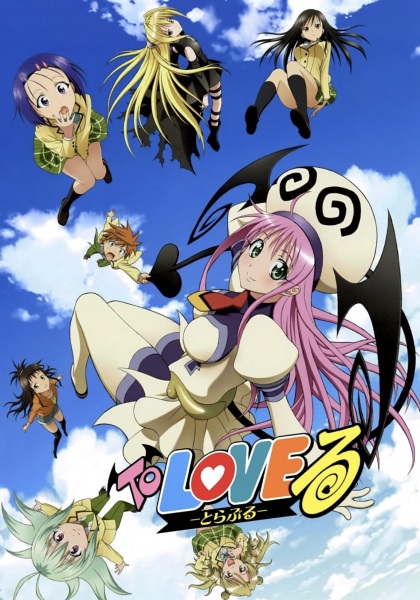
To Love-Ru
Is To Love-Ru worth watching?
Mixed — depends what you want. Anime Codex rates To Love-Ru 5.13 out of 10 — scored on six criteria (story, characters, themes, world-building, animation, and cultural impact), not crowd votes. 225th of 226 on the Codex rubric — bottom 1% of the catalogue. The crowd rates it 1.84 higher than the rubric does — the Codex is harder on it than on 98% of the catalogue.
Where to watch
Trailer
What the data says
Computed from the Codex rubric across the whole catalogue.
Summary
To LOVE-Ru (2008) is a foundational entry in the late-2000s ecchi-harem comedy wave, and within that specific niche it executes the formula with charm and polish. Lala Satalin Deviluke is a genuinely likable lead whose alien-princess optimism and invention gags lift the show above purely cynical fanservice, and Xebec's clean designs and sharp comedic timing serve the slapstick well. Judged as a Shonen Jump romantic comedy, however, its weaknesses are real: the narrative is almost entirely episodic, the central confession plot never advances, and the cast—Rito most of all—shows essentially no growth across 26 episodes. Thematic ambitions about love versus arranged duty are raised only to be discarded for the next lewd accident. Its world-building offers fun sci-fi gadgetry but treats the galactic empire as a gag generator rather than a coherent setting. What makes it notable is less artistic achievement than genre influence: it helped codify harem-comedy conventions and launched a durable, beloved franchise. As a comfort-watch comedy it succeeds; as a piece of storytelling measured against the best romantic comedies in shonen, it is pleasant, competent, and ultimately slight—a 6 that knows exactly what it is and aims no higher.
Criterion breakdown
Story & narrative
The premise of an alien princess crash-landing into Rito's life is a serviceable harem-comedy engine, but the 2008 Xebec adaptation is almost entirely episodic with no narrative momentum. The runaway-fiancee setup and Lala's father's assassination attempts (via Zastin and the alien suitors) provide loose recurring stakes, yet the central will-he-confess-to-Haruna question never advances meaningfully across 26 episodes. The finale resolves nothing, treating plot purely as a delivery mechanism for gag-of-the-week scenarios.
Character writing & growth
Lala is genuinely endearing—her cheerful obliviousness and reliance on Peke and her invention gags give her more personality than the typical harem lead, and Rito's spinelessness is at least consistent. However, the supporting cast (Haruna, Yui, Run, Mikan) function as archetypes defined by a single trait, and almost no one grows; Rito ends the series exactly as indecisive as he began. The introduction of characters like Yami late in the run hints at depth the adaptation never develops.
Themes & emotional resonance
The show makes little attempt at emotional resonance beyond fleeting moments, such as Rito's occasional sincerity toward Haruna or Lala's loneliness as a sheltered princess. Its actual interest is fanservice and slapstick, and any thematic weight about choosing love freely versus political duty is raised and then immediately abandoned for the next gag. Compared to romance-comedy peers that earn genuine feeling, this is thematically thin by design.
World-building & power system
The Devilukean galactic-empire backdrop and Lala's endless parade of nonsensical inventions (the dress-up D-Dial, the Go-Go Vacuum) give the setting a fun sci-fi gadget flavor that distinguishes it from purely earthbound harems. Internal consistency is loose—the alien tech exists mainly to engineer compromising situations rather than to build a coherent world. Zastin and the alien-suitor subplots add some texture, but the premise's originality is undercut by how rarely it's explored seriously.
Animation & direction
Xebec delivers clean, bright character designs faithful to Yabuki's art, with expressive comedic timing and the polished girl designs the franchise is known for. Action and invention sequences are competent but unremarkable, and the direction prioritizes static fanservice framing over dynamic staging. It looks good for a 2008 TV comedy but rarely demonstrates directorial ambition beyond well-composed pin-up shots.
Cultural impact
To LOVE-Ru became a defining pillar of the late-2000s ecchi-harem boom and spawned a long-running franchise (Motto, Darkness) plus an extremely successful manga, cementing Yabuki and Hasemi as fanservice-genre mainstays. Its influence on harem comedy conventions and its enduring fandom presence are significant within its niche. It remains more a genre touchstone than a broadly culturally important work.
Synopsis (from MAL)
Timid 16-year-old Rito Yuuki has yet to profess his love to Haruna Sairenji—a classmate and object of his infatuation since junior high. Sadly, his situation becomes even more challenging when one night, a mysterious, stark-naked girl crash-lands right on top of a bathing Rito. To add to the confusion, Rito discovers that the girl, Lala Satalin Deviluke, is the crown princess of an alien empire and has run away from her home. Despite her position as the heiress to the most dominant power in the entire galaxy, Lala is surprisingly more than willing to marry the decidedly average Rito in order to avoid an unwanted political marriage. To LOVE-Ru depicts Rito's daily struggles with the bizarre chaos that begins upon the arrival of Lala. With an evergrowing legion of swooning beauties that continuously foil his attempted confessions to Haruna, To LOVE-Ru is a romantic comedy full of slapstick humor, sexy girls, and outlandishly lewd moments that defy the laws of physics. [Written by MAL Rewrite]
Ranked nearby




Explore rankings
Discussion
Set a display name above to post.
Loading discussion…